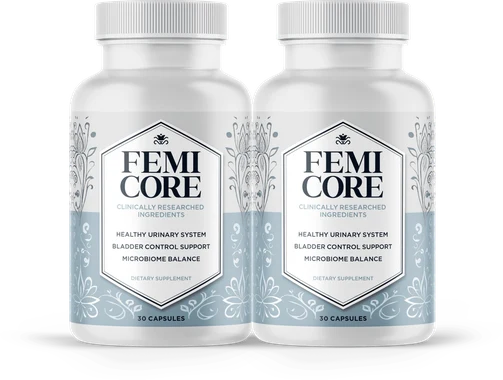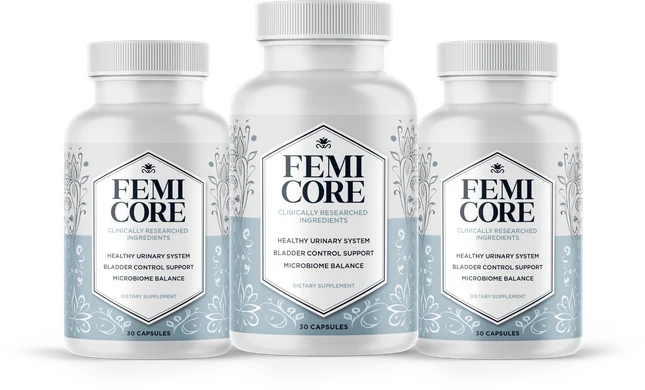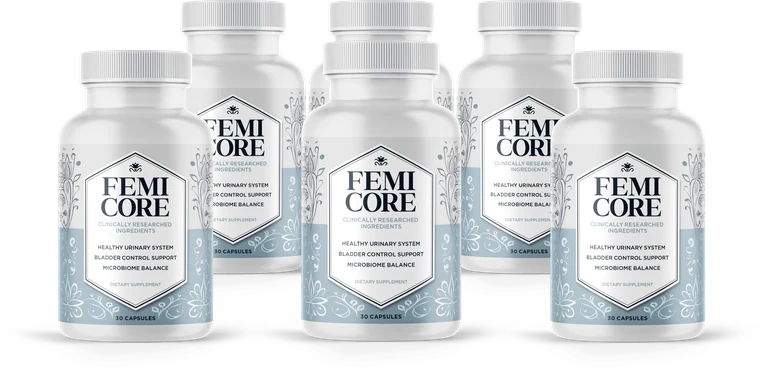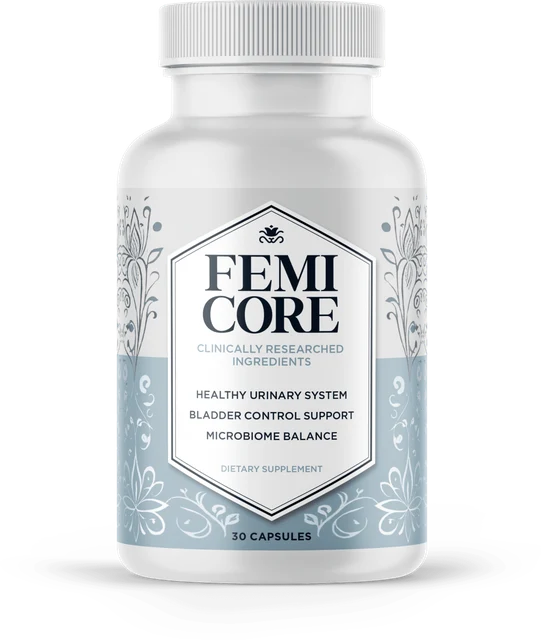
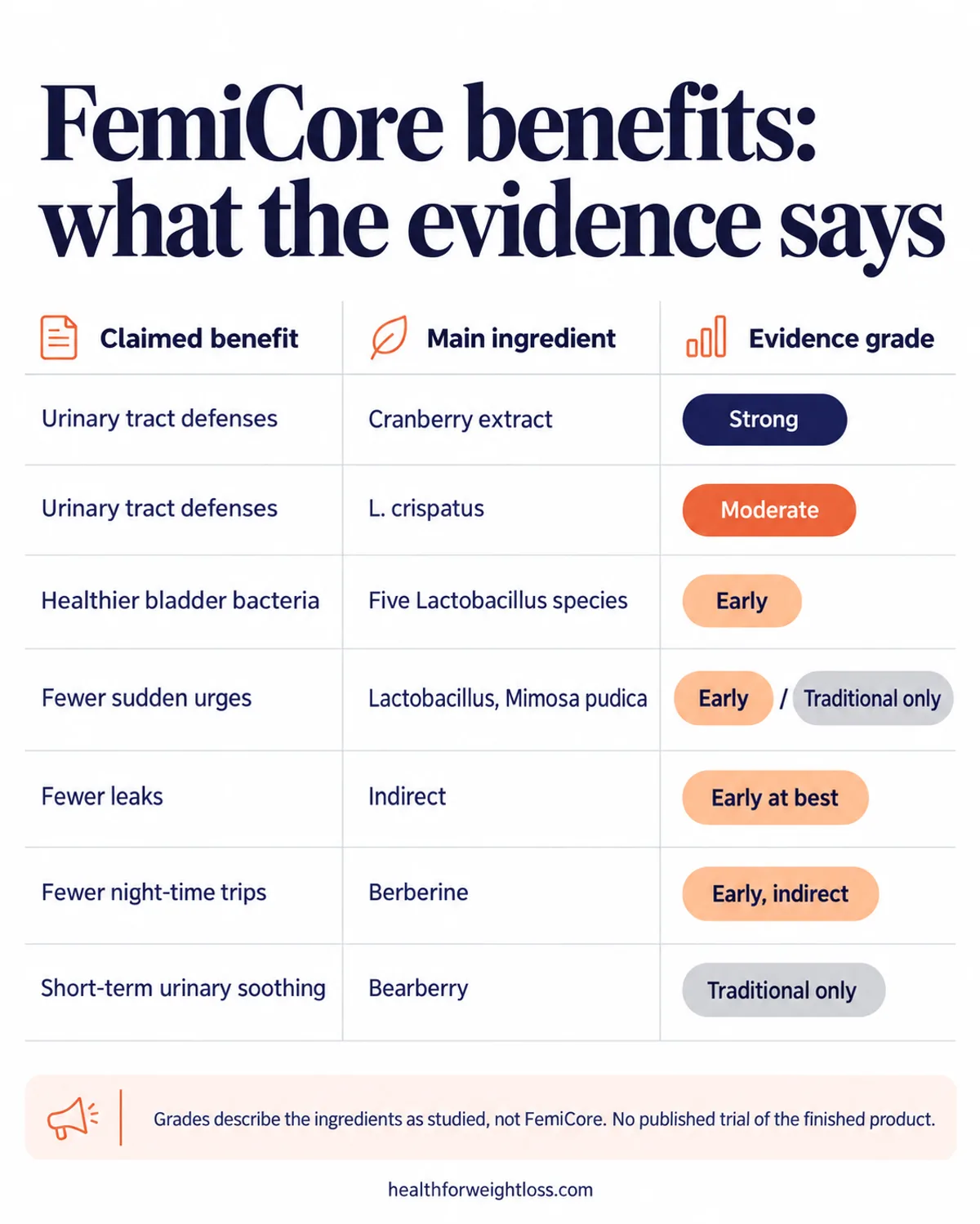
The FemiCore label makes three promises: a healthy urinary system, bladder control support and microbiome balance. This page takes each one, names the ingredient that is supposed to deliver it and grades the human evidence behind that ingredient. The grades describe the ingredients as studied, never FemiCore itself, because no trial of the finished formula exists.
How the grades work
| Grade | Meaning on this page |
|---|---|
| Strong | A systematic review of human trials supports the ingredient for this outcome |
| Moderate | At least one controlled human trial, often with a different route or product |
| Early | Human studies show an association; nothing yet proves cause and effect |
| Traditional only | Long herbal use, lab or animal work, or thin and mixed human data |
A grade is about the ingredient on its own, at the dose used in research. FemiCore does not disclose any dose, so even a strong grade cannot tell you whether one capsule contains enough.
The three label claims, mapped to evidence
| Label claim | Linked ingredient | Evidence strength | What the studies measured |
|---|---|---|---|
| Healthy urinary system | Cranberry extract | Strong, for repeat infections only | Repeat UTIs in women prone to them (Cochrane 2023); results depend on PAC dose |
| Healthy urinary system | Bearberry (uva ursi) | Traditional only | Arbutin turning into antibacterial hydroquinone in urine, in lab work; human data limited and mixed |
| Healthy urinary system | L. crispatus | Moderate, different route | Repeat UTIs in a small placebo-controlled trial of a vaginal, not oral, product |
| Bladder control support | Mimosa pudica | Traditional only (lab and animal) | Anti-inflammatory, antimicrobial and antispasmodic effects outside the human body |
| Bladder control support | Five Lactobacillus species | Early | Fewer Lactobacillus found in some women with urgency incontinence; no symptom trial |
| Microbiome balance | L. casei, L. gasseri, L. plantarum, L. acidophilus and L. crispatus | Early | DNA sequencing showing the female bladder holds bacteria; oral effect on them unproven |
| Not on the label | Granular berberine | Strong elsewhere, lacking for the bladder | Blood sugar and cholesterol at about 1,000 to 1,500 mg a day |
For the long read on each claim, with more background on the studies, see our article on what the benefits of FemiCore are.
Weighing the claims against the price?
Buy 2, 3 or 6 bottles as a single order. You have 60 days from delivery to ask for a refund.
See What FemiCore CostsOpens the official FemiCore store (BuyGoods checkout).
Claim 1: a healthy urinary system
This is the best-supported of the three, and the support comes almost entirely from cranberry. A-type PACs in cranberry make it harder for E. coli to grip the urinary tract wall. The 2023 Cochrane review found cranberry products can lower the number of repeat infections in women who get them often, although earlier reviews were mixed and the benefit tracks the PAC dose.
Bearberry adds a lab-based antibacterial idea. European herbal regulators accept it for mild lower urinary complaints as short courses of about a week, which sits awkwardly with a daily capsule. The L. crispatus trial was promising but used a vaginal product, so it says little about a swallowed one.
Claim 2: bladder control support
This is the claim most buyers care about, and it has the thinnest support. No ingredient in FemiCore has a human trial for leaks or urgency. Mimosa pudica is the ingredient most often tied to calming the bladder, yet its evidence stops at lab and animal work. The probiotic angle rests on observational findings, covered next.
The label does not tie any single ingredient to this claim, so the mapping in the table is our reading of the formula. If steadier bladder control is your main goal, our FemiCore comparison page sets the capsule beside routes that were tested directly on leaks, such as pelvic floor muscle training, and beside a visit to a specialist.
Claim 3: microbiome balance
Since about 2012, sequencing studies from Loyola University Chicago and other groups have shown the female bladder is not sterile. Some found fewer Lactobacillus in women with urgency incontinence. The idea that adding Lactobacillus could help is plausible. It is also unproven: no study shows that an oral probiotic changes bladder bacteria or bladder symptoms. Probiotic effects are tied to specific strains, and FemiCore names species only, with no strain codes and no CFU count.
A realistic timeline
The seller advises at least three months of daily use before judging the result. One bottle lasts a month.
| Point in time | What to expect | Why it matters |
|---|---|---|
| Weeks 1 to 2 | Possible gas, bloating or stomach upset | A common reaction when starting probiotics |
| End of month 1 | First bottle finished; too soon for a verdict by the seller’s own advice | The seller’s minimum is three months |
| Before day 60 after delivery | Last chance to request a refund | The 60 days count from the delivery date |
| End of month 3 | The seller’s suggested point to judge | Falls after the refund window has closed |
Note the gap in that last row. If you follow the seller’s three-month advice, the refund window closes about a month before you reach it. Write down how often you go, how often you leak and how urgent it feels before the first capsule, then compare around day 50.
Plan your trial around the refund date
Sold only on the official store. A refund needs every bottle back, full or empty, and the request must come within 60 days of delivery.
Review the Refund Rules and PackagesOpens the official FemiCore store (BuyGoods checkout).
What no study shows
- A trial of the finished FemiCore capsule, for any outcome.
- An oral probiotic changing bladder bacteria or bladder symptoms.
- Any human trial of Mimosa pudica for urgency, frequency or leaks.
- Cranberry reducing leaks or urgency, as opposed to repeat infections.
- Berberine helping the bladder at any dose.
- Whether a capsule matches study doses, since no individual dose, CFU count, PAC content or arbutin content is disclosed.
- Daily bearberry being suitable for months at a time.
Every unticked box is a question the seller could answer with published data. Until then, treat the three label claims as aims, not results. Our FemiCore buyer guide puts these benefits next to safety, price and who the product suits.
Decided the evidence is enough for a trial?
From $49 to $79 a bottle on the official store, with no autoship on one-time packages.
Start a FemiCore Trial OrderOpens the official FemiCore store (BuyGoods checkout).