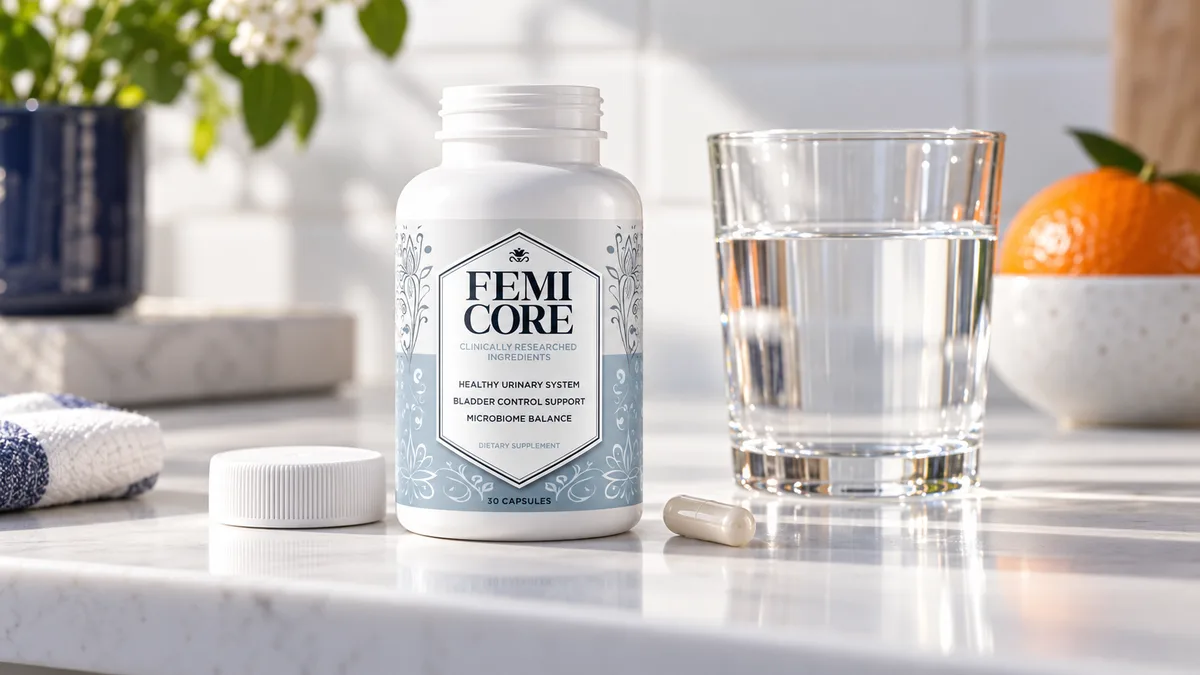
Is FemiCore a health supplement? Yes. In US terms it is a dietary supplement, not a drug, and that classification shapes everything from what the label is allowed to say to what anyone has checked before it reached your door. This guide explains the difference in plain language, how to read the FemiCore label, and what supplement status should mean for your expectations.
If you are new to the product, start with what FemiCore is and the evidence behind its ingredients. This page is about the rules around it.
See the product and its terms on the official store
One-time packages from $49 a bottle, 60-day money-back guarantee, no subscription.
View FemiCore Official StoreOpens the official FemiCore website.
Is FemiCore a health supplement or a drug?
Under US law, a product is a drug if it is intended to diagnose, treat, cure, mitigate or prevent disease. A dietary supplement is a product taken by mouth that contains “dietary ingredients” such as vitamins, minerals, herbs, botanicals or probiotics, and that is sold to supplement the diet.
FemiCore fits the second description. It is a capsule containing four botanicals (mimosa pudica, bearberry, cranberry extract and berberine) and five Lactobacillus probiotic species, sold to support bladder control and a healthy urinary tract. It does not claim to treat overactive bladder or urinary incontinence as diseases, and legally it could not without becoming a drug.
| Prescription bladder drug | Dietary supplement such as FemiCore | |
|---|---|---|
| Who approves it before sale | FDA, after clinical trials | No one; the maker is responsible |
| Claims allowed | Can say it treats a named condition | Can describe support for normal function only |
| Evidence required before sale | Controlled trials showing benefit and safety | None filed with the FDA |
| Dose on the label | Exact amount of active ingredient | Can use a proprietary blend total |
| Who can sell it | Pharmacies, with a prescription | Anyone, including online stores |
| Main oversight | Before and after sale | Mostly after sale |
Neither column is “good” or “bad” on its own. Drugs carry stronger proof and often stronger side effects. Supplements are easier to buy and usually gentler, but the burden of judging them falls more on you.
What the FDA does and does not do for supplements
The 1994 Dietary Supplement Health and Education Act set the current rules. Its effect, in practice:
What the FDA does not do
- It does not test or approve supplements for safety or effectiveness before they go on sale.
- It does not confirm that a supplement contains the amounts its label suggests.
- It does not endorse any brand, including those made in registered facilities.
What the FDA does do
- It requires factories to register and to follow current Good Manufacturing Practice (GMP) rules for identity, purity and labelling.
- It can inspect facilities, issue warning letters, and force recalls of unsafe or contaminated products.
- It polices illegal disease claims, often together with the Federal Trade Commission for advertising.
- It runs a reporting system where consumers and clinicians can report side effects.
So when you read that FemiCore is “made in an FDA-registered, GMP-certified facility”, read it accurately. It means the factory is on the FDA’s list and says it follows manufacturing standards. It does not mean the FDA has looked at FemiCore, and no supplement can honestly claim FDA approval.
How to read the FemiCore label like a supplement label
Every supplement label in the US follows the same structure. Here is what to look for on FemiCore’s, and what each part tells you.
- “Dietary Supplement” on the front. This statement of identity confirms the legal category.
- Serving size and servings per container. For FemiCore: one capsule, 30 per bottle, so one bottle lasts 30 days.
- The Supplement Facts panel. This lists the ingredients. FemiCore groups all nine in a proprietary blend, so you see the names in descending order of weight, not the amount of each one.
- Other ingredients. The capsule shell and any fillers appear here, outside the facts panel.
- Directions. One capsule a day, ideally in the morning with water.
- The standard disclaimer. Any product that makes a structure or function claim must carry this sentence: “These statements have not been evaluated by the Food and Drug Administration. This product is not intended to diagnose, treat, cure, or prevent any disease.”
- Name and address of the maker or distributor, so problems can be reported.
Structure and function claims, decoded
A structure or function claim describes how an ingredient supports normal body function. “Supports bladder control” or “supports a healthy urinary microbiome” are examples. They are legal without FDA review, as long as the maker has its own substantiation and adds the disclaimer above.
A disease claim names a condition the product will fix: “cures overactive bladder”, “stops incontinence in 7 days”, “treats urinary tract infections”. These are not allowed for supplements. If you see them in an ad for FemiCore or any similar product, treat the ad, not necessarily the product, as untrustworthy. The FDA’s health fraud pages list these phrases as warning signs.
Read the official product page yourself
Check the claims, ingredients, packages and guarantee terms at the source before deciding.
Check FemiCore Official PriceOpens the official FemiCore website. Affiliate link: we may earn a commission at no extra cost to you.
What “proprietary blend” means for you
The proprietary blend format is legal and common. It protects a formula from being copied, and it also makes a product hard to evaluate. For FemiCore it hides three numbers that matter:
- The dose of each botanical. Berberine was studied at 900 to 1,500 mg a day for blood sugar. Cranberry products in the 2023 Cochrane review used defined doses. Without amounts you cannot compare.
- The probiotic count. Probiotics are measured in colony-forming units (CFU). No CFU figure is given.
- The strain codes. Probiotic research is strain specific, and the label names species only.
This does not make FemiCore unsafe or ineffective. It makes it unverifiable from the label alone, which is the honest reason a money-back guarantee matters more for a supplement like this than for a drug with published trial data.
Let the guarantee carry the uncertainty
Every official package includes 60 days to decide. Return all bottles with the packing slip for a refund.
See FemiCore Packages and GuaranteeOpens the official FemiCore website. Affiliate link: we may earn a commission at no extra cost to you.
What supplement status means for realistic expectations
Knowing that FemiCore is a supplement, not a drug, should set your expectations in four ways.
Effects, if any, are likely to be modest and gradual
Supplements are not tested to show a defined effect size before sale. The ingredients in FemiCore have a plausible rationale: research since 2014 links fewer protective Lactobacillus bacteria in the bladder to urgency symptoms, and cranberry has good evidence for preventing repeat infections. But a probiotic shift, if it happens, takes weeks. Judge it over 8 to 12 weeks, not days.
The evidence is about ingredients, not the product
No clinical trial has tested the finished FemiCore capsule. Everything known comes from studies of individual ingredients, often at different doses or by different routes. That is normal for supplements and worth remembering when an ad sounds more certain than the science.
Proven options come first
For leaks on coughing, laughing or exercise, supervised pelvic floor muscle training is the first-line treatment in every major guideline, with a 2018 Cochrane review showing much higher cure and improvement rates than no treatment. For women carrying excess weight, losing even a modest amount reduces leak episodes, and our calorie target guide is a practical place to start. A supplement can sit alongside these. It should not replace them.
Safety still matters
“Natural” and “supplement” do not mean “no interactions”. Berberine can lower blood sugar and affects liver enzymes that clear many medicines. Bearberry is traditionally used in short courses only and is avoided in pregnancy and kidney disease. Our side effects guide covers each ingredient in detail.
How to judge any bladder supplement, including FemiCore
A short checklist that works for any product in this category:
| Question | What a good answer looks like | FemiCore |
|---|---|---|
| Is it labelled “Dietary Supplement” with the FDA disclaimer? | Yes, on the bottle | Yes |
| Are claims about support, not cure? | No disease claims | The brand’s claims are support-type; watch for third-party ads that go further |
| Are ingredient amounts disclosed? | Each dose listed | No, proprietary blend |
| Is there a real refund policy? | Written terms, reasonable window | 60 days, return all bottles with the packing slip |
| Is it sold through a traceable checkout? | Named payment processor | BuyGoods |
| Are you avoiding trial or subscription offers? | One-time purchase | One-time packages only |
FemiCore passes most of these. Its main weakness, the undisclosed amounts, is shared with many supplements in the category. For a full scored assessment, see our FemiCore reviews article, and for a quick look at the formula and packages, the FemiCore product page.
Before you start
This article is general information, not medical advice. Talk to a clinician or pharmacist before starting FemiCore if you are pregnant, trying to conceive or breastfeeding, have kidney or liver disease, take medication for diabetes, blood pressure or cholesterol, take warfarin, or have a weakened immune system. Seek medical care rather than a supplement for blood in the urine, pain or burning on urination, fever, flank pain, or leaks that start suddenly.
Bottom line: is FemiCore a health supplement?
Yes. FemiCore is a dietary supplement: it can support normal bladder function in principle, it cannot legally claim to treat a disease, and no regulator has checked that it works before sale. That is not a mark against it. It is simply what the category means. Read the label for what it does and does not tell you, keep your expectations to modest, gradual change, put proven steps first, and use the 60-day guarantee as your safety net if you decide to try it.
Decided it is worth a fair trial?
2 bottles $79 each, 3 bottles $69 each, 6 bottles $49 each. 60 days to decide, with every package.
Visit Official Website (60-Day Guarantee)Opens the official FemiCore website. Affiliate link: we may earn a commission at no extra cost to you.