There is no single number of calories that makes everyone lose weight. There is a number for you, and you can get a reasonable estimate of it in five minutes with a pen. This article walks through that estimate, explains how large a deficit to take from it, and shows how to correct the figure once real-world data starts coming in.
The short version
- Estimate your resting metabolic rate with the Mifflin-St Jeor equation.
- Multiply by an activity factor to get your maintenance calories.
- Subtract 15 to 25 percent to set a deficit, keeping the result above a sensible floor.
- Eat at that target for two to three weeks, then adjust based on your average weekly weight change.
The rest of the article explains each step and why the common shortcuts go wrong.
Step 1: Estimate your resting metabolic rate
Resting metabolic rate (RMR) is the energy your body uses to stay alive while lying still and awake. It accounts for 60 to 70 percent of total calorie burn for most people, which is why it is the foundation of the calculation.
The most accurate simple equation for the general population is Mifflin-St Jeor. A 2005 systematic review by the American Dietetic Association compared the common formulas against measured RMR and found Mifflin-St Jeor predicted within 10 percent of the true figure more often than the alternatives, in people with and without obesity.
The equation uses weight in kilograms, height in centimeters, and age in years:
| Formula | |
|---|---|
| Men | 10 × weight + 6.25 × height − 5 × age + 5 |
| Women | 10 × weight + 6.25 × height − 5 × age − 161 |
To convert pounds to kilograms, divide by 2.2. To convert inches to centimeters, multiply by 2.54.
Worked example A 42-year-old woman, 168 cm (5 ft 6 in), 82 kg (181 lb): 10 × 82 = 820; 6.25 × 168 = 1,050; 5 × 42 = 210. 820 + 1,050 − 210 − 161 = 1,499 kcal per day at rest.
Treat this as an estimate with a margin of about plus or minus 10 percent. Two people with identical stats can differ by 200 calories a day because of differences in muscle mass, organ size, and genetics. The adjustment step later on exists to catch that.
Step 2: Multiply by an activity factor
Maintenance calories, often called total daily energy expenditure (TDEE), add the energy you spend moving around, training, and digesting food. The standard way to estimate it is to multiply RMR by an activity factor.
| Lifestyle | Factor | Description |
|---|---|---|
| Sedentary | 1.2 | Desk job, little deliberate exercise, under about 5,000 steps a day |
| Lightly active | 1.375 | Light exercise 1 to 3 days a week, or an active job with no training |
| Moderately active | 1.55 | Moderate exercise 3 to 5 days a week |
| Very active | 1.725 | Hard exercise 6 to 7 days a week |
| Extremely active | 1.9 | Physical job plus daily hard training, or twice-a-day training |
Almost everyone overestimates their activity level. Three gym sessions a week on top of an otherwise sedentary day is “lightly active”, not “moderately active”. If you are unsure, pick the lower of the two options you are considering. Underestimating produces a slightly bigger deficit than intended, which is a smaller problem than the reverse.
Worked example, continued Our 42-year-old works at a desk and walks the dog most evenings, so she chooses lightly active. 1,499 × 1.375 = 2,061 kcal per day to maintain her current weight.
Step 3: Set the deficit
Energy balance is the physics of weight loss: eat less than you expend and stored energy, mostly body fat, makes up the difference. The question is how much less.
Why “500 calories a day equals a pound a week” is only roughly true
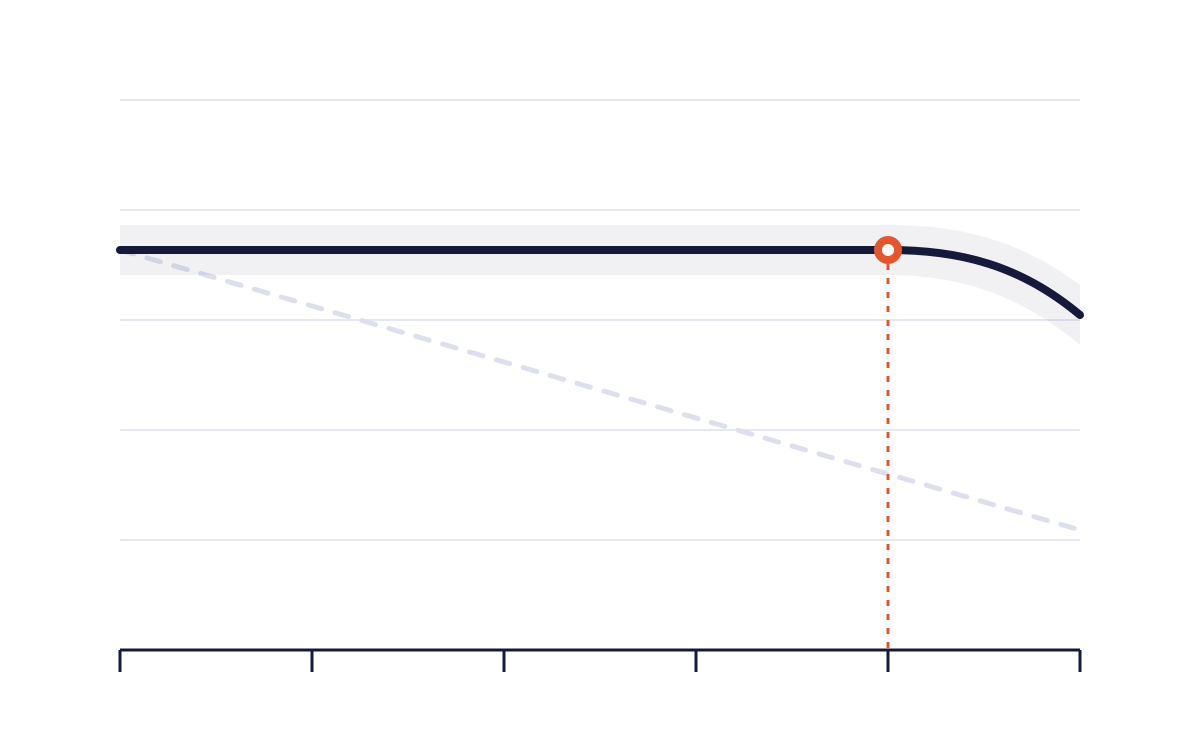
The old rule says a pound of fat holds 3,500 calories, so a 500-calorie daily deficit loses one pound a week indefinitely. The arithmetic is tidy but the biology is not. As you lose weight you need fewer calories to maintain the smaller body, so a fixed intake produces a shrinking deficit. On top of that, the body reduces energy expenditure slightly more than body size alone would predict, an effect called adaptive thermogenesis. Kevin Hall’s group at the National Institutes of Health modelled this in a 2011 Lancet paper and found that the 3,500 rule overstates long-term loss by roughly a factor of two. Over a year, the same 500-calorie cut produces closer to 25 pounds than 52.
That does not mean deficits do not work. It means your target needs to be revisited as you lose weight, and that the first few weeks are not a reliable predictor of the first few months.
Picking a percentage, not a fixed number
A deficit sized as a percentage of maintenance scales to the person. A 500-calorie cut is 20 percent for someone maintaining on 2,500 and a punishing 33 percent for someone maintaining on 1,500.
| Deficit | Expected rate | Who it suits |
|---|---|---|
| 10 to 15 percent | About 0.25 to 0.5 percent of body weight per week | People close to their goal, lifters trying to keep muscle, anyone who has struggled with hunger on past diets |
| 20 to 25 percent | About 0.5 to 1 percent of body weight per week | Most people with a meaningful amount to lose |
| 30 percent or more | Over 1 percent per week | Short periods under supervision; higher risk of muscle loss, fatigue, and rebound |
The 2013 American Heart Association, American College of Cardiology, and Obesity Society guideline recommends a deficit of 500 to 750 calories a day for adults with obesity, which for most people lands in the 20 to 25 percent band.
Worked example, continued Taking 20 percent from 2,061 gives a cut of about 410 calories. 2,061 − 410 = roughly 1,650 kcal per day. At 82 kg, that should produce about 0.4 to 0.6 kg (1 to 1.3 lb) per week once water weight has settled.
Floors
Below a certain intake it becomes difficult to meet protein, fiber, and micronutrient needs from normal food, and hunger and fatigue tend to undermine adherence. Commonly used floors are 1,200 calories for women and 1,500 for men. They are not laws of nature. A very small, older, sedentary woman may genuinely maintain on 1,500 and need to go a little below 1,200 to lose weight; a tall active man might struggle at 1,800. If your calculation lands at or below the floor, the better move is usually to add movement rather than cut food further.
Step 4: Adjust using real data
The calculation gets you within range. Your scale tells you whether you are actually in a deficit.
Weigh yourself on most mornings, after using the bathroom and before eating, and average the readings each week. Daily weight swings by one to two kilograms with water, salt, carbohydrate intake, and digestion, so single readings mean little. Compare weekly averages.
After the first week, which usually includes a drop in water and stored carbohydrate that is not fat, use this rule:
- Losing within your expected range: change nothing.
- Losing faster than about 1 percent of body weight a week for two weeks: add 100 to 150 calories, preferably from protein or fiber-rich carbohydrate.
- Losing slower than expected, or not at all, for two to three weeks: cut 100 to 150 calories, or add 2,000 to 3,000 steps a day, and reassess after another two weeks.
Each time you lose 5 percent of your body weight, rerun the calculation with the new weight. Maintenance drops as you shrink, and an intake that was a 20 percent deficit in week one may be close to maintenance three months later. This is the single most common reason people believe they have “plateaued” when they have simply arrived at a new balance point.
Where the estimate goes wrong, and what to do about it
Food logging errors. Studies that compare self-reported intake with measured intake consistently find under-reporting of 20 to 40 percent, more in people with higher body weight. Oils, dressings, nut butters, drinks, and tastes while cooking are the usual gaps. If your scale is not moving, the first suspect is intake you are not seeing, not a slow metabolism.
Wearable overestimates. Fitness trackers tend to inflate calories burned during exercise. If you already picked an activity factor that accounts for your training, do not add exercise calories back on top.
Reduced spontaneous movement. In a deficit people fidget less, sit more, and walk a little slower without noticing. This can quietly erase 100 to 300 calories of expected expenditure. A step target helps keep it visible.
Hormonal and medical factors. Hypothyroidism, polycystic ovary syndrome, some antidepressants, antipsychotics, beta blockers, insulin, and corticosteroids can all lower expenditure or raise appetite. These do not break energy balance, but they can shift your maintenance figure well below the estimate. If you have adjusted intake twice and still see no change over six weeks, it is worth a conversation with your clinician.
Making the number easier to live with
A target is only useful if you can hit it most days. A few things reliably help:
- Protein first. Aim for roughly 1.2 to 1.6 grams per kilogram of body weight. Protein is the most filling macronutrient per calorie and protects muscle during the deficit. Our protein guide shows how to reach that without supplements.
- Volume from vegetables and fruit. Fiber and water fill the stomach cheaply in calories.
- Fewer liquid calories. Drinks do not register with appetite the way food does.
- A flexible weekly budget. If a 1,650-calorie day is hard on Saturdays, eat 1,550 on three weekdays and 1,950 on Saturday. The weekly total is what the body responds to.
- Rebuild habits, not just the number. The calculation gets the weight off. The habits that got you to the target keep it off.
A note on who should not do this unsupervised
If you are pregnant or breastfeeding, under 18, have type 1 diabetes or take insulin or sulfonylureas, have a history of an eating disorder, or have kidney, liver, or heart disease, calorie restriction should be planned with a clinician or registered dietitian. The numbers in this article are a starting point for healthy adults, not a prescription.