
Based on what is known about its nine ingredients, the FemiCore side effects most people could expect are mild: some gas or bloating while the gut gets used to the probiotics. The real cautions sit with two ingredients, berberine and bearberry, and they matter for specific groups rather than for everyone. Below you will find each ingredient’s safety profile, a side-effect table, who should speak to a doctor first and which symptoms mean you should stop.
If you want to know what each ingredient is meant to do, our FemiCore ingredients list covers that. For the overall verdict on the product, read our FemiCore reviews. This page sticks to one question: what could go wrong, and for whom.
Read the full ingredient label first
The official site lists all nine ingredients. Every package is covered by a 60-day money-back guarantee.
See the FemiCore Label on the Official SiteOpens the official FemiCore website. Affiliate link: we may earn a commission at no extra cost to you.
Why FemiCore side effects are hard to pin down
Two facts shape everything on this page. First, FemiCore uses a proprietary blend, so the label names the nine ingredients but not how much of each is inside. Second, we are not aware of any published clinical trial of the finished FemiCore capsule. Nobody has counted side effects in a group of women taking this exact product.
That leaves one honest method: look at each ingredient’s safety record at the doses that have been studied, then assume FemiCore carries a smaller version of the same risks. One capsule a day has to hold nine ingredients, so it is unlikely to contain, for example, the 900 to 1,500 mg of berberine used in diabetes trials. Smaller amounts usually mean milder effects. We cannot confirm that without the numbers, though, so the cautions below still apply.
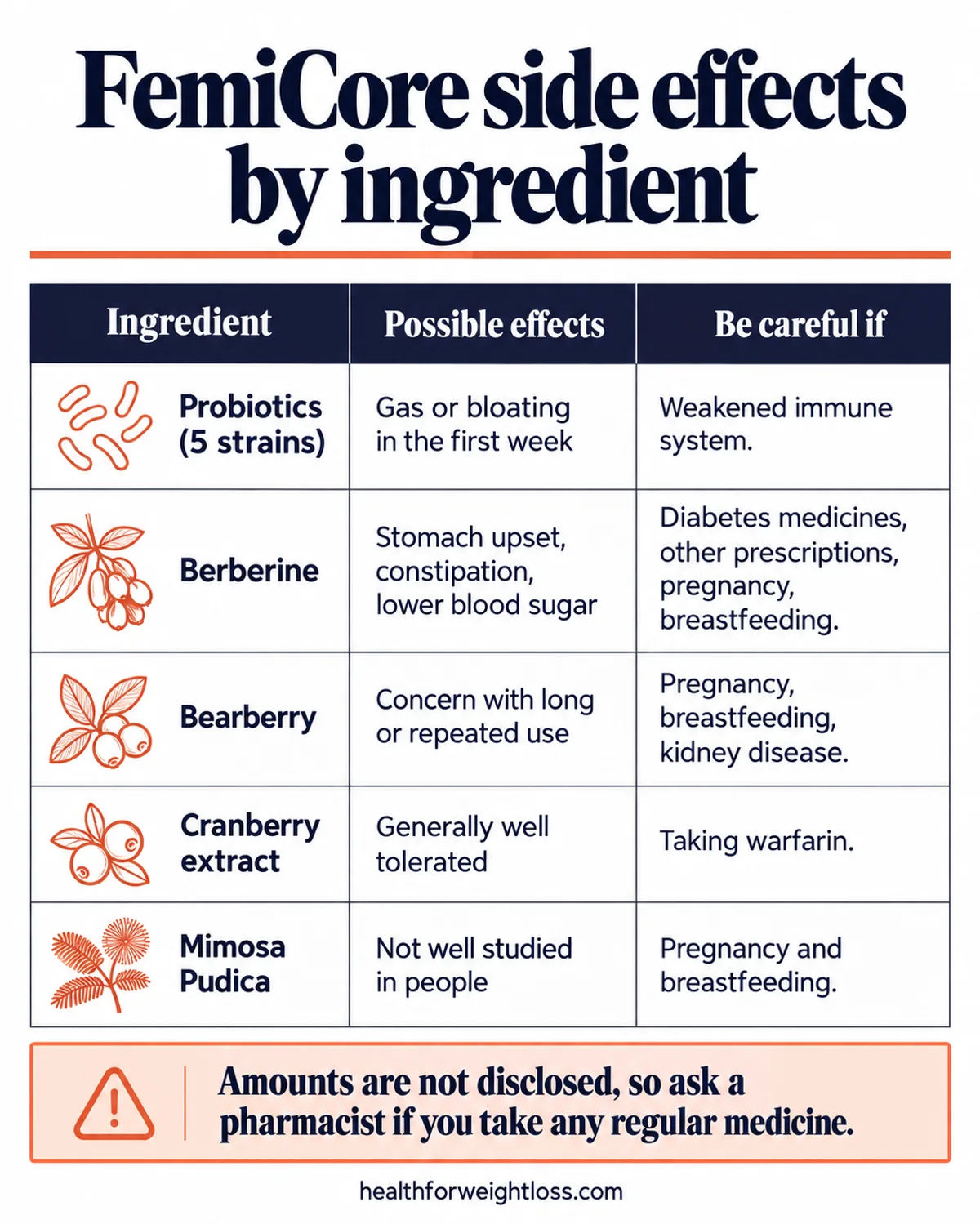
FemiCore side effects by ingredient
| Ingredient | Possible effects | Who should be careful | How much safety data |
|---|---|---|---|
| 5 Lactobacillus strains (crispatus, acidophilus, plantarum, gasseri, casei) | Gas, bloating, softer stools in the first week | People with a weakened immune system | Large; widely used and generally well tolerated |
| Berberine | Stomach upset, cramping, constipation; lower blood sugar | Diabetes medicines, drugs cleared by CYP3A4 or CYP2D6, pregnancy, breastfeeding | Good; many human trials at 900 to 1,500 mg a day |
| Bearberry (uva ursi) | Concern is mainly with long or repeated use | Pregnancy, breastfeeding, kidney disease, anyone planning months of use | Traditional use; few modern trials |
| Cranberry extract | Generally well tolerated | People taking warfarin | Large; many trials in women |
| Mimosa pudica | Unknown | Pregnancy and breastfeeding, as a precaution | Very limited human data |
The probiotic strains: an adjustment period
Five of the nine ingredients are Lactobacillus bacteria. These are among the best-tolerated supplements there are. The usual complaint is mild gas or bloating in the first several days, which tends to fade as the gut settles. In a trial of L. crispatus given as a vaginal suppository to women with recurrent UTIs, the probiotic was well tolerated. The one group that needs real caution is people whose immune system is suppressed, for example during chemotherapy or after an organ transplant. In those situations, live bacteria should only be taken with a doctor’s agreement.
Berberine: the ingredient most worth checking
Berberine is the active compound with the most pharmacology behind it, and that cuts both ways. A 2015 meta-analysis found it lowered blood glucose, blood fats and blood pressure at 900 to 1,500 mg a day. The same activity explains its side effects:
- Digestive upset. Stomach discomfort, cramping and constipation are the most common complaints in trials.
- Lower blood sugar. Helpful for some, but it can add to metformin, insulin or other diabetes medicines.
- Drug interactions. Berberine slows CYP3A4 and CYP2D6, two liver enzymes that clear many common drugs, including some statins, blood pressure medicines and antidepressants. Slower clearance can mean higher drug levels.
- Pregnancy and breastfeeding. It should be avoided because of a risk of jaundice in newborns.
Bearberry: built for short courses
Bearberry leaf contains arbutin, which the body converts into compounds that act in the urinary tract. Herbal references, summarized in a 2008 review, treat it as a short-term remedy. German monographs suggest courses of one to two weeks, up to about five courses a year. That sits awkwardly with a capsule designed to be taken every day for months. The bearberry amount in FemiCore is not disclosed, and it may well be small. Still, this is the clearest reason to talk to a clinician before long-term use. Bearberry should be avoided in pregnancy, while breastfeeding and by anyone with kidney disease.
Cranberry: low risk, one known caution
Cranberry has one of the larger evidence bases of any urinary ingredient. The 2023 Cochrane review found it reduced symptomatic UTIs in women with recurrent infections, and it is generally well tolerated. The one caution concerns warfarin. Case reports have described changes in blood clotting in people taking both. If you take warfarin, ask the clinic that monitors your INR before adding any cranberry product.
Mimosa pudica: the least-known ingredient
Mimosa pudica, the “sensitive plant”, has a long history in traditional medicine but very little human research. There is no strong signal of harm. There is also not enough data to call it proven safe, particularly in pregnancy or while breastfeeding, so avoiding it in those situations is the sensible default.
No serious red flags for you on this list?
One capsule a day, one-time packages, no subscription. Return bottles within 60 days if it does not agree with you.
Check FemiCore Official PriceOpens the official FemiCore website. Affiliate link: we may earn a commission at no extra cost to you.
What the first few weeks may feel like
Most people who react to a probiotic and berberine formula notice it early. A rough guide:
- Days 1 to 7. Mild gas, bloating or a change in bowel habit is the most likely effect. Taking the capsule with breakfast rather than on an empty stomach may be gentler on digestion.
- Weeks 2 to 4. Any probiotic bloating has usually faded. Constipation that persists may be the berberine and is worth noting in a diary.
- Beyond a month. New symptoms that appear late are less likely to be an adjustment effect. Stop and get them checked.
Keep a short daily note from day one: bathroom trips, night-time waking, urgency and any digestive change. It helps you tell a side effect from a coincidence, and it gives you something concrete to show a clinician.
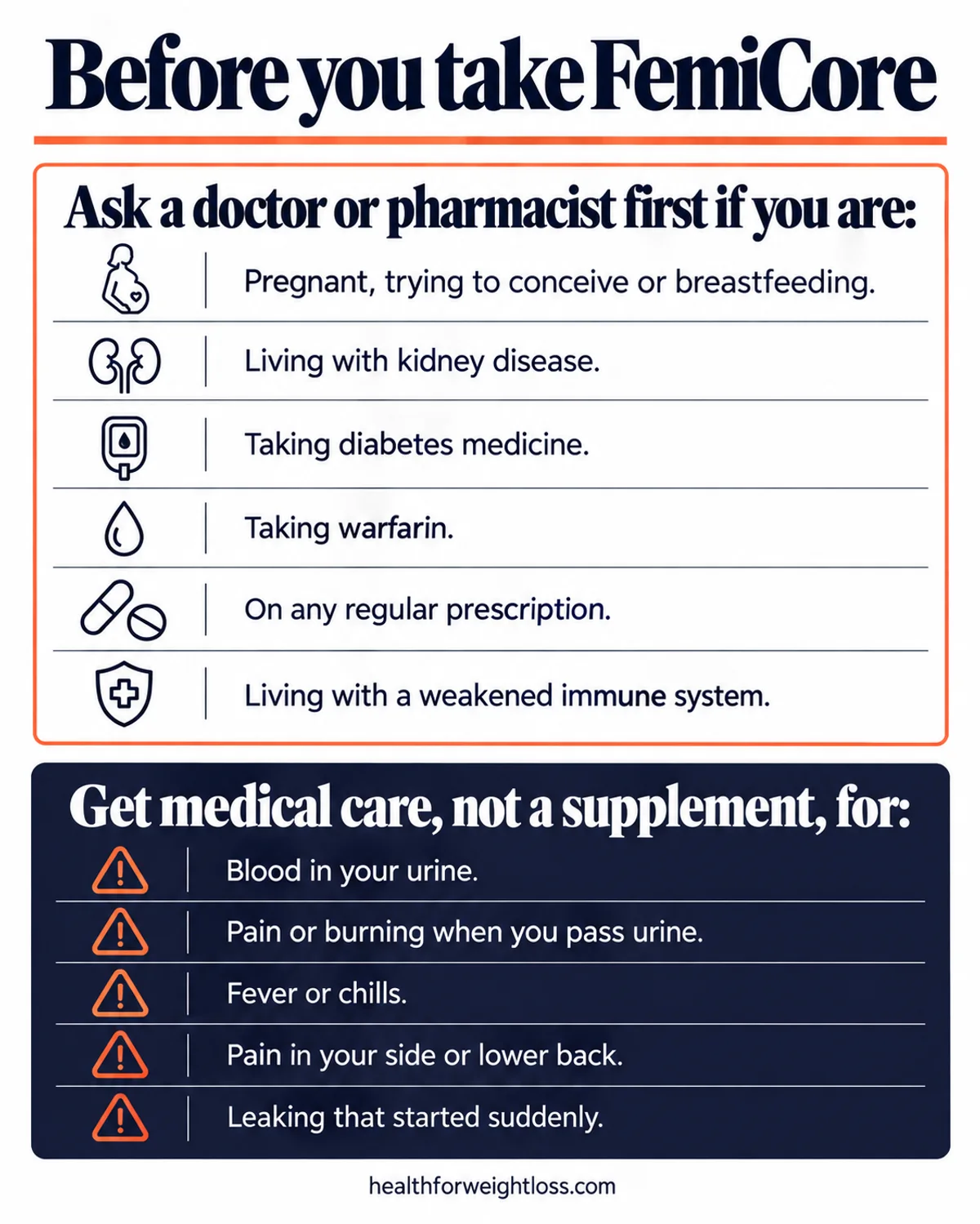
Who should talk to a doctor before taking FemiCore
Most healthy adults can make this decision alone. These groups should get a professional opinion first:
- Pregnant, trying to conceive or breastfeeding. Berberine and bearberry are both avoided in these situations.
- Kidney disease of any stage. Bearberry is traditionally avoided.
- Diabetes treated with medication. Berberine may push blood sugar lower than intended.
- Taking warfarin. Because of the cranberry case reports.
- On regular prescriptions of any kind. A pharmacist can check them against berberine’s effect on liver enzymes in a few minutes.
- A weakened immune system. Live bacteria need a doctor’s agreement.
Symptoms that are not side effects
Some symptoms are easy to blame on a new supplement when they point to something else. These need medical attention, whatever you are taking:
- Blood in your urine, even once
- Pain or burning when you pass urine
- Fever, chills or pain in your side or lower back (flank pain)
- Leaking that started suddenly, without an obvious reason
They can signal a urinary infection, a kidney problem or another condition that a supplement cannot treat. Do not wait to see whether FemiCore helps.
A note for readers on a weight-loss plan
Many of our readers are cutting calories at the same time as looking at bladder support. One overlap is worth knowing. Berberine’s blood sugar effect is part of why it gets attention for weight, but if you are eating noticeably less and also take a glucose-lowering medicine, the effects stack. Signs of low blood sugar include shakiness, sweating, sudden hunger and feeling muddled. If that describes your situation, involve your doctor before adding FemiCore, and keep your daily calorie target moderate rather than extreme.
FemiCore is not a weight-loss product, and we do not count any weight effect in its favor. The bigger lever for bladder control is steady, sustainable weight loss itself.
Cleared it with your pharmacist?
Buy from the official store so the 60-day refund applies. Free US shipping on 3 and 6 bottles.
Visit Official Website (60-Day Guarantee)Opens the official FemiCore website. Affiliate link: we may earn a commission at no extra cost to you.
Practical ways to lower your risk
- Take one capsule a day, as directed. Doubling up adds more berberine and bearberry without any known benefit.
- Avoid stacking. Do not take FemiCore alongside a separate berberine, uva ursi or high-dose cranberry product.
- Start one new thing at a time. If you begin FemiCore and a new medicine in the same week, you will not know which caused a problem.
- Bring the bottle to your pharmacist. The ingredient list is short enough to check in one conversation.
- Buy the genuine product. Marketplace and look-alike listings can be old or counterfeit stock, which adds risks of its own. Our FemiCore official website guide explains how to check.
Medical note
This page is general information, not personal medical advice. It is based on published research on FemiCore’s ingredients, not on trials of the product itself. Speak to a doctor, nurse or pharmacist before taking it if you are pregnant or breastfeeding, have kidney disease, take prescription medicines or have a weakened immune system. Report any serious reaction to a clinician, and seek prompt care for blood in your urine, fever, pain or a sudden change in bladder control.
Bottom line
For a healthy adult not on regular medication, FemiCore side effects are likely to be limited to brief digestive changes, because most of the formula is probiotics and cranberry, both widely tolerated. Berberine is the ingredient that interacts with medicines and blood sugar. Bearberry is the one that does not fit long-term daily use well. Pregnancy, breastfeeding, kidney disease, diabetes medication, warfarin and a weakened immune system are the situations where a doctor’s opinion should come first. For a short overview of the formula and packages, see our FemiCore product page.
Decide with the guarantee on your side
If FemiCore does not suit you, return all bottles, empty or full, within 60 days of delivery for a refund.
See Today’s FemiCore PackagesOpens the official FemiCore website. Affiliate link: we may earn a commission at no extra cost to you.