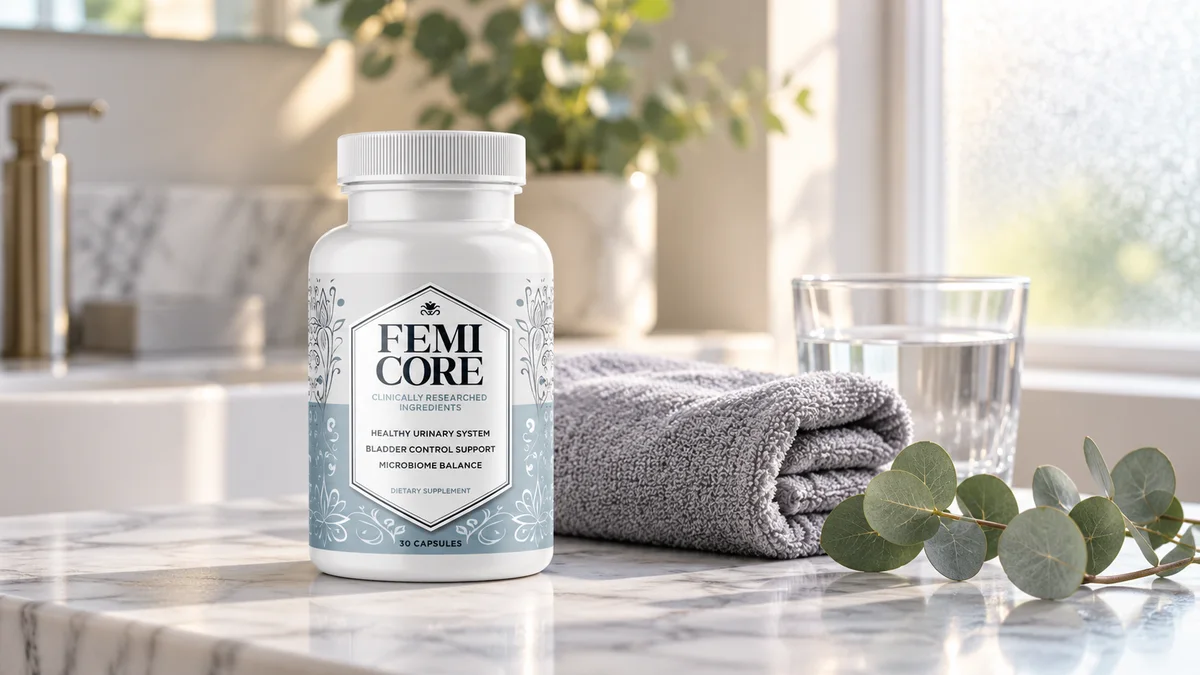
Most FemiCore reviews online are sales pages wearing a review’s clothes. This one is not. We went through the nine ingredients, read the urinary microbiome studies the marketing leans on, checked the pricing and refund terms on the official site, and asked the question a bladder-control supplement has to answer: is there a plausible reason this would do anything, and is the price fair for the uncertainty? Here is what we found.
The short version FemiCore is a once-a-day capsule for women with urgency, frequency and leaks. It combines four botanicals with five Lactobacillus strains, aimed at the bladder’s own bacterial community. The idea is grounded in real research, two of the ingredients have decent human evidence for related outcomes, and the 60-day refund is genuine. Against that: the blend is proprietary with no disclosed doses, there is no trial of the finished product, and the $793 “bonus value” is marketing. We rate it 3.9 out of 5: worth a 60-day trial for urge symptoms if you have ruled out infection and tried pelvic floor training, not a replacement for either.
Want to skip to the price?
Current packages, free US shipping on 3 and 6 bottles, 60-day money-back guarantee.
Check FemiCore Official PriceOpens the official FemiCore website. Affiliate link: we may earn a commission at no extra cost to you.
What FemiCore is, and who it is for
FemiCore is a dietary supplement marketed to women who experience urge incontinence, frequent urination, night-time waking to use the bathroom, and the kind of leaks that follow a sudden strong urge. It is sold as a bottle of 30 capsules, one taken each morning, through the official website only, with checkout handled by the retailer BuyGoods.
The target customer is clear from the manufacturer’s material: women in their 40s through 70s, often past menopause, who have been told their options are pads, pelvic floor exercises, or prescription anticholinergic drugs with their well-known dry-mouth, constipation and cognitive side effects. That is a large group. Population surveys put urinary incontinence at roughly one in three women over 40, rising with age and body weight.
What makes FemiCore different from the cranberry capsules at the pharmacy is its premise. Rather than only soothing or flushing the urinary tract, it claims to repopulate it with protective bacteria. To judge that claim you have to know a little about a scientific finding from 2012 that changed how urologists think about the bladder.
The science FemiCore is built on: the bladder is not sterile
For most of the twentieth century, medical textbooks taught that urine in a healthy bladder is sterile. Standard urine cultures grow nothing in most women without infection, and that was taken as proof.
In 2012, a group at Loyola University Chicago led by Alan Wolfe used DNA sequencing and expanded culture methods on urine collected directly from the bladder by catheter. They found bacterial DNA in most samples, including from women with no symptoms. The bladder, like the gut and the vagina, has its own microbiome. It is simply sparse and hard to culture with the methods hospitals use.
Two years later the same group compared the urinary microbiome of women with urgency urinary incontinence against women without it. The differences were striking. Women with urgency symptoms were more likely to carry Gardnerella and other organisms associated with imbalance, while women without symptoms were more likely to be dominated by Lactobacillus crispatus, the same species that dominates a healthy vaginal microbiome. The study did not prove that the bacteria cause the symptoms, but it established a correlation that has since been replicated and extended.
This is the foundation of FemiCore’s pitch: if women with urgency have fewer protective Lactobacillus, supplying those strains might help. It is a reasonable hypothesis. It is also, as of this writing, a hypothesis. No published trial has given an oral multi-strain probiotic to women with urge incontinence and measured leaks or urgency episodes as the outcome.
The nine ingredients, with the evidence for each
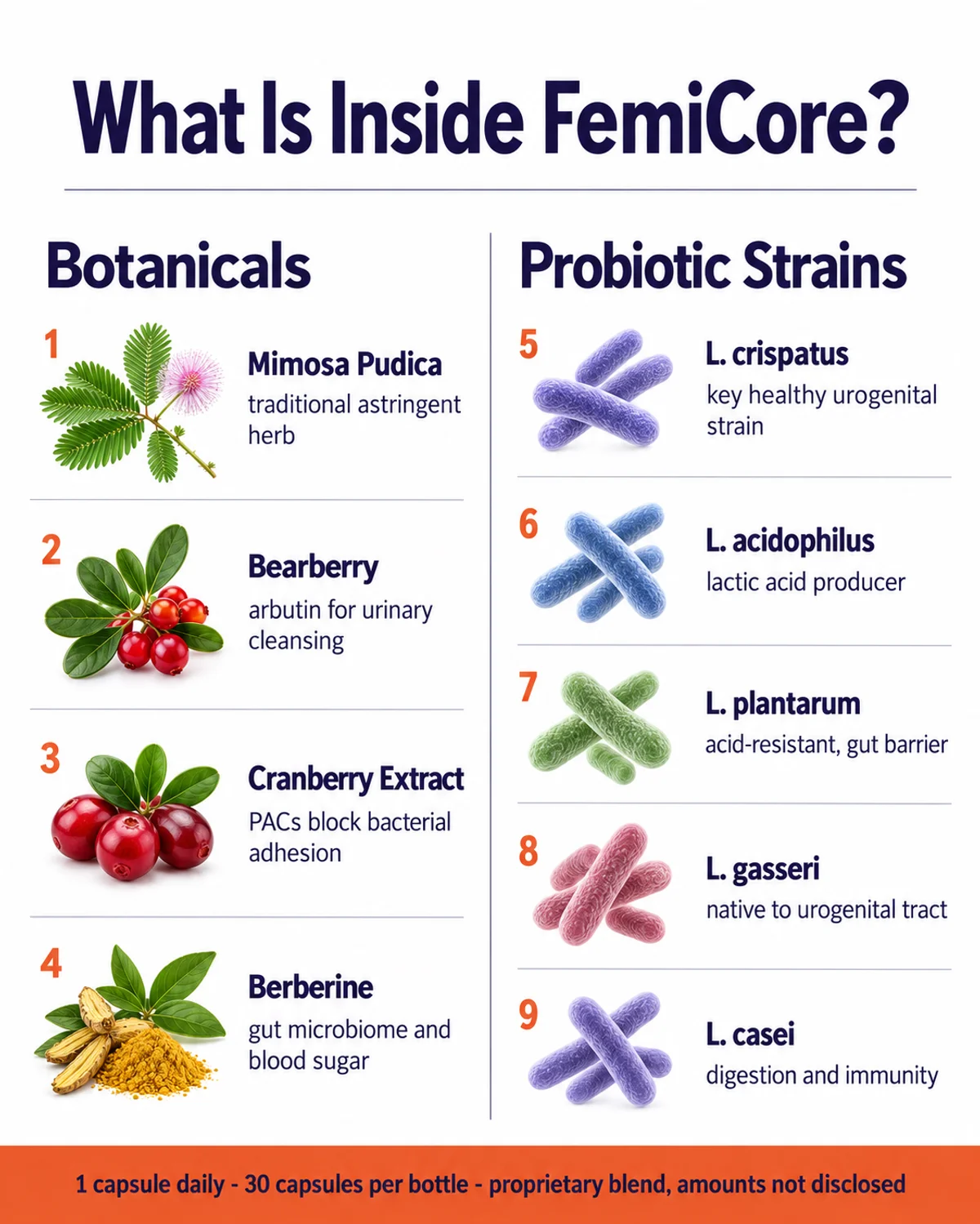
FemiCore lists nine ingredients in a single proprietary blend. The manufacturer does not disclose how much of each is in a capsule. That matters, and we return to it below. First, what each ingredient is and what is known about it.
The four botanicals
Mimosa Pudica. The “sensitive plant” whose leaves fold when touched. In Ayurvedic and folk medicine it has been used for urinary complaints and as an antispasmodic. Laboratory and animal studies show smooth-muscle relaxing and antimicrobial activity. We found no human trials for bladder outcomes. Rationale: plausible. Human evidence: none.
Bearberry (Uva Ursi). Leaves of Arctostaphylos uva-ursi contain arbutin, which the body converts to hydroquinone, a urinary antiseptic. It has been used in European herbal medicine for centuries and is approved in Germany for short-term use in uncomplicated lower urinary tract complaints. The important caveat is “short-term”: monographs recommend no more than one to two weeks at a time and no more than five courses a year because of hydroquinone’s potential liver and kidney toxicity at high cumulative doses. A daily supplement taken for months is a different pattern of use, and the undisclosed dose makes it impossible to judge whether that is a concern here.
Cranberry Extract. The most studied bladder botanical. Cranberry proanthocyanidins stop E. coli from attaching to the bladder lining. The 2023 Cochrane review, covering 50 trials and nearly 9,000 participants, concluded that cranberry products reduce the risk of symptomatic urinary tract infection in women with recurrent infections, in children, and in people after bladder procedures. That is a meaningful upgrade from the inconclusive 2012 version of the review. Note what cranberry does not do: it does not treat urgency or incontinence directly. Its relevance is that low-grade bacterial irritation can drive urgency, and fewer infections may mean a calmer bladder.
Granular Berberine. A yellow alkaloid from plants such as barberry and goldenseal. Berberine has an unusually large body of human research for a botanical, mostly in metabolic health. A 2015 meta-analysis of 27 randomized trials found it lowered fasting glucose, HbA1c, cholesterol and blood pressure, with effects on glucose comparable to metformin in some trials, at doses of roughly 900 to 1,500 mg a day. It is also antimicrobial, including against E. coli. Its place in a bladder formula is indirect: high blood sugar causes frequent urination and raises infection risk, so better glucose control can mean fewer bathroom trips. For readers of a weight loss site, berberine’s modest effects on weight (around 2 kg over 12 weeks in people with metabolic syndrome) are the most relevant finding, but only at doses far above what a nine-ingredient proprietary blend in a single capsule can contain.
The five probiotic strains
Lactobacillus crispatus. The star ingredient and the one with the most relevant human trial. In 2011 Stapleton and colleagues at the University of Washington ran a randomized, placebo-controlled trial in 100 women with recurrent urinary tract infections. Those who received L. crispatus for 10 weeks had a recurrence rate of 15 percent against 27 percent on placebo, and the women in whom the strain colonised had the biggest benefit. Two caveats matter for FemiCore: the probiotic was given as a vaginal suppository, not an oral capsule, and the outcome was infection, not incontinence. Oral Lactobacillus can reach the vaginal and urinary tract via the gut, but less reliably.
Lactobacillus acidophilus. A workhorse probiotic that produces lactic acid and hydrogen peroxide, both of which make the local environment hostile to pathogens. It has been studied in combination with L. rhamnosus for vaginal health with mixed but generally positive results. Little direct bladder research.
Lactobacillus plantarum. Hardy, survives stomach acid well, and has good evidence for gut outcomes such as irritable bowel symptoms. Its contribution to a bladder formula is likely indirect, through gut health, since the gut is the reservoir from which most urinary pathogens originate.
Lactobacillus gasseri. Interesting for two reasons. It is a normal resident of the healthy female urogenital tract. Separately, a specific strain, L. gasseri SBT2055, reduced abdominal visceral fat by about 4.6 percent over 12 weeks in a Japanese randomized trial of fermented milk in adults with obese tendencies. FemiCore does not state which strain of L. gasseri it uses, so this finding cannot be assumed to transfer.
Lactobacillus casei. Well studied for gut and immune outcomes; some evidence from a small trial that a L. casei fermented drink reduced recurrence of superficial bladder cancer, which is not relevant to incontinence but shows the species does interact with the bladder environment. Direct evidence for urgency: none.
What this adds up to Two ingredients, cranberry and berberine, have strong human evidence for outcomes adjacent to bladder control. One, L. crispatus, has a good trial for urinary infection by a different route of delivery. The rest are reasonable supporting choices with mostly laboratory or gut evidence. Nothing in the formula is exotic or alarming. The gap is between “these ingredients have a rationale” and “this product at this dose reduces leaks”, and that gap has not been closed by any study we can find.
Checked the ingredients and want to try it?
Only the official website carries the 60-day guarantee and the current pricing.
Visit Official Website (60-Day Guarantee)Opens the official FemiCore website. Affiliate link: we may earn a commission at no extra cost to you.
The proprietary blend problem
A proprietary blend lists ingredients in descending order by weight but gives only the total. For FemiCore, the label tells you that Mimosa Pudica is the largest component and L. casei the smallest, and nothing about the amount of anything in between.
Why this matters in practice:
- Cranberry works in trials at roughly 36 mg of proanthocyanidins a day. A capsule that also has to hold eight other ingredients may or may not deliver that.
- Berberine has metabolic effects at 900 to 1,500 mg a day. A single capsule cannot physically contain that alongside anything else, so whatever berberine is present is at a dose with no direct trial support.
- Probiotics are measured in colony-forming units (CFU). FemiCore does not state a CFU count, which is the single most important number for a probiotic product.
- Bearberry has an upper safety limit for prolonged use. Without the dose, you cannot tell whether daily use for six months is comfortably below it.
To be fair, proprietary blends are the industry norm, and many well-regarded supplements use them. But it means FemiCore asks you to take the formulation on trust. The 60-day guarantee is the manufacturer’s answer to that, and it is a reasonable one, as long as you understand that you are running a personal experiment, not following a protocol.
How FemiCore is supposed to work, and on what timescale
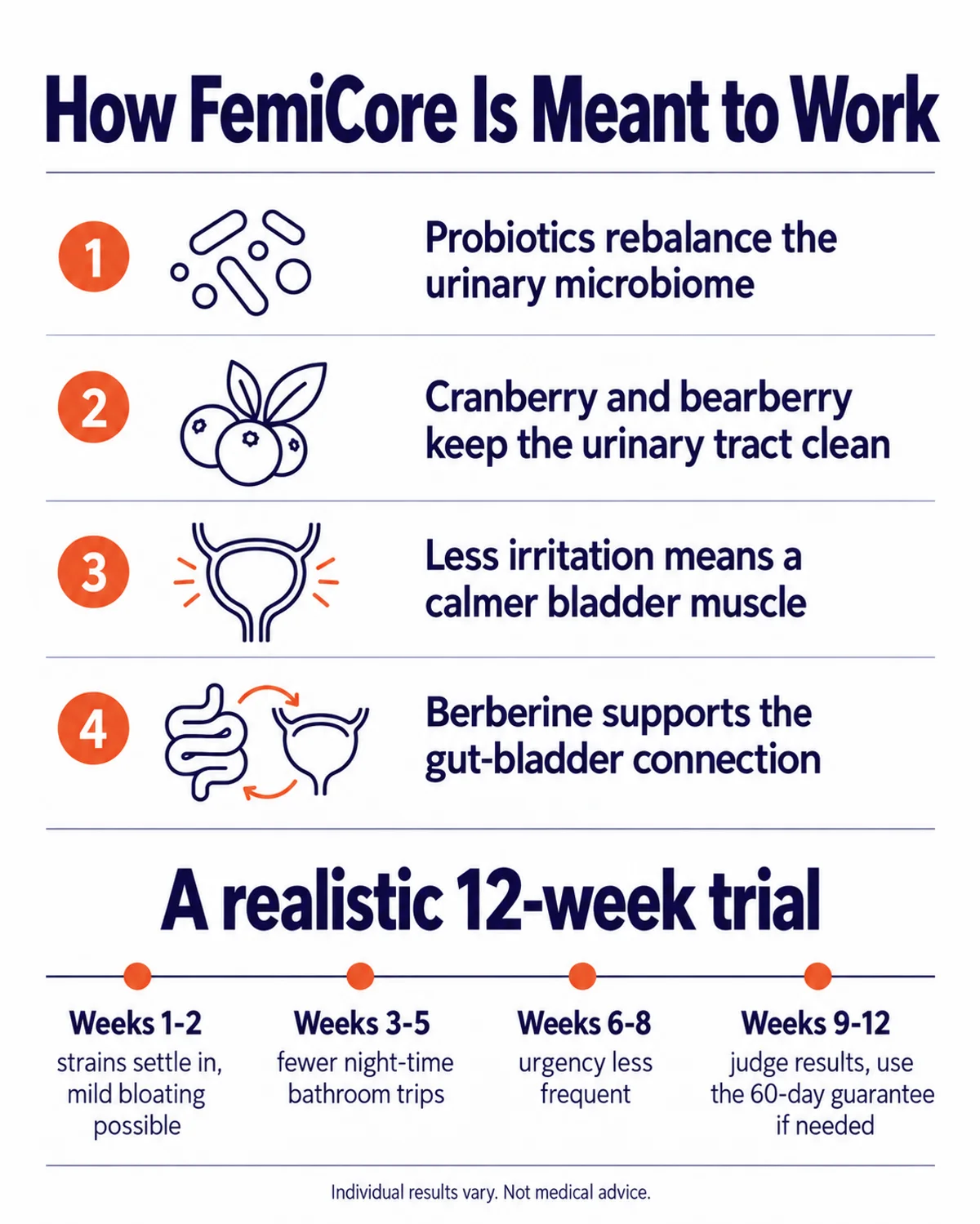
Putting the ingredients together, the manufacturer describes three overlapping actions:
- Reduce bacterial irritation. Cranberry and bearberry make the bladder lining a less hospitable place for E. coli and related organisms. Expected timescale if it works: days to a couple of weeks.
- Shift the microbiome toward Lactobacillus. The five strains, if they survive digestion and colonise, crowd out organisms associated with urgency. Expected timescale: weeks to months. The Stapleton trial ran 10 weeks.
- Calm the bladder signal and support metabolism. Mimosa Pudica’s antispasmodic activity and berberine’s effect on glucose are the proposed routes to fewer urgent signals. Expected timescale: variable.
The practical implication is that FemiCore should be judged at two months, not two weeks. That coincides with the refund window, which means you have to decide whether to request a refund at about the point the probiotic mechanism would plausibly start showing results. Keep a simple diary of night-time trips and urgency episodes from day one so you have something better than memory to decide with.
FemiCore reviews from customers: what the pattern looks like
The manufacturer cites 19,263 reviews and an average around 4.8 stars. We cannot verify that count, and reviews published on a seller’s own site are selected by the seller. With that said, the themes that come up repeatedly in customer accounts are consistent and worth summarising:
What satisfied customers describe: fewer night-time bathroom trips, usually the first change noticed; less “planning around bathrooms” when out; being able to return to exercise classes or long walks without a pad; and, less often, better digestion, which is plausible given five probiotic strains.
What dissatisfied customers describe: no noticeable change after one bottle (the most common complaint, and consistent with the timescale above); bloating in the first week; and frustration with the returns process, mainly around having to ship all bottles back at their own cost.
What is absent: we found no pattern of reports of serious adverse effects, which fits the ingredient list.
Treat these as texture, not data. The honest statement is that FemiCore’s customer feedback looks like that of most probiotic supplements: a majority reporting modest improvement, a meaningful minority reporting nothing, and almost no one reporting harm.
Side effects, interactions and who should not take it
FemiCore is non-GMO, contains no stimulants, and is produced in a GMP-certified, FDA-registered facility. That last phrase refers to the facility’s registration, not to FDA approval of the product. No dietary supplement is FDA approved.
Common, mild: gas, bloating or a change in bowel habit in the first week, typical of starting any probiotic. Berberine can cause constipation or loose stools.
Berberine interactions: it lowers blood sugar, so it adds to the effect of insulin and oral diabetes drugs and can cause hypoglycaemia. It inhibits the liver enzymes CYP3A4 and CYP2D6, which metabolise many medications including some statins, calcium channel blockers, immunosuppressants such as cyclosporine, and certain antidepressants. If you take any of these, speak to a pharmacist before starting.
Bearberry cautions: not for long-term continuous use in large amounts, not for people with kidney disease, and it works best in alkaline urine, so very high vitamin C intake may reduce its effect.
Do not take FemiCore if you are: pregnant or breastfeeding (berberine crosses the placenta and can cause neonatal jaundice; bearberry is contraindicated), under 18, immunocompromised (live probiotics carry a small infection risk), or have kidney or liver disease without medical advice.
See a clinician first if: you have blood in your urine, pain on urination, fever, a sudden new onset of incontinence, or leakage after pelvic surgery or childbirth. These need assessment, not a supplement.
What works better than any supplement for incontinence
A review that only compared FemiCore to other capsules would be doing you a disservice. Two interventions have far stronger evidence for urinary incontinence than any supplement, and both are free.
Pelvic floor muscle training. The 2018 Cochrane review of 31 trials found women who did supervised pelvic floor training were about eight times more likely to report cure of stress incontinence and five times more likely to report cure or improvement of any incontinence than controls. This is the first-line treatment in every clinical guideline. A physiotherapist can teach it in one or two sessions; apps and written guides work for many women.
Weight loss, if you carry excess weight. This is where FemiCore’s audience and this site’s overlap. In the 2009 PRIDE trial published in the New England Journal of Medicine, overweight and obese women with incontinence who followed a six-month intensive weight loss programme lost an average of 8 percent of body weight and reduced weekly incontinence episodes by 47 percent, against 28 percent in the control group. Every kilogram of abdominal weight presses on the bladder; removing it helps mechanically, and better glucose control reduces urine volume. If you have weight to lose, our guides on setting a calorie target and walking for weight loss will do more for your bladder than any capsule, and they cost nothing.
Bladder training and fluid timing. Scheduled voiding that gradually extends the interval between bathroom visits, cutting caffeine and alcohol, and front-loading fluids earlier in the day all have guideline support for urge symptoms.
FemiCore can sit alongside these. It should not replace them.
FemiCore compared with the alternatives
Most women reading FemiCore reviews are weighing it against something else: a cheaper cranberry capsule, D-mannose, a prescription, or simply doing nothing. Here is how the options line up on the things that matter.
| Option | What it targets | Evidence quality | Typical monthly cost | Main drawback |
|---|---|---|---|---|
| FemiCore | Urinary microbiome, irritation, urgency | Ingredient-level, no product trial | $49 to $79 | Undisclosed doses |
| Pharmacy cranberry (36 mg PAC) | Infection recurrence | Good (Cochrane 2023) | $8 to $15 | Does nothing for urgency without infection |
| D-mannose | E. coli adhesion | Mixed; small trials | $15 to $25 | Same limitation as cranberry |
| Single-strain oral probiotic | Gut and vaginal flora | Moderate for vaginal health | $15 to $30 | Few bladder-specific trials |
| Prescription anticholinergics or mirabegron | Overactive bladder muscle | Strong, many RCTs | Varies by insurance | Dry mouth, constipation, cognitive effects with anticholinergics |
| Pelvic floor muscle training | Stress and mixed incontinence | Strong (Cochrane 2018) | Free to one physio visit | Requires daily practice for months |
| Weight loss (if overweight) | Pressure on bladder, glucose | Strong (PRIDE trial) | Free | Slow, requires sustained change |
Read across the table and a sensible order emerges. Start with the free interventions with the best evidence: pelvic floor training and, if relevant, weight loss. If urge symptoms persist, see a clinician to rule out infection and discuss prescription options. FemiCore belongs in the middle: more comprehensive than a $10 cranberry capsule, far less evidenced than a prescription, and reasonable as a self-funded trial for women who want to try a non-drug route before or alongside medical treatment.
Leaks during exercise: where bladder control and weight loss meet
A surprising number of women stop exercising because of leaks, which then makes weight loss harder, which then makes leaks worse. Breaking that loop is worth a few paragraphs because it is the reason many readers of this site will have searched for FemiCore in the first place.
Leaking during a jump, a run or a heavy lift is usually stress incontinence: the pelvic floor and the tissue supporting the urethra cannot hold against a sudden rise in abdominal pressure. FemiCore’s mechanism does not address that directly. What does: pelvic floor training (which also improves the pelvic floor’s reflex contraction just before a cough or landing), losing abdominal weight, and choosing lower-impact movement while the pelvic floor strengthens.
Practical adjustments that let you keep training:
- Swap the impact, keep the intensity. Brisk incline walking, cycling, rowing and swimming raise heart rate without the repeated landings of running or jumping. Our 12-week walking plan is built for exactly this.
- Lift, but exhale on effort. Breathing out through the hardest part of a squat or deadlift, rather than holding your breath, reduces the pressure spike on the bladder.
- Empty your bladder before training and limit caffeine beforehand. Obvious, often skipped.
- Do pelvic floor contractions as part of the warm-up. Ten slow holds and ten quick pulses, every session.
Where FemiCore may help in this picture is with the urge component that often accompanies stress leaks in women with mixed incontinence, and with the night-time waking that leaves you too tired to train. It is a supporting player, not the fix.
How to run a fair 60-day trial
If you decide to try FemiCore, run it like an experiment so the refund decision is based on evidence rather than impression.
- Baseline for one week before you start. Each day, note the number of bathroom visits, the number of night-time wakings to urinate, the number of urgency episodes you would rate as strong, and any leaks. A notes app is fine.
- Take it at the same time daily. The label says one capsule in the morning. Probiotics generally survive better taken with or just before food.
- Change nothing else for the first month. If you start pelvic floor training, cut caffeine and begin FemiCore in the same week, you will not know what worked. Add the other changes in month two if you want, and note the date.
- Review at day 28 and day 56. Compare the weekly averages to baseline. A meaningful response is a reduction of a third or more in night-time wakings or strong urgency episodes. Smaller changes are within normal week-to-week variation.
- Decide by day 56. That leaves four days to contact support and post the bottles back inside the 60-day window if the numbers have not moved.
Done this way, the worst case is $207 plus return postage and two months of data about your own bladder that will be useful to any clinician you see next.
Pricing, bonuses and the guarantee, exactly as stated
Pricing on the official site at the time of writing:
| Package | Per bottle | Shipping | Total | Extras |
|---|---|---|---|---|
| 2 bottles (60 days) | $79 | $9.99 | $158 + $9.99 | None |
| 3 bottles (90 days) | $69 | Free (US) | $207 | None |
| 6 bottles (180 days) | $49 | Free (US) | $294 | 3 digital bonus guides |
The three bonuses with the 6-bottle package are digital PDFs: “7 Days to Rekindle the Passion in Your Marriage” (stated value $199), “Reset Your Gut: Perfect Digestion While Eating Your Favorite Foods” ($397), and “Unlock Painless Hips & Legs: The Complete Lower Body Mobility Blueprint” ($197). The combined “$793 value” is the manufacturer’s figure. Treat the guides as a free extra, not as $793 of value; nobody would pay those prices for them separately.
Which package makes sense. Because the plausible mechanism takes eight to twelve weeks, a single month is not a fair trial, and the manufacturer does not sell one anyway. The 3-bottle package covers a full 90-day course at $69 a bottle. The 6-bottle package is $87 more in total for twice the supply and is the right choice only if you have already decided to use it for six months. Our suggestion for a first order is the 3-bottle package: it covers the evaluation window, ships free, and keeps the downside at $207 before the guarantee.
The 60-day guarantee. It is real and BuyGoods processes it. The conditions: contact FemiCore customer support within 60 days of the purchase date, return all bottles from the order, empty, partial or sealed, along with the packing slip, to the address they give you. The purchase price is refunded to the original payment method. Return postage is yours, and the $9.99 shipping on the 2-bottle package may not be refunded. Keep the shipping box and the slip. If you order the 6-bottle package and decide at day 55 that it has not worked, you are shipping six bottles back, which is a few dollars more in postage but otherwise straightforward.
See today’s FemiCore pricing
2 bottles $79 each, 3 bottles $69 each, 6 bottles $49 each. Prices are set by the manufacturer and can change.
Check FemiCore Official PriceOpens the official FemiCore website. Affiliate link: we may earn a commission at no extra cost to you.
Pros and cons
Reasons to consider it
- The underlying idea, restoring Lactobacillus to the urinary tract, is grounded in peer-reviewed research from Loyola and elsewhere.
- Cranberry and berberine have strong human evidence for adjacent outcomes (infection prevention; glucose control).
- L. crispatus has a good randomized trial for urinary infection recurrence.
- One capsule a day, no stimulants, no reported pattern of serious side effects.
- A real 60-day guarantee from an established retailer.
- Priced in the normal range for a multi-strain probiotic with botanicals.
Reasons for caution
- Proprietary blend: no doses, no CFU count. You cannot compare it with the studies.
- No clinical trial of FemiCore itself. All evidence is for individual ingredients, often by different routes or at higher doses.
- Bearberry is traditionally a short-course herb; daily long-term use at an unknown dose is a question mark.
- Berberine interacts with common medications.
- The “19,263 reviews” and “$793 bonus value” are unverifiable marketing figures.
- It is not a treatment for stress incontinence, and pelvic floor training and weight loss have far better evidence.
Our rating
| Criterion | Score (out of 5) | Note |
|---|---|---|
| Ingredient rationale | 4.5 | Coherent, research-informed formula |
| Evidence for the finished product | 2.0 | None; ingredient-level only |
| Transparency | 2.5 | Proprietary blend, no CFU |
| Safety profile | 4.0 | Benign for most; real interactions for some |
| Value | 4.0 | Fair pricing, genuine guarantee |
| Marketing honesty | 3.0 | Inflated bonus values and review counts |
| Overall | 3.9 | Worth a 60-day trial for urge symptoms, with realistic expectations |
Final verdict: who should try FemiCore, and who should not
Consider a 60-day trial if you are a woman with urge-type symptoms (sudden urges, frequency, night-time waking), you have had infection ruled out, you are already doing pelvic floor exercises or are willing to start, you are not on interacting medication, and you can afford $207 as an experiment with a refund safety net.
Skip it if your leaks happen mainly on coughing, laughing or exercise (that is stress incontinence and the pelvic floor is the answer), you take diabetes medication or drugs metabolised by CYP3A4 without medical supervision, you are pregnant or breastfeeding, or you are looking for a weight loss product. For weight, the ingredients are in the right family but the doses are not disclosed and almost certainly too low.
FemiCore is a reasonable product built on an interesting idea that has not yet been tested in the way its marketing implies. That is true of most supplements. What sets it slightly apart is that the idea is better than average, the ingredients are sensible, and the guarantee is real. If you try it, keep a diary, give it the full 60 days, and judge it on the numbers rather than on how the sales page made you feel.
Ready to run your own 60-day trial?
Order from the official website, keep the packing slip, and judge it on your diary numbers.
Visit Official Website (60-Day Guarantee)Opens the official FemiCore website. Affiliate link: we may earn a commission at no extra cost to you.
For a condensed overview of the product, pricing and bonuses, see our FemiCore product page.