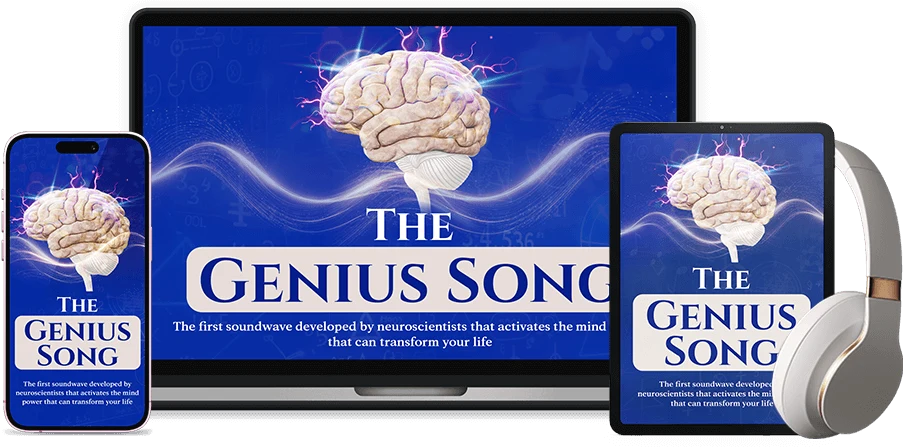
The Genius Song is sold on outcomes: insight, memory, faster learning, luck, money and more, all from a short daily track that the seller says wakes up a sleeping gamma brain wave. This page takes each promised benefit in turn and rates it against the research we could find. One fact frames all of it: no published study has tested this track, so every rating below describes the nearest research, not the product.
The promised benefits, rated
| Benefit the seller claims | Nearest research | Our evidence rating |
|---|---|---|
| Gamma “activated” in adults | 40 Hz sound and light studies, mainly in mouse models of Alzheimer’s | None for this track |
| Sharper focus, faster learning, better memory | Binaural-beat studies: a medium pooled effect in 2019, doubts about brainwave change in 2023 | Weak, indirect |
| Eureka moments, problems solved with ease | Nothing that measures this for an audio track | None |
| Luck, synchronicities, “abundance” | Not something a study of sound could show | None |
| Promotions, money, a better job | No research link | None |
| Better relationships and children’s grades | Stories in the video only | None |
| Weight loss, quitting smoking | No trial of any kind | None |
| Migraines and joint pain going away | No trial; the site disclaims treating disease | None |
| Calmer bedtimes for children | Stories in the video only | None |
The pattern is clear. Only one row, attention and memory, has any research nearby, and even there the studies use other sounds in lab tasks over short periods.
The mechanism the seller describes
The sales story runs in four steps. Adults have a gamma brain wave that modern life has left “dormant”. Gamma is “the super brain wave”. A sound using “brain entrainment” can switch it back on by linking several brain regions. The Genius Song is that sound, compressed from an hour into seven minutes.
What the seller leaves out is any description of the sound itself. There is no frequency, no explanation of whether it uses beats, pulses or music, and no recording data. Without that, there is nothing an outsider could test. The claim also assumes that gamma is “off” in ordinary adults, which is not how researchers describe it: gamma rhythms are present in normal waking brains and are studied in connection with attention and memory processing.
Hear the seller’s explanation in full
The sales presentation runs about 39 minutes. The order itself is a $39 digital track with a 90-day refund.
Visit the Official WebsiteOpens the seller’s official website (orders go through a ClickBank checkout). Affiliate link: we may earn a commission at no extra cost to you.
What the gamma research does cover
Here is the research that sits closest to the seller’s story, in plain terms.
- MIT and 40 Hz stimulation. The Tsai lab has exposed mice bred to model Alzheimer’s disease to light and sound pulsed at 40 Hz and reported changes in disease markers and memory tasks in those animals. Small pilot studies in people with mild Alzheimer’s dementia have followed, mainly to test whether the approach is feasible and tolerated. This is medical research in a disease setting. It does not study luck, wealth, success or healthy adults’ IQ.
- Meditators’ gamma. A 2004 study from the University of Wisconsin (Lutz and colleagues) recorded strong gamma activity in long-term meditation practitioners while they meditated. The video’s monk story looks like a simplified version of this. The study measured meditation, not an audio track.
- Entrainment and binaural beats. The picture is split. Combining binaural-beat trials, a 2019 paper in Psychological Research reported an effect of medium size (g = 0.45) across cognition, anxiety and pain measures. A 2023 PLOS ONE systematic review tested a different question, whether the beats move brain rhythms at all, and counted 5 supporting studies, 8 contrary ones and 1 mixed. Neither tested The Genius Song, and neither looked at luck or wealth.
So when the video says MIT “found” that lucky and successful people share one brain wave, there is a gap between the claim and the work. Our article on gamma waves and the Genius Song pitch covers this research at more length.
The other research claims in the video
The video stacks up more studies and institutions. None comes with a paper we could match to the claim as stated, so each stays a seller statement.
| What the video says | What we can tell you |
|---|---|
| A 2026 discovery, and a paper dated December 27, 2025 | No paper is named; the site footers still read Copyright 2023 |
| A Princeton report (NASA in the text page) | No report is identified; the text page swaps the institution |
| A British double-blind study of children sensing callers | No study is named |
| The Einstein Center Berlin linking flow to gamma (“colleagues in Japan” in the text page) | Again the institution changes between pages |
| Edison’s gamma device | No source given |
| Billionaires rising at 4 AM for gamma | No source given |
| Columbia showing gamma can “influence another person” | No study is named |
The seller’s own reference list does not help much here. Its 14 entries mix theta research and broader entrainment papers with pieces on creativity from Inc.com and Medium and a TED talk, and the same list appears on the page for The Genius Wave, a separate theta product. The video, meanwhile, is about gamma. The “98% of children are creative geniuses” line traces to George Land’s creativity test, popularized in the 1992 book Breakpoint and Beyond, not to a peer-reviewed NASA paper.
The seven-second hook
Right at the start, the video teases a “brain trick” lasting seven seconds, then a seven-second “morning ritual”. What is sold is a seven-minute track, and no separate seven-second trick is ever explained. It is a small thing, but it is the first promise a viewer hears, and it does not match the product.
The presenter’s own caveat
One line in the video is worth more than the rest. Describing a casino win, the presenter says there is, “of course, no evidence” that the track caused it. That honesty should be applied to every story in the video, not only the casino one.
The stories come from the presenter, who uses the pen name Dr. Robert Lake according to the site’s disclaimer, and from testimonials that the Terms say may be dramatized, voiced by avatars or actors, or given by paid participants or people close to the founders. The seller’s figure of 18,366 helped Americans also appears as 19,389 on another page. None of this is evidence of benefit.
Prefer to test the claims on yourself?
$39 once through ClickBank, seven minutes a day by the seller’s instructions, and 90 days to ask for a refund.
Check the Current PriceOpens the seller’s official website (orders go through a ClickBank checkout). Affiliate link: we may earn a commission at no extra cost to you.
Health claims: weight, smoking, pain
Because this is a weight-loss site, the health stories need a direct answer. The video mentions a colleague who lost 16 lb, someone who quit smoking, migraines that disappeared and joint pain that eased. These are anecdotes with no names we can check and no follow-up.
The site itself carries the usual FDA-style notice, which rules out diagnosing, treating, curing or preventing any disease. The Terms add that entrainment is “not an exact science” and file the products under entertainment. If you are working on your weight, your sleep, food, activity and medical advice will matter far more than any audio track.
Timing promises
| What the seller says | Our note |
|---|---|
| Works the first time you listen | The seller’s statement; nothing measures it |
| Many notice a change within two or three days | No data shown |
| Most people listening daily get results inside about two weeks | No data shown |
If you try it anyway, these timelines are useful in one way: they all fall well inside the 90-day refund window. You can listen daily for a month, keep brief notes and still have time to decide.
A fair expectation
Seven quiet minutes with your eyes closed can feel restful, and a short, regular wind-down may help some people settle before sleep. That is a benefit of the habit, which any calm audio can provide. It is not evidence that this particular track does something special to gamma, memory, luck or money.
Remember too that the Terms contain two lines that pull in opposite directions. One places the products in the entertainment category. The other asserts that what the seller says about entrainment, focus and mental energy rests on established science. We give the first one more weight, because it matches what the research shows.
On ordering: for now, the front page of the official site leads with The Genius Wave, a related audio by the same seller, and the presentation for The Genius Song is found on that site’s /video/ page. For the full picture with our score, see the Genius Song guide, and for listening precautions the safety page.
Happy to treat it as an experiment?
Set your expectations by the research, not the video. One $39 payment, digital delivery, refunds for 90 days.
Check the Price on the Official SiteOpens the seller’s official website (orders go through a ClickBank checkout). Affiliate link: we may earn a commission at no extra cost to you.