The Genius Song gamma waves pitch rests on one idea: that a fast brain rhythm called gamma is “dormant” in most adults, and that a short daily sound wave can wake it up. Gamma waves are real, and there is serious research on 40 Hz stimulation. This article summarizes what that research covers, who was studied and what was found, in neutral terms, so you can see how far it is from the claims in the sales video.
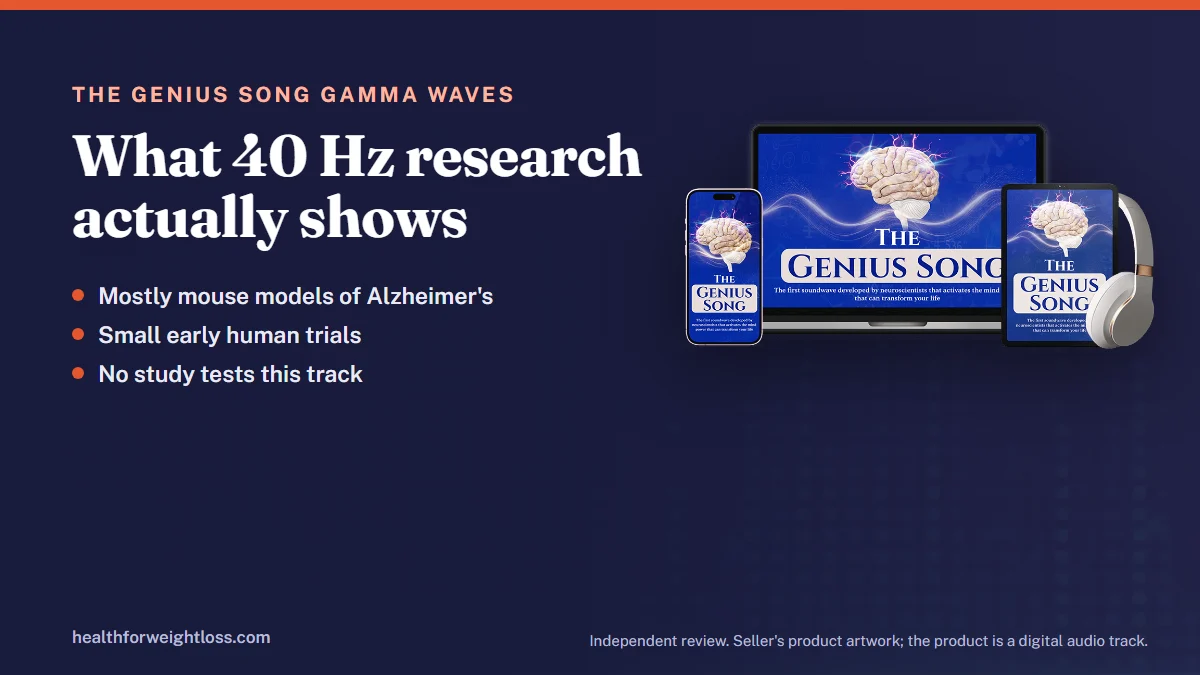
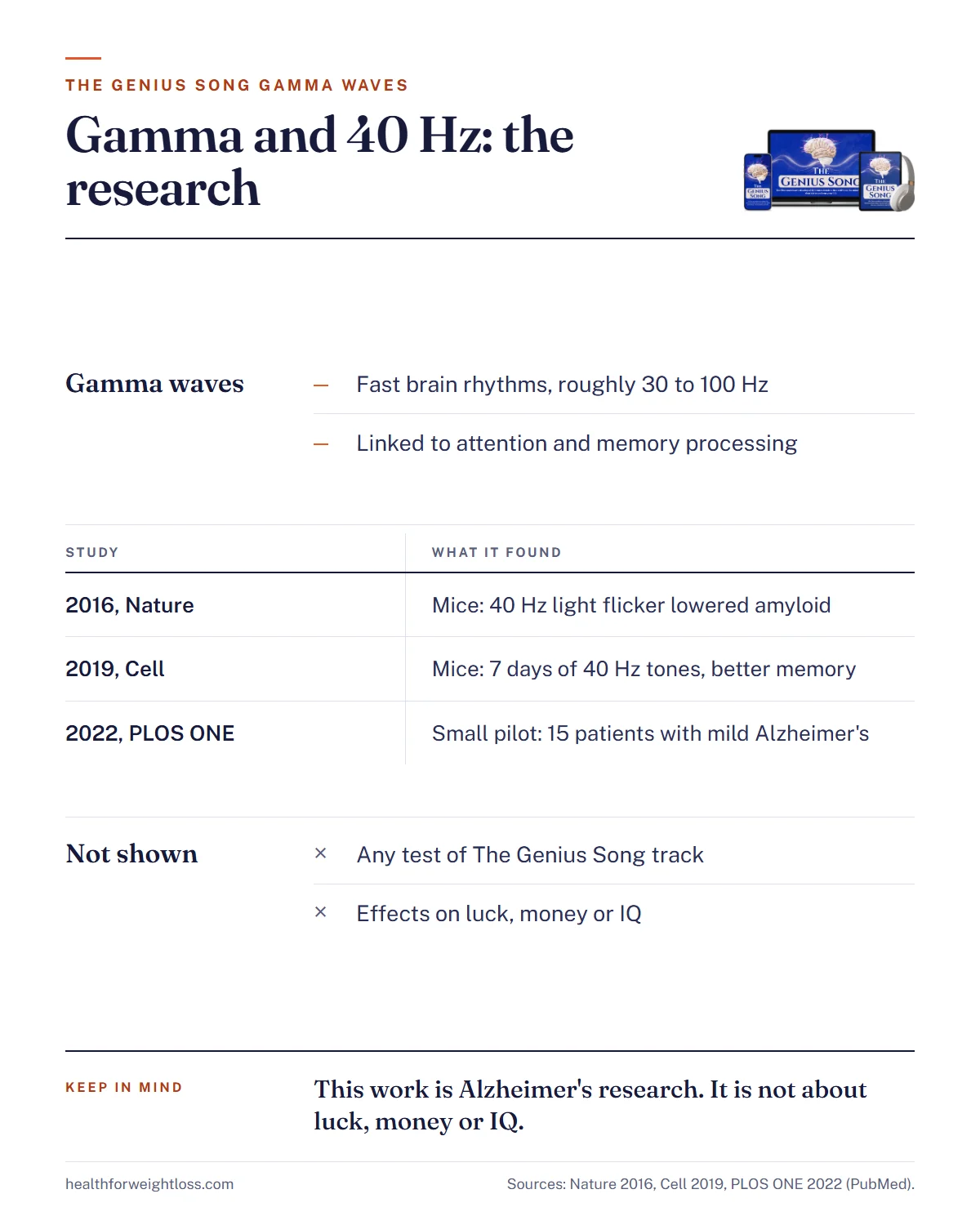
In one paragraph Gamma rhythms (roughly 30 to 100 Hz) are linked to attention and memory processing. MIT’s best-known 40 Hz light and sound work used mostly mice bred to model Alzheimer’s disease, followed by small early human trials. Meditators have shown strong gamma activity in EEG studies. None of this research tests The Genius Song, and its subject is never luck, money or IQ.
This article is independent: we are not the seller, and we may earn a commission if you buy through our links. For a plain overview of the product before the science, read what The Genius Song is.
The Genius Song gamma waves claim, in the seller’s words
The narrator of the sales video introduces himself as Dr. Robert Lake; a footer note on the site reveals that this is a pen name, which leaves his credentials unverified (our article on the presenter behind The Genius Song goes into this). Here is the gamma story as he tells it:
- Gamma is “the super brain wave”, and it is “suppressed” or “deactivated” by modern life after childhood.
- “MIT found that all lucky, wealthy, successful people have this one brain wave in their mind at all times.”
- Four routes can activate gamma: meditating twice a day for twenty minutes, waking at 4 AM, a biofeedback machine, or “a special sound wave”.
- The sound wave uses “brain entrainment” and, he says, compresses an hour of entrainment into seven minutes.
- Listening “will begin activating your gamma by connecting several regions of your brain to each other”.
The claimed results go far beyond brain rhythms: eureka moments, faster learning, luck, money, promotions, better relationships, kids’ school grades and even weight loss. These are the seller’s claims and none of them is proven.
One detail is worth knowing. The sales page’s own bibliography leans on theta and general entrainment studies plus creativity articles, and it is identical to the list on the seller’s other audio page. The video is about gamma, but its own reference list barely is.
What gamma waves are
Your brain cells fire in rhythms that can be picked up with EEG (electrodes on the scalp) or with electrodes inside the brain. Researchers group those rhythms by speed. Gamma is the fast end, roughly 30 to 100 cycles per second (Hz), and a lot of studies focus on activity near 40 Hz.
Gamma activity has been linked in research to attention, to holding and processing information, and to how different brain areas coordinate during a task. That is a description of when gamma shows up, not proof that boosting it makes anyone smarter. Brain rhythms are measurements of activity, and more of one rhythm is not automatically better.
Want to hear what the seller built?
Sold as one $39 audio file via ClickBank. About 7 minutes long, says the seller; we have not bought it to check.
Visit the Official WebsiteThis is an affiliate link via ClickBank to the seller’s site. We may be paid a commission; your price is unchanged.
What MIT’s 40 Hz research found
The best-known gamma stimulation work comes from Li-Huei Tsai’s lab at MIT. Here are the three papers most often linked to the idea, in order.
2016, Nature (mice). Iaccarino and colleagues reported that a mouse model of Alzheimer’s disease showed weaker gamma activity before plaques formed. Driving certain brain cells at 40 Hz, but not at other frequencies, lowered amyloid levels. A non-invasive version, a light flickering at 40 Hz, reduced amyloid in the visual cortex of the mice.
2019, Cell (mice, sound added). Martorell and colleagues used 40 Hz tones. After seven days, mouse models of Alzheimer’s did better on spatial and recognition memory tests and had less amyloid in the hearing and memory areas of the brain. Sound and light together produced wider changes than either one alone.
2022, PLOS ONE (small human trials). Chan and colleagues reported a Phase 1 feasibility study (25 cognitively normal volunteers, 16 people with mild Alzheimer’s dementia and 2 people with epilepsy who had brain electrodes) and a Phase 2A pilot with 15 patients with mild probable Alzheimer’s dementia. Patients used a 40 Hz light and sound device daily for three months. It was well tolerated, and the 40 Hz group showed less brain shrinkage in some measures and did better on a face-name recall test than the control group. The authors concluded that a larger, pivotal trial is needed. Two of the authors, including the senior author, declared that they co-founded a company developing the approach.
| What the 40 Hz research did | What The Genius Song marketing says |
|---|---|
| Studied mouse models of Alzheimer’s disease | Speaks to healthy adults about luck and success |
| Used a defined 40 Hz flicker or tone | Does not describe the track’s frequencies |
| Daily sessions under study conditions | Seven minutes a day at home |
| Measured amyloid, brain volume, memory tests | Promises insight, money, relationships, grades |
| Small human pilots, larger trials still needed | “Starts working the very first time you listen” |
Want to compare the pitch with the research?
The seller’s video makes the gamma case in its own words. The track costs $39, and the Terms give you 90 days to change your mind.
See the Seller’s WebsiteThis is an affiliate link via ClickBank to the seller’s site. We may be paid a commission; your price is unchanged.
What meditators’ brains showed
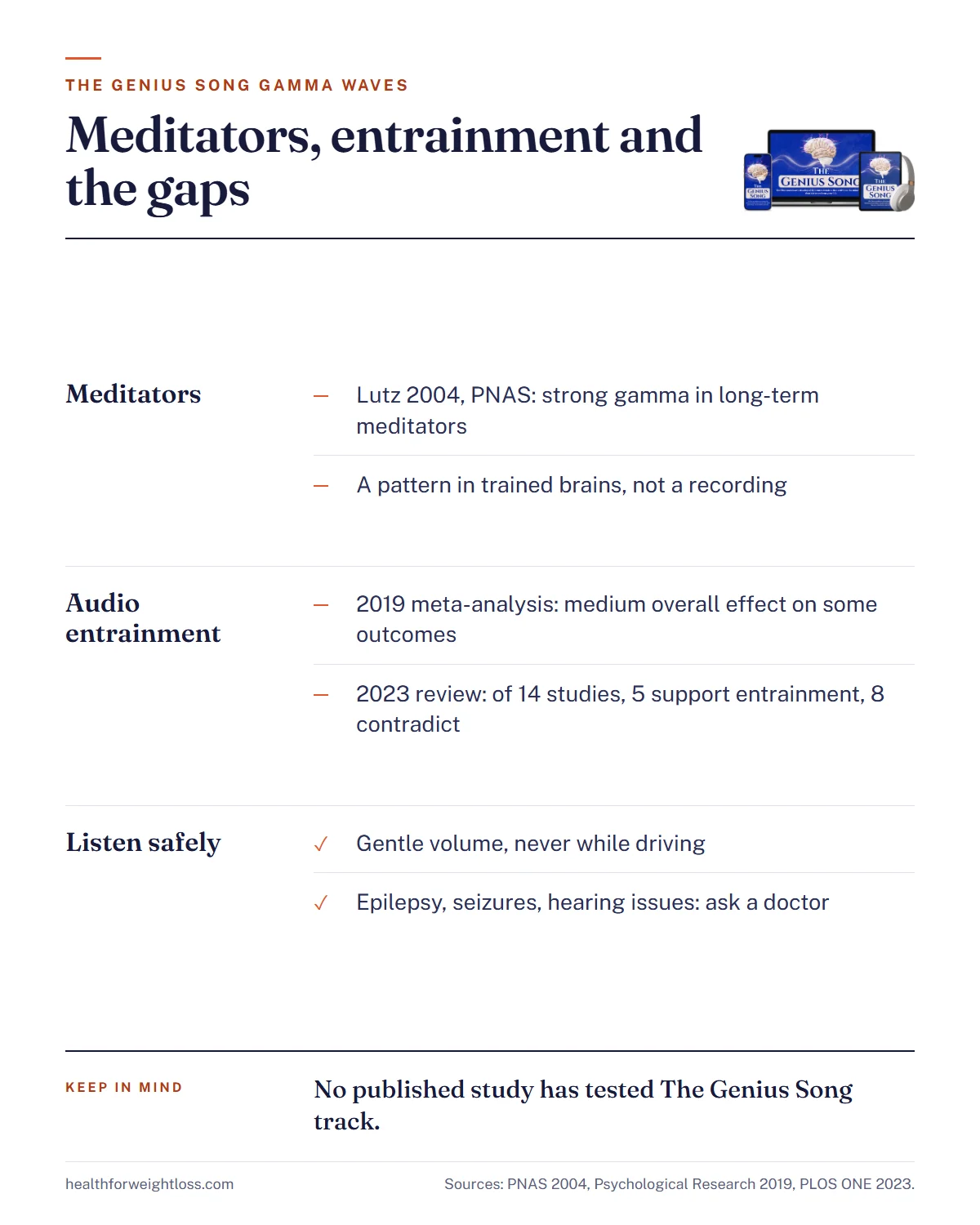
The presenter’s first route to gamma is meditation, and here there is a real study behind the story. In 2004, Antoine Lutz, Richard Davidson and colleagues at the University of Wisconsin published an EEG study in PNAS. Long-term Buddhist practitioners produced sustained, high-amplitude gamma activity with strong synchrony across the scalp while they meditated, which differed from a control group.
The ratio of gamma activity (25 to 42 Hz) to slower activity (4 to 13 Hz) was already higher in the practitioners at rest, and it rose sharply during meditation. The authors suggested that mental training may bring both short-term and long-term changes in the brain.
This is likely where the seller’s “monk” story comes from, in simplified form. What the study shows is a pattern in people with many years of practice. It does not show that a recording can produce the same pattern, or that the pattern brings luck or wealth.
What the research on audio entrainment says
The Genius Song is described as using “brain entrainment”, meaning sound designed so brain activity follows its rhythm. That idea has been tested with binaural beats and similar audio for years.
- Garcia-Argibay’s 2019 meta-analysis (Psychological Research, with two co-authors) combined binaural beat studies and reported an overall effect of medium size on several outcomes (cognition, anxiety and pain perception), with the size depending on the beat frequency and on how long and when people listened. It measured those outcomes, not whether brain rhythms changed.
- A 2023 systematic review in PLOS ONE looked at whether binaural beats actually shift brain rhythms. Of 14 studies, five supported the entrainment idea, eight contradicted it and one was mixed. The authors pointed to wide differences in methods.
Taken together, the picture is mixed. The 2019 pooled analysis reported a medium-sized effect for some outcomes, yet in the 2023 review most studies did not show the expected change in brain rhythms. Nobody has tested this product’s track.
What no study shows
Putting the pieces together, here is what we could not find in the published research:
- Any study showing one brain wave common to “all lucky, wealthy, successful people”.
- Any study of The Genius Song track, or of a seven-minute track compressing an hour of entrainment.
- Any evidence that gamma stimulation brings luck, money, promotions or better relationships.
- Any evidence that it treats migraines, joint pain, smoking or weight. The footer even says: “This product is not intended to diagnose, treat, cure, or prevent any disease.”
The seller’s Terms are candid in their own way. Their “For Entertainment Purposes Only” section labels entrainment “not an exact science” and offers the products as entertainment. The same Terms also claim that brainwave entrainment claims “are substantiated by established scientific research”. Both lines sit in one document.
Interested in trying it anyway?
$39 one time, digital delivery, and a 90-day refund clause in the Terms. Treat it as a relaxation habit, not a treatment.
Check the Current Price on the Official SiteThis is an affiliate link via ClickBank to the seller’s site. We may be paid a commission; your price is unchanged.
If you listen: practical notes
These are our own suggestions for any audio product built around entrainment:
- Pick a gentle volume. According to the NIDCD, loud headphone listening can harm your hearing gradually.
- Never listen while driving or operating machinery.
- People with epilepsy, past seizures or hearing difficulties should get a doctor’s view before starting.
- Do not use it in place of care. If you have memory worries, see a professional rather than relying on a track.
Price, refund and the fine print
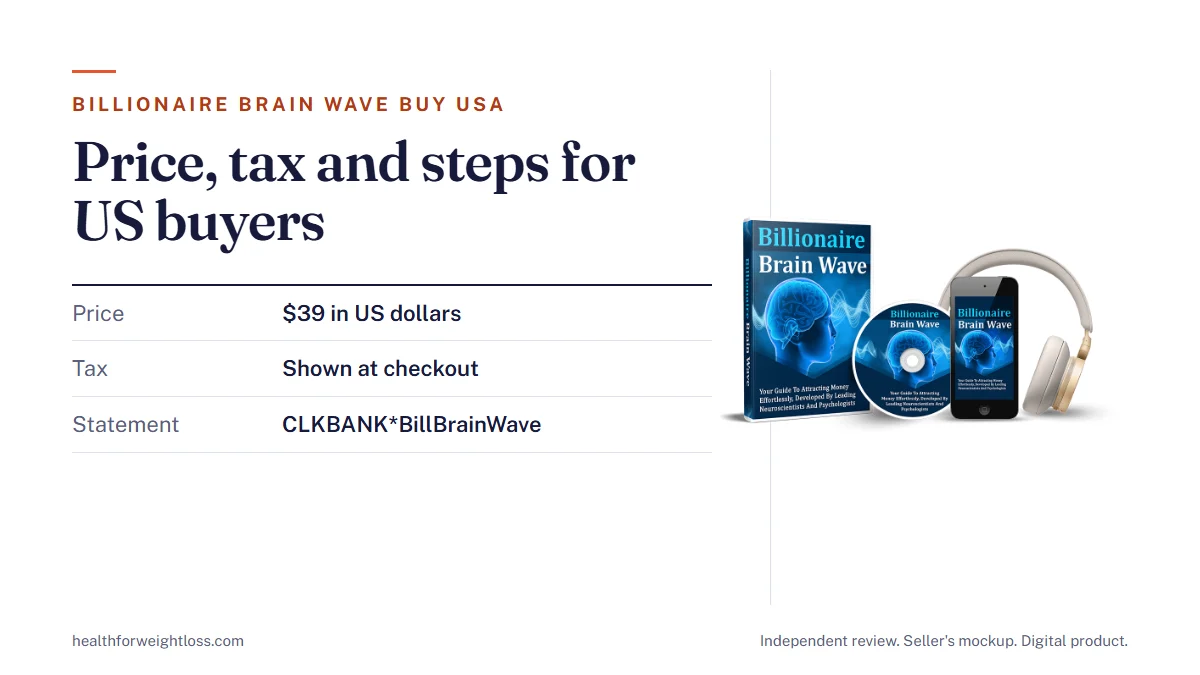
You pay $39 per the Terms of Sale, converted by ClickBank into your currency with any local tax added. Digital buyers can request a refund for 90 days under the Terms, a limit the ClickBank checkout repeats. Do not be thrown by /TOS/refunds/: that page holds a 60-day return policy for NeuroActivate bottles, Ohio address included, left over from something else. Go through ClickBank and keep the receipt.
Bonus details depend on which page you read. Out loud, the video counts “three free bonuses” before walking through four (a children’s audio named The Genius Child, a wealth book over 100 years old, a guided session credited to a Calm app creator, a five-habit printable). In writing, /text/ promises “4” and shows three; The Genius Child is the one missing.
On trust: the Terms concede that testimonial names were changed, that actors or avatars may stand in for customers, and that some of those featured were paid. The customer counts on the pages (18,366 and 19,389) are the seller’s, unverified and inconsistent. Our full Genius Song reviews guide covers the rest.
Where to find it
Our links open the seller’s site through ClickBank. The official site’s home page currently features the seller’s related audio, The Genius Wave; The Genius Song presentation is on the same site’s /video/ page. The seller’s pages describe them differently (12 minutes of theta for the Wave, 7 minutes of gamma for the Song), which makes them two separate products. Check the product name at checkout.
Bottom line
The genius song gamma waves story borrows from real science. Gamma rhythms exist, MIT has studied 40 Hz light and sound in mouse models of Alzheimer’s with small early human trials, and long-term meditators have shown strong gamma activity. That research is about disease models and trained brains, not luck or wealth, and it does not test this track. If you try it, treat it as a short daily listening habit and decide on how you actually feel before the refund period runs out.
Decided to test it for yourself?
Digital audio track, $39 via ClickBank. Save the receipt and keep the 90-day refund window in mind.
Go to the Official SiteThis is an affiliate link via ClickBank to the seller’s site. We may be paid a commission; your price is unchanged.