People who search for The Genius Song by Dr. Lake usually want to know one thing: who is the man in the video, and can his credentials be trusted? The most useful answer comes from the seller itself. Small print under the sales pages puts it plainly: “Robert Lake is a pen name used with the consent of our leading neuroscientist”. This article sets out what the presenter claims about himself, what the disclaimer admits, and what that means if you are thinking of buying.
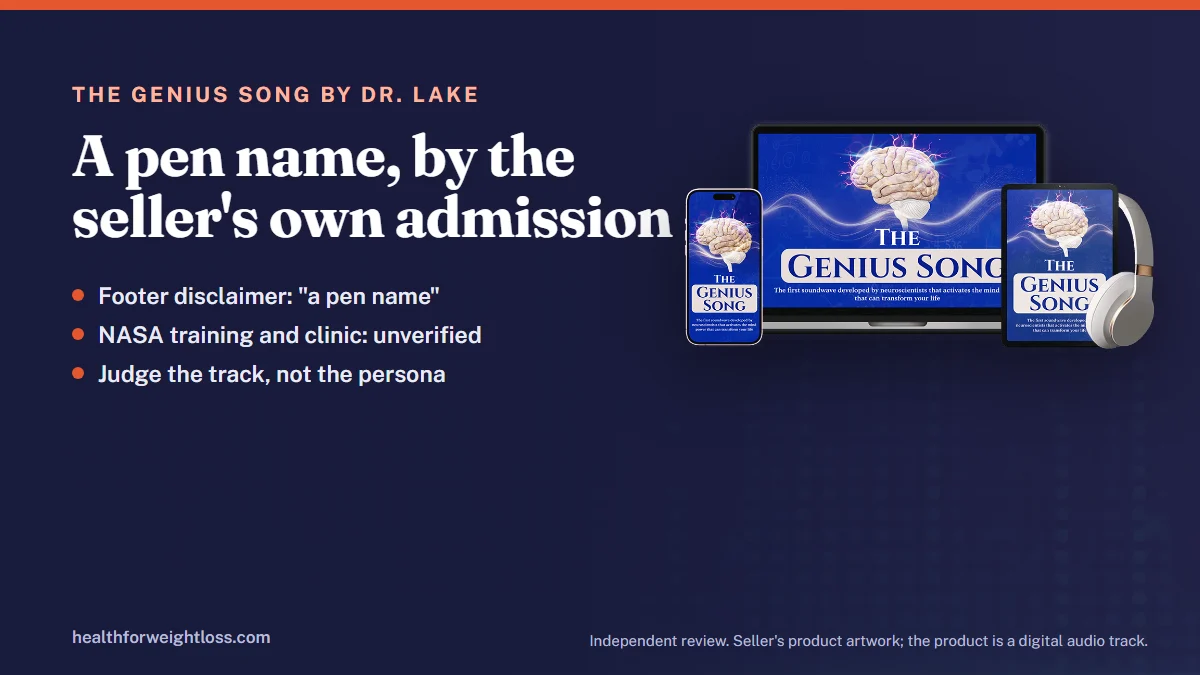
Short answer The seller itself admits “Dr. Robert Lake” is not a real name. The credentials attached to it (NASA training, 34 years as a neuroscientist, a New York City clinic) are claims nobody outside the company can check.
This article is independent: we are not the seller, and we may earn a commission if you buy through our links. For how the other voices in the video should be read, see our guide on Genius Song reviews and testimonials.
The Genius Song by Dr. Lake: what the site itself says
The disclaimer sits at the bottom of the /video/ and /text/ pages, in small print below the order section. The relevant part reads:
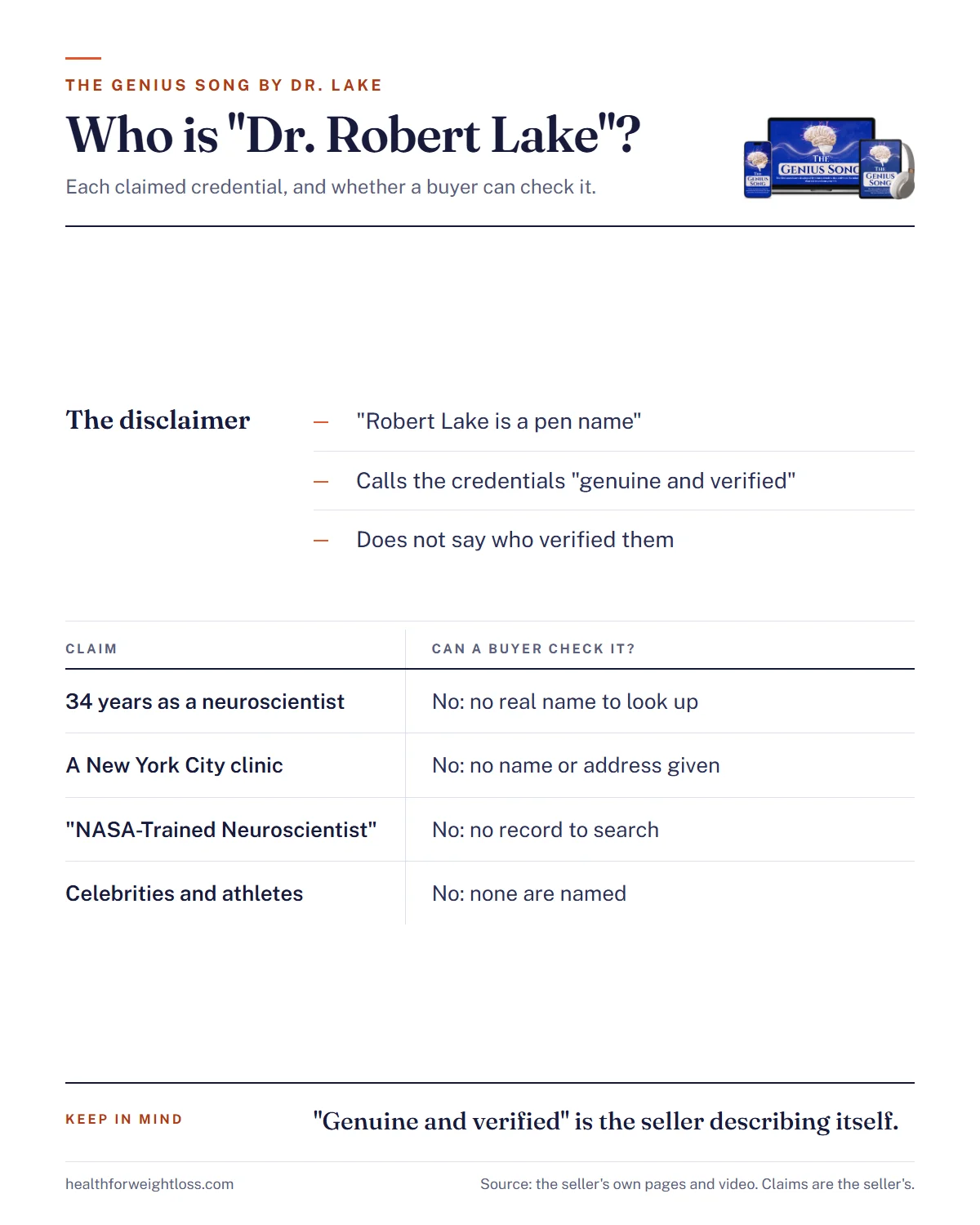
“Dr. Robert Lake is a pen name used with the consent of our leading neuroscientist, who wishes to maintain personal privacy for himself and his family. The qualifications and credentials attributed to this name are genuine and verified.”
Two sentences, two very different kinds of statement. The first is an admission: the name is invented. The second is an assurance: the credentials behind it are real. The disclaimer does not say who verified them, which degree or institution is meant, or how a buyer could confirm any of it. So the first sentence is something you can rely on, and the second is something you have to take on trust.
The same footer goes on to say that featured feedback “originates from real users” but that experiences “may be dramatized via digital avatars”, adding that a number of those shown are personally tied to the people who made the product.
Prefer to judge the presentation yourself?
You can read the footer note yourself under the sales presentation. The track costs $39, paid on a ClickBank checkout.
Visit the Official WebsiteCommission-earning link: you land on the seller’s site via ClickBank, and buying costs you nothing extra.
Who the presenter says he is
Across the 39-minute video and the text version of the sales page, the presenter builds his authority in several ways. Here is each claim and whether a reader can check it.
| What is claimed | Where | Can a buyer verify it? |
|---|---|---|
| His name is “doctor Robert Lake” | Video, 01:43 | No: the site says it is a pen name |
| “Thirty four years as a neuroscientist” | Video, about 24:18 | No: no real name to look up |
| Runs a “New York City clinic” | Video, about 17:59 | No: no clinic name or address given |
| Label “NASA-Trained Neuroscientist” | /text/ page | No: no record can be searched |
| Headline: “Top NASA Scientist” | /text/ page | No |
| Has “consulted corporations and worked with celebrities and athletes” | Video, about 24:14 | No: none are named |
| Speaks “as a doctor and scientist putting my credibility on the line” | Video, about 21:25 | Credibility tied to a name that is not real |
Notice how much of the sales pitch leans on this persona. The guarantee section, the research stories and the explanation of gamma waves are all delivered in the first person by “Dr. Lake”. The presenter also says he and his colleagues “in the lab” call gamma “the super brain wave”. Without a real identity, none of that experience can be weighed.
Why the pen name matters for buyers
A pen name on its own is not unusual. Authors use them all the time. The difference here is that the name is doing a specific job: it carries expert authority. When a sales video says a neuroscientist with NASA training designed a sound wave, the training is the reason you are asked to believe the sound wave works.
The FTC’s Endorsement Guides make a related point. When an ad presents an endorser as an expert, that person’s qualifications must actually give them the expertise they are presented as having. We are not making a legal judgment about this site. Our point is a practical one: with a pen name, the buyer has no way to test whether the expertise is there.
What you can fairly conclude:
- The name tells you nothing. Searching for “Robert Lake neuroscientist” will not lead you to the person in the video, by design.
- The credentials are unverified. “Genuine and verified” is the seller describing itself.
- The product is not proven or disproven by this. A track can exist and play fine whatever the presenter is called.
- Extra caution is reasonable. If the most prominent voice in the pitch cannot be identified, the claims he makes deserve the same skepticism as any unattributed claim.
The research the presenter leans on
Because the presenter is unverified, the studies he describes carry the whole scientific case. In the video he mentions a “stunning report from Princeton”, a paper he dates to the end of December 2025, an MIT finding about a single brain wave supposedly shared by every lucky, wealthy and successful person, a British double-blind study about children, and research from Columbia University showing gamma “could influence another person”.
The text page tells the same story with NASA in place of Princeton. Its “98% of kids” creative genius figure appears to come from a creativity test by George Land, which reached a wide audience through Breakpoint and Beyond (1992). We found no peer-reviewed NASA paper reporting it, and nothing published that ties success to one particular brain rhythm.
Gamma waves themselves are real brain rhythms, and researchers have studied them, mostly in contexts like memory and Alzheimer’s disease. None of that research tests The Genius Song track, and none is about luck or money. The presenter himself concedes the point once. After telling a casino story, he adds: “there is, of course, no evidence to support that the genius song caused that”.
Still curious about the track itself?
One audio file, $39. Under the Terms you can change your mind for up to 90 days.
Check the Current Price on the Official SiteCommission-earning link: you land on the seller’s site via ClickBank, and buying costs you nothing extra.
The other voices in the video
The presenter is not the only figure whose identity is uncertain. Among the success stories are a Tustin nurse, a Dallas man who left his job and a Manhattan woman who was promoted, plus a string of named viewers asking questions in the FAQ section.
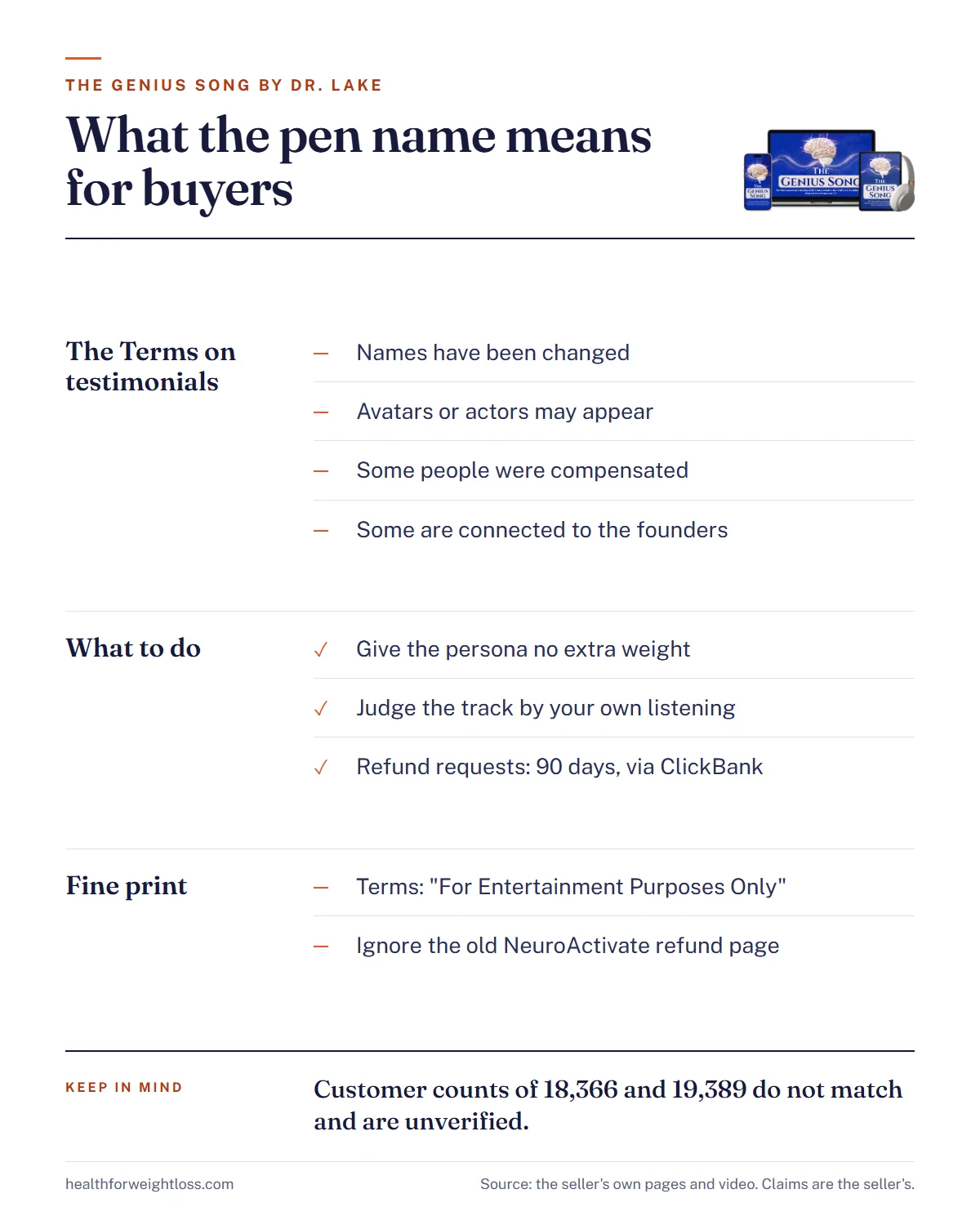
The Terms explain how to read them. Names “have been changed”. The seller says “We use pen names”. “Some aspects of the marketing have been dramatized.” Feedback may be shown through “digital representations, avatars, or actors”. The people giving testimonials may include “early supporters, friends, or family members of the company’s founders”; some were paid; and the results shown “are exceptional results and may not reflect the experience of a typical customer”.
The FTC guides treat that kind of business, family or paid relationship as a material connection that should be disclosed. The Terms do disclose it, which is to their credit. It also means none of these stories counts as an independent review. The same goes for the seller’s customer figures: 18,366 Americans in the video narration, 19,389 in the written page’s headline. They are unverified and they do not match.
Where the presentation is
All of our links go to the seller’s site through ClickBank. The official site’s home page currently features the seller’s related audio, The Genius Wave; The Genius Song presentation, with the Dr. Lake video, is on the same site’s /video/ page. Wave and Song are separate purchases, which is why the item name at checkout deserves a glance. Company details such as the seller’s name and location are covered in our article on the official seller behind The Genius Song.
The fine print that applies whoever the presenter is
- Price: $39 in the Terms of Sale, paid through ClickBank in local currency plus any tax.
- Track: a daily headphone session of about 7 minutes, going by the seller. Our team has not bought it, so the length is unconfirmed.
- Bonuses: counts disagree. Spoken in the video: “three free bonuses”, followed by four items (a century-old book about attracting money, a kids’ focus audio called The Genius Child, a guided visualization by someone who makes Calm app content, a habits printout). Written on /text/: “4”, followed by three items, with the kids’ audio absent.
- Entertainment only: a Terms heading reads “For Entertainment Purposes Only”, and the text below it admits entrainment is “not an exact science”.
- Refunds: 90 days for digital purchases, per the Terms, matched by ClickBank’s checkout wording. Ignore /TOS/refunds/: it is an old 60-day bottle policy for a product called NeuroActivate, with an address in Ohio. Go through ClickBank and hang on to the receipt.
- Safety (our advice): low volume, never at the wheel, and a medical opinion first for anyone with a seizure disorder, epilepsy or impaired hearing.
If you want a wider view of the warning signs and what checks out, our article is The Genius Song a scam weighs them one by one.
Want to decide on the track, not the persona?
Give it a few weeks of listening; if nothing changes, ask ClickBank for your money back inside 90 days.
Go to the Official SiteCommission-earning link: you land on the seller’s site via ClickBank, and buying costs you nothing extra.
Bottom line
The Genius Song by Dr. Lake is presented by someone the seller itself says is using a pen name. His NASA training, his 34 years in neuroscience and his New York clinic are claims attached to that invented name, and no buyer can check them. That does not prove the track is worthless. It does mean the presenter’s authority should play no part in your decision. Should you try it, let your own ears decide, keep the volume low, and claim the refund before day 90 if it disappoints.
Made up your mind?
The Genius Song costs $39 through ClickBank. Whoever the presenter really is, the 90 days you get to request a refund do not change.
Check the Current PriceCommission-earning link: you land on the seller’s site via ClickBank, and buying costs you nothing extra.