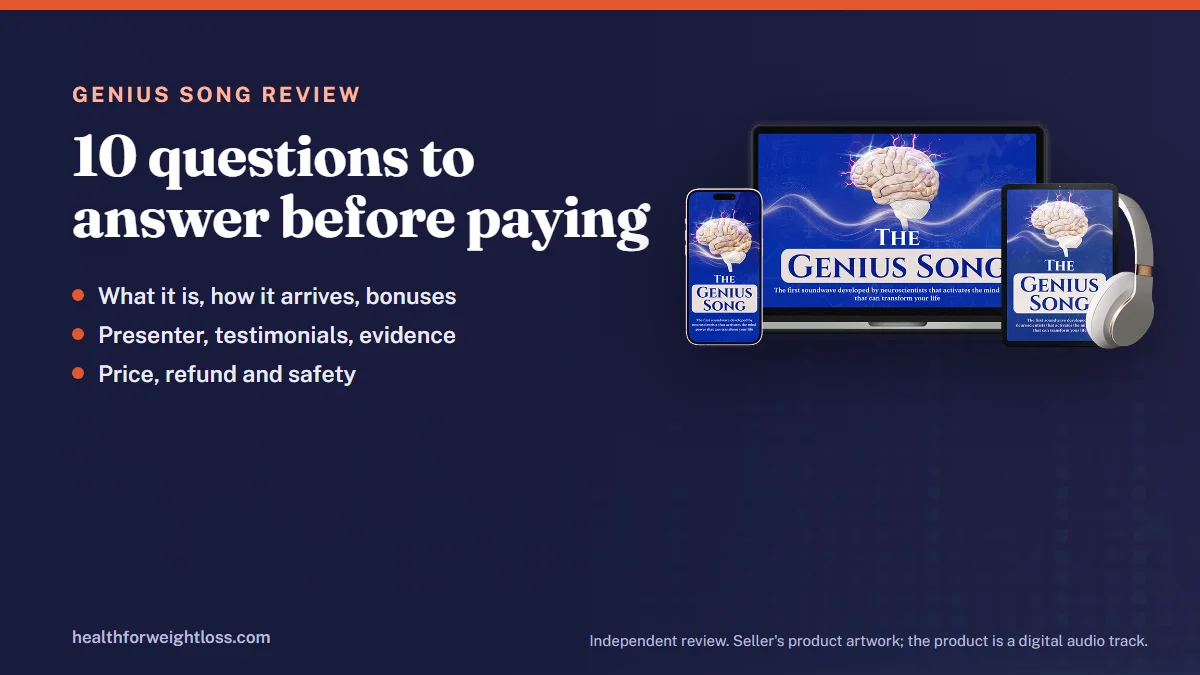
The Genius Song reviews are, for the most part, the stories told inside the seller’s own sales video. Before you let them sway you, it helps to know what the seller itself says about how those stories were made. This guide walks through the people named in the video, the testimonial rules written into the seller’s Terms, the customer numbers attached to the praise, and a short set of questions you can put to any review of this product, including ours.
The fact to keep in mind The seller’s Terms say names in its marketing were changed, some scenes were dramatized, avatars or actors may stand in for customers, some speakers were paid, and the Terms call the results exceptional, not typical.
This article is independent: we are not the seller, and we may earn a commission if you buy through our links.
The Genius Song reviews start inside the sales video
The Genius Song is a short digital audio track, about seven minutes long by the seller’s account, sold for $39. Not having bought it, we cannot describe what it sounds like. What we can describe is the 39-minute video that sells it, which is built around stories of people whose lives changed after listening.
| Who appears | What the video says about them | Can a reader check it? |
|---|---|---|
| Rachel, “a nurse from Tustin, California” | Feels in control, kinder at home, learning French | No; names were changed per the Terms |
| Michael in Dallas | Built an Amazon business and quit his job | No |
| Hannah from Manhattan | A promotion and the end of a family “curse” | No |
| The presenter’s colleagues | A finished book, a son’s C turning to an A, an engagement, a promotion, 16 lb lost | No |
| FAQ askers | Questions from Sofia, Olivia, Ray, Amy, Damon, Brian, Liz, Sean and Russell | No |
The stories are warm and specific, and that is what makes them persuasive. Specific details, such as a town or a job title, make a story feel verified even when nothing about it can be traced.
Prefer to hear the stories in context?
The seller’s site hosts the full presentation. Watch it knowing what the Terms say about how testimonials are produced.
Visit the Official WebsiteThis is an affiliate link routed by ClickBank; orders placed after clicking can pay us a commission.
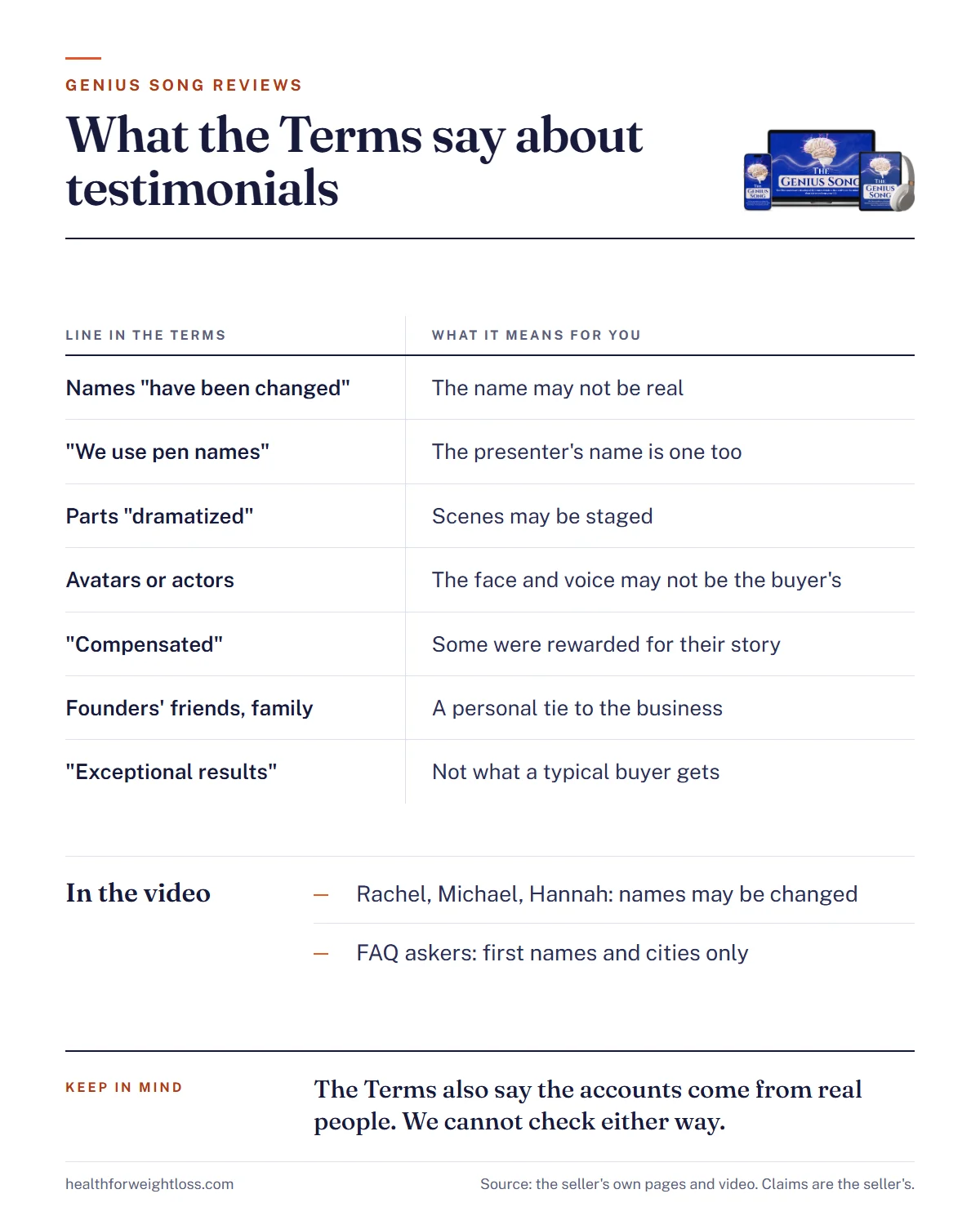
What the seller’s Terms disclose about every story
The most useful document for judging these testimonials is not a review site. It is the seller’s own Terms of Sale, last updated in January 2026. Read side by side with the video, it changes how each story lands.
| Line in the Terms | What it means for you |
|---|---|
| Names “have been changed” | The person’s name may not be their real one |
| “We use pen names” | The presenter’s name is one too, per the site’s disclaimer |
| Parts “have been dramatized” | Scenes may be staged for effect |
| “Digital representations, avatars, or actors” | The face and voice may not be the customer’s |
| People were “compensated” | Some were rewarded for sharing their story |
| Speakers may be “early supporters” or relatives of the founders | Some have a personal tie to the business |
| “Exceptional results” | Not what a typical buyer should expect |
To be fair to the seller, the same section also states that the accounts “come from real people” and that the substance of the experiences is genuine. We have no way to confirm or disprove that. What we can say is that, by the seller’s own description, you cannot tell which parts of a given testimonial are real, acted or rewarded.
The same caution applies to the man presenting the video. He introduces himself as Dr. Robert Lake, a neuroscientist with a New York City clinic. A disclaimer in the footer of the sales pages says the name Robert Lake is a pen name, adopted with the agreement of the company’s leading neuroscientist. His stated background is therefore something we cannot check.
The numbers attached to the praise
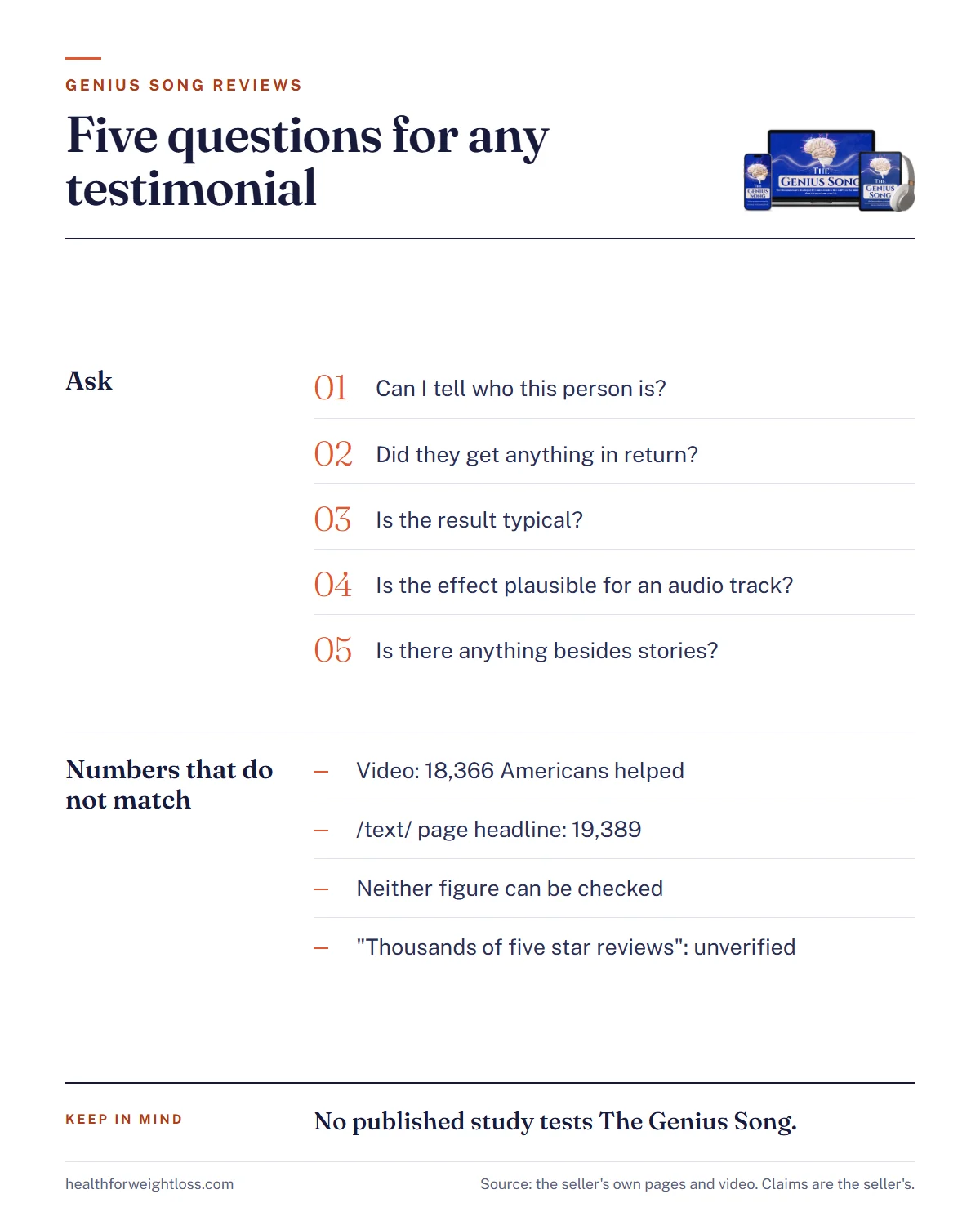
Numbers make praise feel large. The video says the track has helped 18,366 everyday Americans, and the body of the text version repeats that figure, but the headline of the same text page says 19,389. The presenter also speaks of “thousands of five star reviews” and “hundreds of emails” from listeners.
None of these can be checked. The seller says it offers the track only through its own website, so there is no store listing where a verified purchase sits next to a rating. We do not publish star ratings or counts for this product for the same reason, and you should be wary of any page that does without saying where the numbers came from.
Five questions to put to any testimonial
The FTC’s guide to evaluating online reviews suggests thinking about the source, comparing several sources, and watching for incentives such as payment or free products, which are not always disclosed. Applied to this product, five questions do most of the work.
- Can I tell who this person is? If the name is changed and the face may be an avatar, the answer is no.
- Did they get anything in return? The Terms say some were compensated or are close to the founders.
- Is the result typical? The Terms answer this one directly: the results are exceptional.
- Is the claimed effect plausible for a short audio track? A promotion, a casino win or weight loss would need far more than a listening habit to explain.
- Is there anything besides stories? A published trial of the track would count. We found none.
If a testimonial fails the first three, it can still be entertaining, but it should carry no weight in your decision.
Ran the five questions and still want to try it?
$39 for the track, paid through ClickBank; the Terms accept refund requests for 90 days.
See the Current Price on the Seller’s SiteThis is an affiliate link routed by ClickBank; orders placed after clicking can pay us a commission.
What the stories leave out
Testimonials describe outcomes. They rarely describe evidence, and here the evidence is thin. No published study tests The Genius Song. Binaural beat research, the closest field, is split. A 2019 meta-analysis put the pooled effect at medium for some outcomes; a 2023 PLOS ONE review counted 5 of 14 studies supporting brainwave entrainment and 8 contradicting it. Nothing in that research covers luck, money or promotions.
The video itself contains one helpful admission. When a viewer asks about luck at the casino, the presenter grants that some customers reported lucky streaks, then says there is “no evidence to support” a link to the track. The same logic fits every other story in the video.
The seller’s Terms add more context. Under the heading “For Entertainment Purposes Only”, the Terms present the products as entertainment, and that brain entrainment should not be treated as an exact science. The sales pages also carry the familiar FDA-style line: the statements have not been evaluated by the FDA, and the product is not meant to diagnose or cure disease.
The fine print an honest write-up should cover
Stories aside, a few facts matter more to a buyer than any testimonial.
Refunds. Digital buyers get 90 days under the Terms, and ClickBank’s checkout states 90 days as well. The site also hosts a separate refund page that does not belong to this product: it sets out a 60-day return policy covering unopened bottles of “NeuroActivate”, with a return address in Ohio. Use ClickBank’s refund route instead, and save the receipt email it sends.
Bonuses. In the video, “three free bonuses” are announced and four are described: “The Genius Child” audio for children, a century-old book on financial success, a guided visualization made by a Calm app creator, and a habits poster to print (five habits). On the text page the promise is “4 free bonuses”, yet only three are listed, without The Genius Child.
Where the link lands. Clicking our link sends you through ClickBank to geniussongoriginal.com. That home page is currently given over to another audio from the same seller, The Genius Wave, while the Genius Song pitch sits one page deeper, at /video/ on the same site. They are different products by the seller’s own description, so read the name on the checkout before you pay.
Listening safely (our advice). Choose a gentle volume. Driving and machine work do not mix with an eyes-closed track. And a seizure history, epilepsy or a hearing condition is a reason to speak with a doctor before day one.
Ready to see the offer page?
Confirm the checkout says The Genius Song, keep the ClickBank receipt, and note the 90-day date.
Go to the Official WebsiteThis is an affiliate link routed by ClickBank; orders placed after clicking can pay us a commission.
Our reading of the testimonials
Treat the stories in the video as advertising, which by the seller’s own Terms is what they are. They may contain real experiences, but they come with changed names, possible actors, rewards and personal ties, and they are selected as exceptional. That leaves the purchase to be judged on what can be checked: a $39 digital track, an unproven set of claims and a 90-day refund window. For the claims and the research in more depth, read our full breakdown of the sales claims, and for a short scored summary see our one-page scorecard.
If a refund is refused, the FTC’s page on card charges explains how to raise a dispute with the bank that issued your card.
Want to judge it on your own terms?
Try it as a short daily habit rather than a promise, and use the 90-day refund if it does nothing for you.
Visit the Official WebsiteThis is an affiliate link routed by ClickBank; orders placed after clicking can pay us a commission.