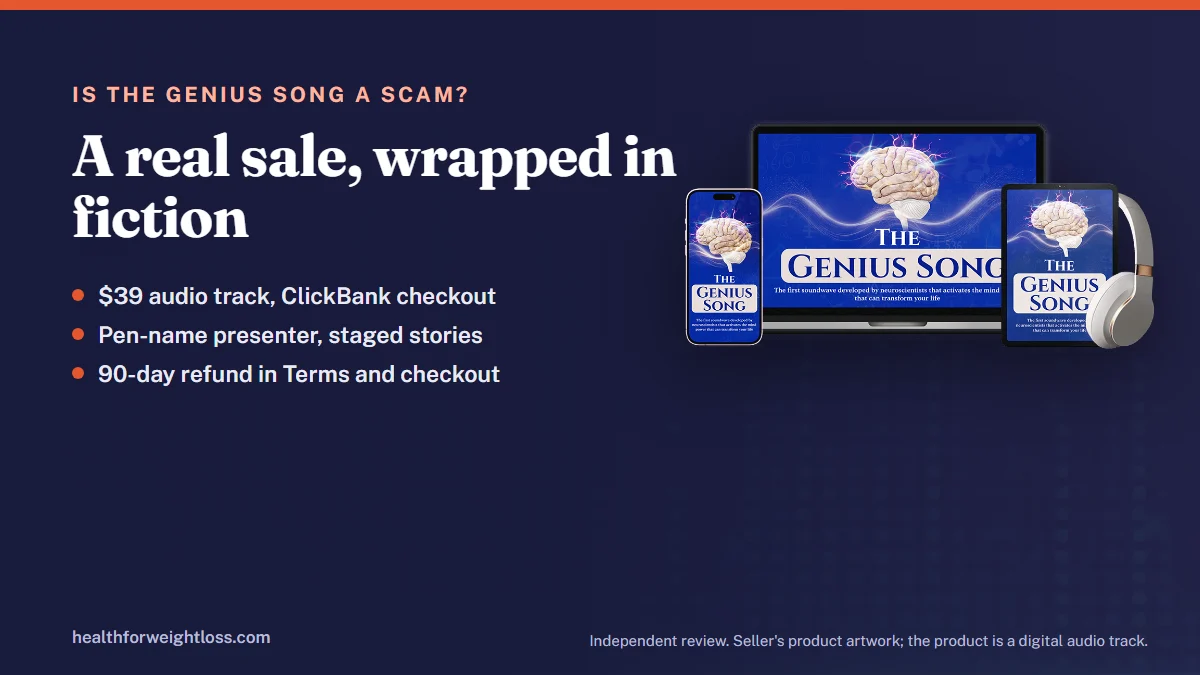
Is The Genius Song a scam? After a long video about a “7-second brain trick”, a NASA-trained doctor and a sound that brings luck, the doubt is fair. We went through the captions of the sales video, the text-only page, the Terms, the returns page and the ClickBank order form, and sorted every finding into one of two piles: what holds up and what does not. The verdict comes first, the evidence after it.
Our verdict The Genius Song is a real digital product: an audio track the seller says runs about 7 minutes, priced at $39 on a ClickBank order form that allows refund requests for 90 days. It is also sold with aggressive, partly fictional marketing, and the seller’s own fine print admits a good part of that.
This article is independent: we are not the seller, and we may earn a commission if you buy through our links. We have not purchased the track. Its length and content are described here from the seller’s own pages, and we quote no customer reviews, because none of them can be matched to a checked order.
See the offer and its fine print yourself
A $39 digital audio track sold through ClickBank. The Terms and the checkout both state a 90-day refund window.
Visit the Official WebsiteSponsored ClickBank link to the seller. If an order follows, a commission may reach us; your price stays put.
Is The Genius Song a scam? The verdict, explained
A scam in the strict sense takes your money and gives nothing back, or makes a refund impossible. Overselling is a different problem: you receive what the checkout described, but it came wrapped in promises it cannot keep. Going by everything we could check, The Genius Song belongs in the second group.
The order runs through ClickBank, a large online retailer that takes the payment, sends the receipt and handles refunds. Its checkout page names the item “The Genius Song (90-Day 100% Money Back Guarantee)” and marks it as a digital product that is neither shipped nor billed again. The Terms of Sale state the price in one plain line: “You are paying $39 today for The Genius Song.” Nothing in that chain looks like a seller planning to disappear.
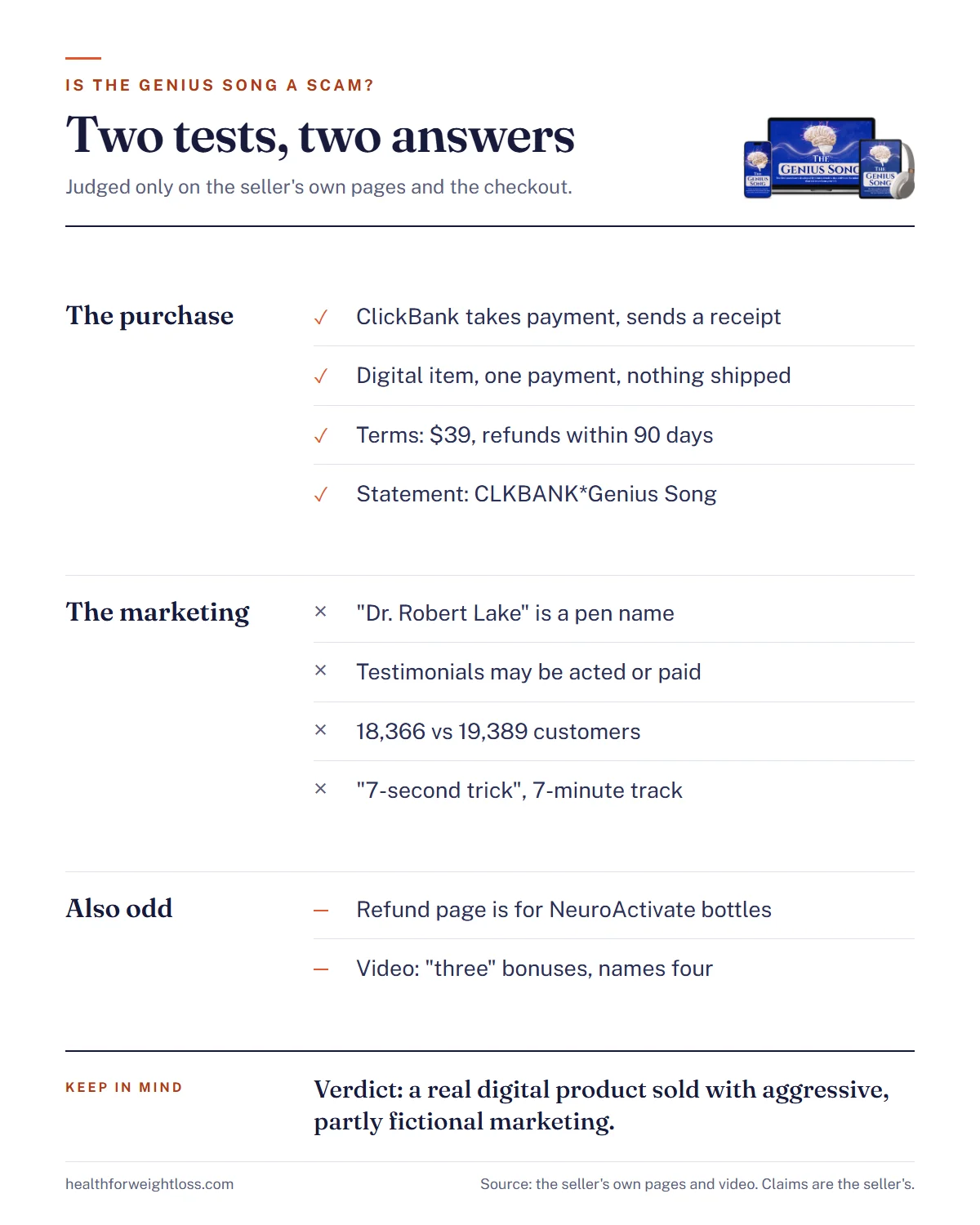
The marketing is where the honesty runs out. By the site’s own admission, the presenter’s name is invented. The testimonials may be performed. Two different customer counts appear on two versions of the same pitch. The hook sells a “7-second” trick and delivers a track of about 7 minutes. That is why our label is a real digital product sold with aggressive, partly fictional marketing. For the full product review, see our main review of The Genius Song.
Test 1: does the purchase hold up?
These are the parts a buyer can actually rely on, because they come from the checkout and the legal pages rather than the video.
| What we checked | What we found |
|---|---|
| Who takes the payment | ClickBank, at geniusbr.pay.clickbank.net |
| Name of the item | “The Genius Song (90-Day 100% Money Back Guarantee)” |
| Type of product | Digital, not shippable, a single payment |
| Price in the Terms | $39 |
| Refund window | 90 days, stated by both the Terms and ClickBank |
| Line on your card statement | CLKBANK*Genius Song |
| Company named in the Terms | Happy Consumer LLC, based in Puerto Rico |
Buyers outside the US see a converted figure with their local tax on top, which means the final number may differ from $39. When the page was viewed from India it showed a rupee figure plus tax, and no extra product box was attached. Any offers shown after payment stayed out of view, since we stopped before paying.
Delivery is described in two ways. In the video, the presenter promises an email with the track within minutes. The text version of the sales page instead promises login details for a “Private Audio Portal” you can stream from any device. The checkout simply says access opens once payment is approved. We cannot say which of these buyers get, but a fuzzy delivery description is carelessness, not proof of fraud.
Test 2: does the marketing hold up?
Here the answer is no. Every row in this table comes from the seller’s own material.
| What the pitch says | What the fine print or the facts show |
|---|---|
| “Dr. Robert Lake”, NASA-trained | The site’s disclaimer calls the name a pen name |
| Customers telling real stories | Terms: names changed, actors or avatars, some paid |
| 18,366 Americans helped | The /text/ headline says 19,389; neither is checkable |
| A “7-second brain trick” | What you buy is a track of about 7 minutes |
| Findings from MIT, Princeton, NASA | No study of this track; all unverified |
| Price “not guaranteed beyond today” | A sales script; $39 was the price on every page |
| A refund page for the product | It was written for NeuroActivate bottles |
| “Three free bonuses” | The video names four; /text/ says 4, lists three |
A few rows need more than a line.
The presenter. On camera he calls himself doctor Robert Lake, mentions a New York City clinic and claims 34 years as a neuroscientist; the text page goes further and labels him “NASA-Trained”. Yet the footer of those same pages says Robert Lake “is a pen name used with the consent of our leading neuroscientist”. It then calls the credentials “genuine and verified” without naming anyone. A real expert may be behind the voice. Nobody outside the company can confirm it, so his titles should carry no weight in your decision.
The testimonials. The video tells of Rachel, a nurse from Tustin, California, plus Michael in Dallas and Hannah from Manhattan, and reads out questions from listeners in Tampa, Boston, Atlanta and elsewhere. The Terms explain what sits behind such stories: changed names, pen names, dramatized marketing, feedback acted out by “digital representations, avatars, or actors”, some people compensated, and some connected to the founders as early supporters, friends or relatives. The results are described as exceptional, not typical. Federal Trade Commission guidance on endorsements treats ties like these as something a reader is entitled to know.
The bonuses. The video promises “three free bonuses” and then describes four: “The Genius Child” (an audio said to help children focus); a century-old classic on attracting financial success; a visualization session credited to a well-rated Calm app author; and a 5-habit printout. The /text/ page advertises “4 free bonuses” worth “$197.00” but lists only three: the book, a “Genius Visualization” and a “Create Your Ideal Future” infographic. It is a small mismatch, and a sign nobody checked the pages against each other.
Partly fictional, in the seller’s own words
The unusual thing about this offer is how much the seller concedes once you leave the video. The Terms carry a section headed “For Entertainment Purposes Only”. It describes brain entrainment as “not an exact science”, asks buyers not to treat it like one, and says the products are supplied for entertainment. Another clause rules out reading any of it as medical, financial or legal advice.
The same document also claims that every statement about brainwave entrainment, focus and mental energy is backed by established scientific research. Those two passages pull in opposite directions. We read the entertainment line as the more telling of the two, because it describes the most the seller is willing to stand behind.
Put the admissions together and the picture is consistent: an invented name for the expert, staged or paid testimonials, a dramatized story, and a product framed as entertainment. None of that means your money vanishes. It means the story told in the video is not the factual record.
Read the Terms before you decide
They set the $39 price, the 90-day refund for digital products, the testimonial disclosures and the entertainment-only framing.
Check the Current Price on the Official SiteSponsored ClickBank link to the seller. If an order follows, a commission may reach us; your price stays put.
What the science behind the pitch really supports
The video rests on one idea: adults have a “dormant” gamma brain wave, and a sound can switch it back on. Gamma activity does exist: it is the quick end of the brain’s rhythms, somewhere between 30 and 100 Hz, and scientists tie it to attention and to how memories are handled. The Tsai lab at MIT has tested flickering light and 40 Hz tones, chiefly in mice engineered to mimic Alzheimer’s, with only early, small human pilots so far. None of that work concerns intelligence, luck or income.
Long-term meditators have been recorded producing strong gamma activity (Lutz and colleagues, 2004), which may be the source of the video’s story about monks. Binaural beat research is mixed. A 2019 meta-analysis pooled the trials and saw a medium-sized effect on certain measures, while a 2023 systematic review counted more entrainment studies that failed to find the expected brainwave shift than studies that found it. We found no published study of The Genius Song itself, and none showing that lucky or wealthy people share a single brain wave.
The presenter concedes the point once. Asked about winning at the casino, he answers that “there is, of course, no evidence to support that the genius song caused that”. The same caveat fits the promises about promotions, weight, migraines and smoking. The FDA-style line on the site makes the same point from the other side: the product is not intended for any disease.
Green flags and red flags side by side
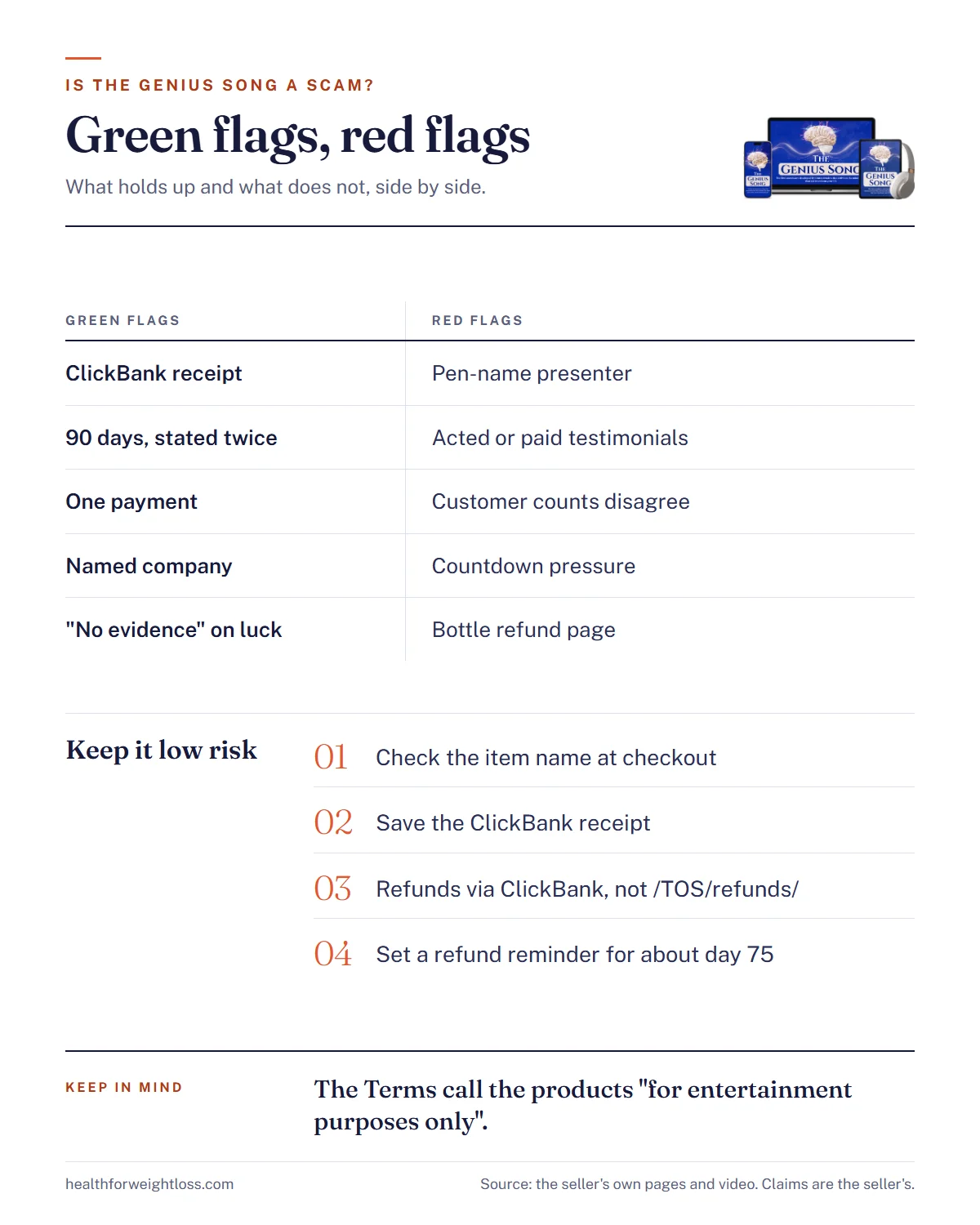
| Green flags | Red flags |
|---|---|
| ClickBank checkout and receipt | Presenter known only by a pen name |
| 90 days for refunds, stated twice | Testimonials may be acted or paid |
| One payment, no subscription | Customer counts that contradict each other |
| A named company in the Terms | Countdown pressure and a “waiting list” |
| Honest “no evidence” line on luck | Refund page copied from a bottle product |
If you want a structured way to work through these before paying, our ten-question buyer checklist turns them into ten questions.
If you still want to try it
Use the official site, not a copy. The official site’s home page currently features the seller’s related audio, The Genius Wave; The Genius Song presentation is on the same site’s /video/ page. The two are separate items with separate checkouts, a 12-minute theta session and a 7-minute gamma track by the seller’s description, so confirm the item name on the ClickBank page before you pay.
Then protect the refund. The site has a page at /TOS/refunds/ that describes a 60-day return of unopened NeuroActivate bottles to an address in Ohio. Nothing in it suits an emailed audio file, so set it aside. What governs this order is the 90-day period promised twice, once in the Terms and once by ClickBank. Keep the ClickBank receipt with your order number, and request any refund through ClickBank at clkbank.com or 1-800-390-6035. Our guide to avoiding Genius Song scam traps covers look-alike sites, follow-up emails and card disputes in more detail.
A word of caution from us rather than the seller: play it quietly enough to feel at ease, keep it well away from the car and from machinery, and talk to a doctor before the first session if you live with epilepsy, have ever had a seizure or have damaged hearing.
Going ahead? Check the item name at checkout
The ClickBank page should read “The Genius Song (90-Day 100% Money Back Guarantee)”. Save the receipt it sends.
Visit the Official WebsiteSponsored ClickBank link to the seller. If an order follows, a commission may reach us; your price stays put.
Who should skip it
Skip it if you hope to fix a health problem. The video’s stories about migraines fading, joint pain easing, quitting smoking and a colleague losing 16 lb are anecdotes from the seller, and the product is not a treatment. Skip it if you expect luck or money, since nothing supports that. Skip it as well if waiting on a $39 refund would stretch your budget. Anyone worried about memory or focus will get more from a doctor’s visit than from a download.
The final answer
Is The Genius Song a scam? Not in the sense of taking your money for nothing: the checkout, the receipt, the single payment and the 90-day refund window all look like an ordinary digital sale. In the sense of honest marketing, it fails badly, and the seller’s own disclaimers prove it, from the pen name to the acted testimonials to the entertainment-only clause. Treat it as a $39 listening experiment with a refund window, not as a discovery.
Still curious enough to test it?
One payment of $39, delivered digitally. Listen at a low volume, judge it for yourself, and keep the receipt until the 90 days pass.
Check the Current Price on the Official SiteSponsored ClickBank link to the seller. If an order follows, a commission may reach us; your price stays put.