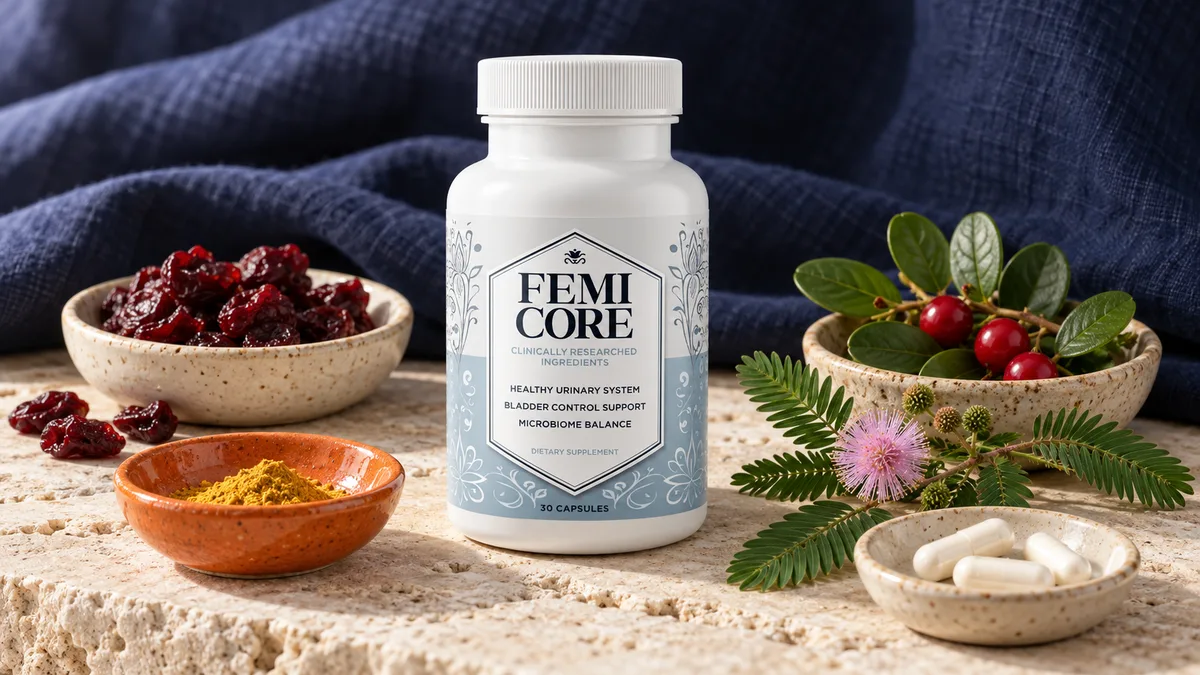
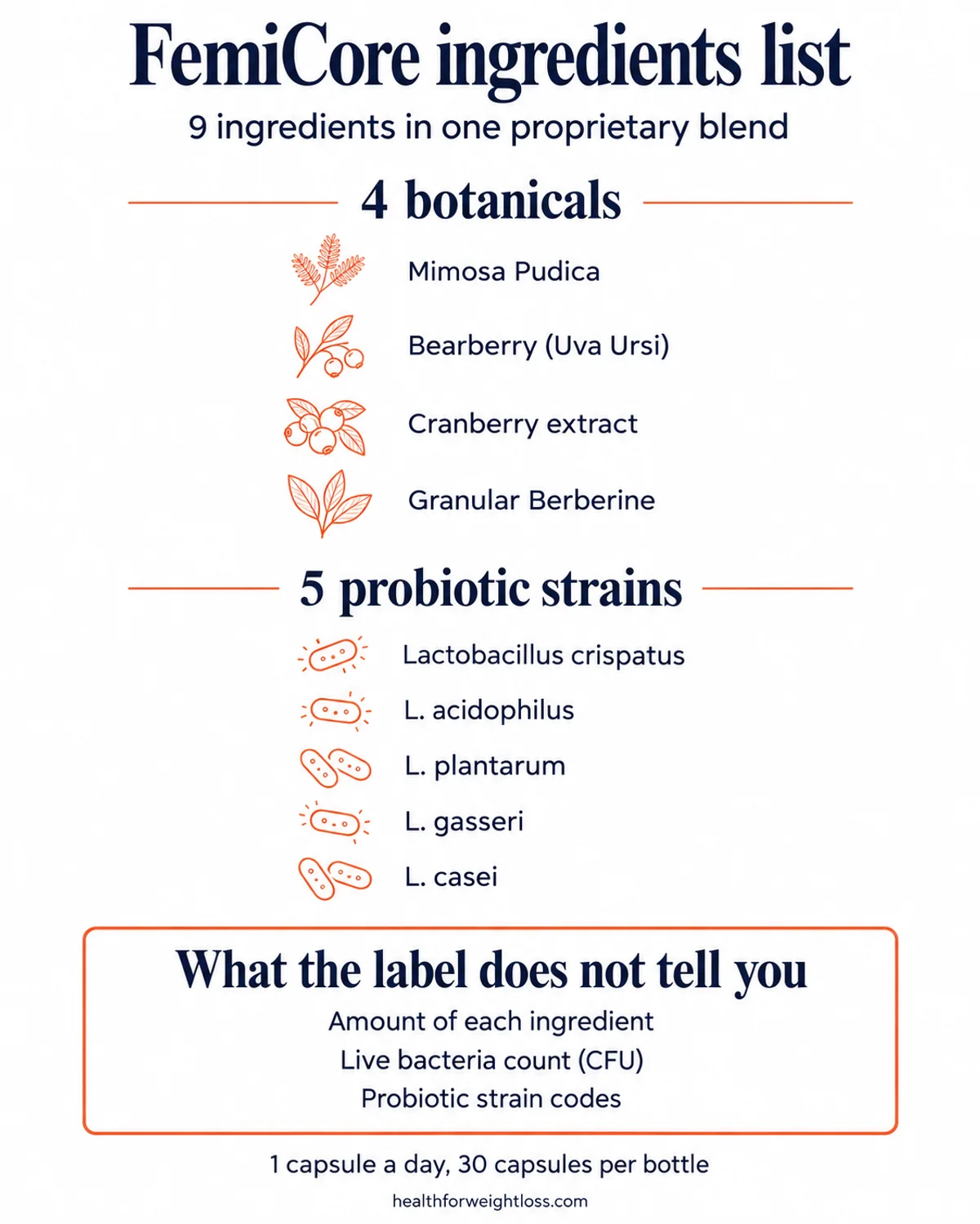
The FemiCore ingredients list is short: nine items, four from plants and five live bacteria. What it leaves out is the amount of any of them. Below we take each ingredient in turn: what it is, why a bladder formula would include it, and what human research supports. We also spell out what the proprietary blend keeps hidden, so you know exactly what you are paying for.
For our overall verdict, including price and the refund terms, start with our FemiCore reviews. This page sticks to the label and the science behind each line on it.
Read the ingredient panel at the source
The official page shows the full formula, the current packages and the 60-day money-back guarantee.
See FemiCore Ingredients on the Official SiteOpens the official FemiCore website. Affiliate link: we may earn a commission at no extra cost to you.
The FemiCore ingredients list at a glance
Every capsule holds one blend of nine ingredients. Here is the whole list, with the job each ingredient is meant to do in a bladder formula and how much human evidence backs that job.
| # | Ingredient | Type | Role in the formula | Human evidence for the urinary tract | Amount disclosed |
|---|---|---|---|---|---|
| 1 | Mimosa Pudica | Botanical | Traditional urinary and antispasmodic herb | Traditional only | No |
| 2 | Bearberry (Uva Ursi) | Botanical | Arbutin, a urinary antiseptic | Traditional, short-term use | No |
| 3 | Cranberry extract | Botanical | Makes it harder for E. coli to stick to the bladder wall | Good, for recurrent UTI | No |
| 4 | Granular Berberine | Plant alkaloid | Antimicrobial; lowers blood sugar | Indirect (metabolic trials) | No |
| 5 | L. crispatus | Probiotic | Main protective species in a healthy female urogenital tract | Promising (vaginal use) | No |
| 6 | L. acidophilus | Probiotic | General Lactobacillus support | General probiotic only | No |
| 7 | L. plantarum | Probiotic | Hardy species common in fermented foods | General probiotic only | No |
| 8 | L. gasseri | Probiotic | Native to the gut and vagina; metabolic research | Metabolic only | No |
| 9 | L. casei | Probiotic | Common in fermented dairy | General probiotic only | No |
Two things stand out. Only two of the nine, cranberry and L. crispatus, have human research that touches the urinary tract directly. And the last column reads “No” from top to bottom.
What the proprietary blend keeps hidden
US labeling rules let a supplement group its ingredients into a named blend and print only the blend’s total weight. Companies say this stops competitors copying the formula. For you as a buyer, it leaves three gaps:
- Dose. Berberine trials used 900 to 1,500 mg a day. Cranberry trials used defined amounts of juice or extract. With no number on the label, you cannot line FemiCore up against either.
- Live bacteria count. Probiotics are measured in colony-forming units (CFU). No CFU figure is given for the five species, so you cannot tell whether they are present in useful numbers.
- Strain identity. Probiotic results are strain specific. The belly-fat study on L. gasseri used a strain called SBT2055. The ingredient list we have seen names species only, so there is no link to any tested strain.
There is also a simple space limit. One small capsule has to carry all nine ingredients. A single ingredient cannot be present at the gram-level doses some studies used. Treat the list as a description of what is in the capsule, not of how much.
Prefer to judge the formula yourself?
One capsule a day, 30 per bottle. Every package carries the same 60-day refund.
Check FemiCore Official PriceOpens the official FemiCore website. Affiliate link: we may earn a commission at no extra cost to you.
The four botanical ingredients
Mimosa Pudica
What it is. A creeping tropical plant in the pea family, nicknamed the sensitive plant because its leaves fold shut when touched.
Why it is here. Ayurvedic and folk medicine have used it for urinary complaints and as a muscle relaxant. The idea in a bladder formula is a calmer, less twitchy bladder muscle.
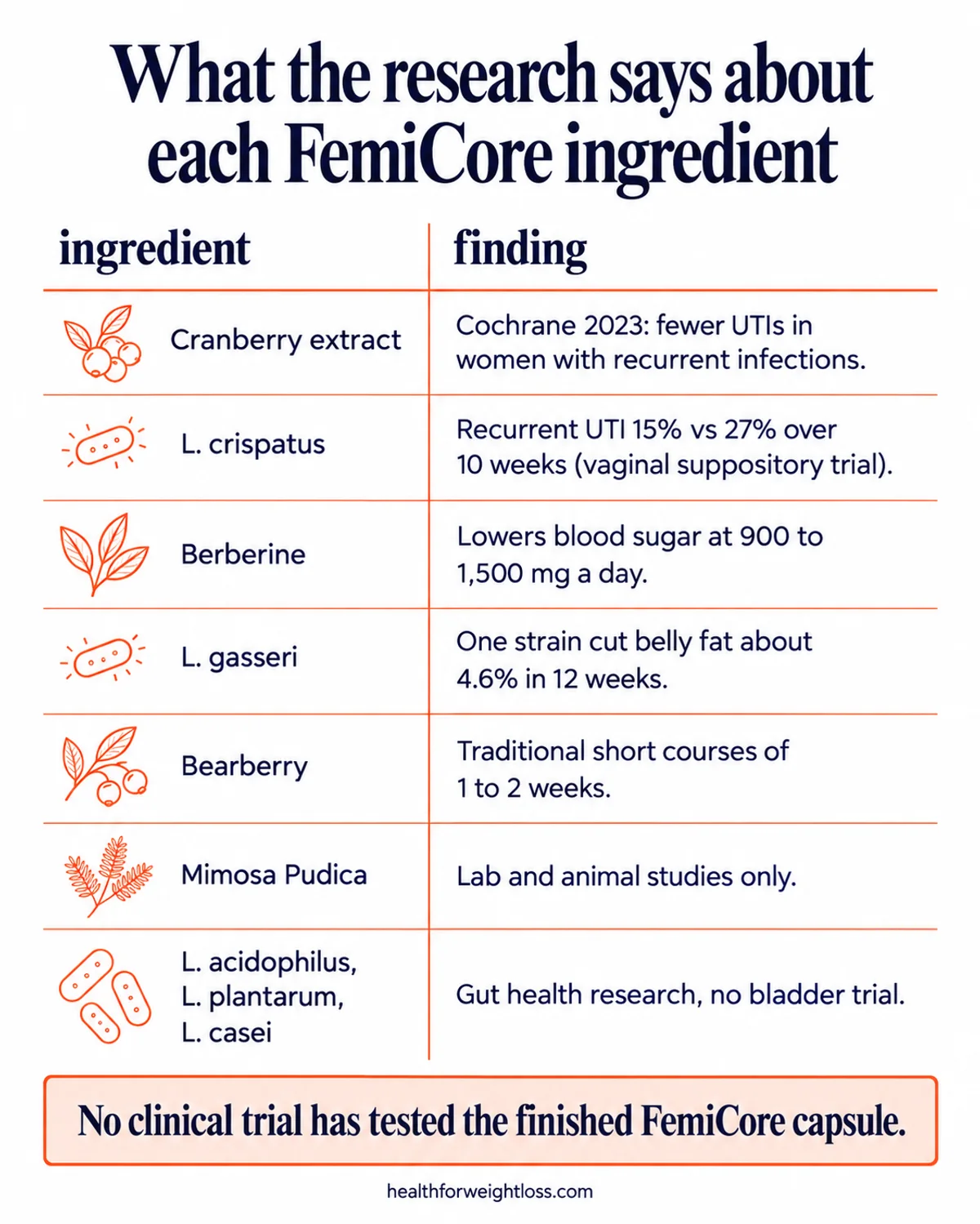
What research says. Support comes from laboratory and animal work. We found no human trial with bladder outcomes.
Not disclosed. Which part of the plant is used, and how much.
Bearberry (Uva Ursi)
What it is. A low evergreen shrub whose leaves contain arbutin. The body turns arbutin into hydroquinone, which has antibacterial activity once it reaches the urine.
Why it is here. It is one of the oldest herbal urinary antiseptics in European practice.
What research says. A 2008 review of natural approaches to lower urinary tract infection describes bearberry as a short-term remedy. German herbal monographs suggest courses of one to two weeks, and no more than about five courses a year.
Not disclosed. The dose. That matters more here than for any other ingredient, because FemiCore is meant to be taken every day for months, which is not how bearberry is traditionally used.
Cranberry extract
What it is. A concentrate of the North American cranberry, rich in compounds called proanthocyanidins.
Why it is here. Those compounds make it harder for E. coli, the usual cause of bladder infections, to grip the bladder lining.
What research says. The 2023 Cochrane review is the strongest single piece of evidence behind any FemiCore ingredient. It found that cranberry products reduce the risk of symptomatic urinary tract infection in women with recurrent infections. Note the scope: fewer infections, not fewer leaks or less urgency.
Not disclosed. The extract amount and its proanthocyanidin content, which is the figure that actually predicts an effect.
Granular Berberine
What it is. A bitter yellow alkaloid found in plants such as barberry and goldenseal.
Why it is here. Berberine has antimicrobial activity, and it lowers blood sugar. High blood sugar makes the kidneys produce more urine and can raise infection risk, so the link to the bladder is real but indirect.
What research says. A 2015 meta-analysis found berberine lowered glucose, blood fats and blood pressure at roughly 900 to 1,500 mg a day. There are no trials using bladder outcomes.
Not disclosed. The dose. Given the capsule size, FemiCore almost certainly contains far less than trial amounts.
The five Lactobacillus strains
The probiotic half of the formula rests on two findings. A 2012 study showed that the bladder is not sterile; it has its own small community of bacteria. Then in 2014, Pearce and colleagues found that women with urgency incontinence were less likely to have a Lactobacillus-dominated urinary microbiome than women without symptoms. That is an association, not proof that adding Lactobacillus fixes anything, but it explains why a bladder product would include five of them.
Lactobacillus crispatus
This is the species most closely tied to a healthy female urogenital tract, and the one with the best urinary data. In a 2011 trial, women with recurrent urinary tract infections who used an L. crispatus vaginal suppository had fewer repeat infections over 10 weeks: 15 percent versus 27 percent on placebo. The catch is the route. Those women did not swallow a capsule. Whether an oral dose reaches the urogenital tract in useful numbers is still an open question.
Lactobacillus gasseri
L. gasseri lives naturally in the human gut and vagina. Its best-known human research is metabolic rather than urinary. In a 2010 Japanese trial, adults who drank fermented milk containing the SBT2055 strain lost about 4.6 percent of their abdominal visceral fat over 12 weeks. FemiCore does not name a strain, so that result does not automatically apply.
L. acidophilus, L. plantarum and L. casei
| Species | Where you usually meet it | Evidence relevant to the bladder |
|---|---|---|
| L. acidophilus | Yogurt cultures, many general probiotics | No bladder-specific trial in our evidence base |
| L. plantarum | Sauerkraut, kimchi, sourdough | No bladder-specific trial in our evidence base |
| L. casei | Cheese and fermented milk drinks | No bladder-specific trial in our evidence base |
These three are well-established gut probiotics. Their role in FemiCore looks like general support for a Lactobacillus-friendly environment rather than a targeted bladder effect.
Botanicals plus five probiotic strains in one capsule
See current FemiCore packages, with free US shipping on 3 and 6 bottles.
See Today’s FemiCore PackagesOpens the official FemiCore website. Affiliate link: we may earn a commission at no extra cost to you.
Why pair plant extracts with live bacteria?
The formula seems to work on two timescales. The botanicals aim at the short term: bearberry’s antiseptic action and cranberry’s anti-stick effect act on bacteria already in the urinary tract. The probiotics aim at the longer term, trying to shift the bacterial community toward the Lactobacillus pattern seen in women without symptoms.
One fair question has no published answer. Berberine and bearberry both have antibacterial activity, and they share a capsule with five live bacteria. We know of no data on whether they affect each other in the bottle or in the gut.
Ingredient safety, line by line
| Ingredient | Main caution |
|---|---|
| Mimosa Pudica | Little human safety data; a reason for extra care in pregnancy |
| Bearberry | Traditionally short-term only; avoid in pregnancy, breastfeeding and kidney disease |
| Cranberry extract | Case reports of interaction with warfarin; ask your clinician |
| Granular Berberine | Stomach upset or constipation; lowers blood sugar on top of diabetes drugs; blocks the liver enzymes CYP3A4 and CYP2D6; avoid in pregnancy and breastfeeding |
| Five Lactobacillus species | Mild gas or bloating in the first week; caution if your immune system is weakened |
For what these cautions look like in practice, and what to do about them, see our guide to FemiCore side effects.
What the ingredients mean for weight and metabolism
Two ingredients on the list have research in people trying to manage weight. Berberine improved blood sugar and blood fats in trials, and L. gasseri SBT2055 trimmed belly fat a little. Neither result can be expected from FemiCore, because the doses and strains are unknown. Do not buy it as a weight-loss product.
The link between weight and the bladder runs the other way, and it is well proven. In the PRIDE trial, overweight women who lost about 8 percent of their body weight cut their weekly leak episodes by 47 percent, against 28 percent in the comparison group. If your metabolism feels slower than it used to, our explainer on whether metabolism slows with age sets out what really changes after 40.
Before you start
This article is general information, not medical advice. Check with a doctor or pharmacist before taking FemiCore if you are pregnant or breastfeeding, take any regular medication (especially for diabetes, blood pressure, cholesterol or blood thinning), or have kidney disease. Blood in your urine, burning or pain when you pass urine, fever, pain in your side or back, or leaks that start suddenly all need a medical check rather than a supplement.
Bottom line
The FemiCore ingredients list combines one well-supported urinary ingredient (cranberry), one promising probiotic (L. crispatus), one traditional antiseptic meant for short courses (bearberry), a metabolic compound with indirect relevance (berberine), a traditional herb with no human bladder data (Mimosa Pudica), and four general probiotics. The logic is coherent. The missing doses mean you are trusting the manufacturer on quantity. If you decide to try it, buy through the official website so the 60-day refund applies, and see our FemiCore product page for a one-screen summary.
Try the full nine-ingredient formula, risk-managed
60-day money-back guarantee on every package. Return all bottles, empty or full, with the packing slip.
Visit Official Website (60-Day Guarantee)Opens the official FemiCore website. Affiliate link: we may earn a commission at no extra cost to you.