“My metabolism slowed down” is the most common explanation people give for weight gained in their 30s and 40s. It is also, according to the largest study ever done on human energy expenditure, mostly wrong. That is good news, because the things that actually cause midlife weight gain are far easier to change than your cells.
What the study measured
In 2021 a team led by Herman Pontzer at Duke University published an analysis in Science of energy expenditure data from more than 6,400 people aged 8 days to 95 years across 29 countries. The measurements came from doubly labelled water, the gold standard method, in which a person drinks water tagged with harmless isotopes and the rate at which those isotopes leave the body reveals how much carbon dioxide, and therefore how much energy, was produced over one to two weeks. It captures total expenditure in free-living conditions, not just resting rate in a lab.
Because larger bodies burn more energy, the researchers adjusted every measurement for fat-free mass and fat mass. That adjustment is the key to the finding. They were asking: for a given body composition, does metabolic rate change with age?
What it found
Four distinct phases emerged:
| Life stage | Adjusted energy expenditure |
|---|---|
| Birth to about 1 year | Rises rapidly, peaking at roughly 50 percent above adult levels when adjusted for size |
| About 1 to 20 years | Declines by roughly 3 percent a year toward adult levels |
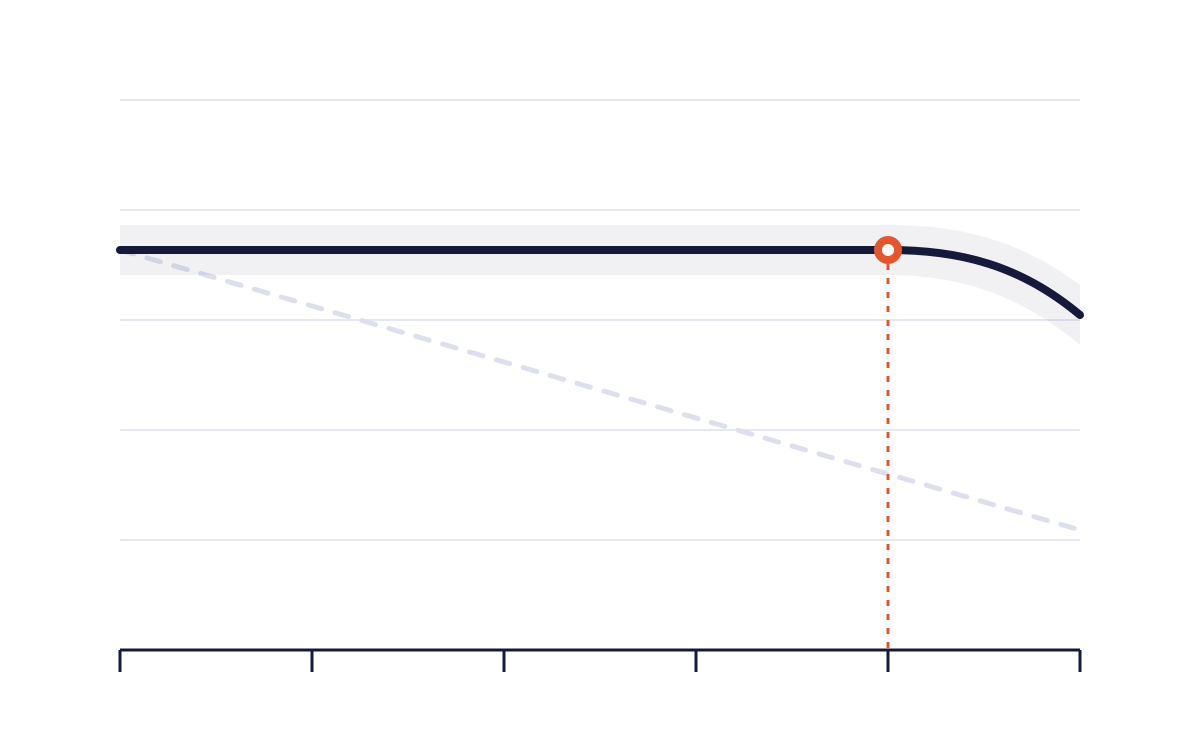
| About 20 to 60 years | Flat. No significant change, in men or women, including during pregnancy and menopause |
| About 60 onward | Declines by about 0.7 percent a year, so a 90-year-old expends roughly 26 percent less than a 60-year-old of the same size |
The middle row is the one that matters for most readers. Adjusted for body composition, a 55-year-old burns energy at the same rate as a 25-year-old. Metabolism, in the strict sense of how fast your tissues use energy, does not slow during the decades when most people gain weight.
So why does weight go up?
If metabolic rate per kilogram of lean tissue is stable, the explanation has to be either less lean tissue, less movement, or more food. In practice it is usually all three, each contributing a small amount.
Muscle loss
Adults who do not train lose roughly 3 to 8 percent of their muscle mass per decade after age 30, accelerating after 60. Muscle at rest uses about 13 calories per kilogram per day, compared with roughly 4.5 for fat tissue. Losing three kilograms of muscle and gaining three of fat leaves the scale unchanged and lowers resting expenditure by around 25 calories a day. That sounds trivial, and in a single day it is. Over a decade, with no compensating change in intake, it is a kilogram or two of fat.
More importantly, losing muscle reduces the amount of movement that feels easy, which feeds the next item.
Less movement, especially the kind you do not notice
Non-exercise activity thermogenesis, or NEAT, is the energy spent on everything that is not sleeping, eating, or formal exercise: walking to the car, climbing stairs, fidgeting, standing, carrying shopping. James Levine’s research at the Mayo Clinic showed NEAT can differ by as much as 2,000 calories a day between two people of similar size, depending on occupation and habits.
NEAT tends to fall through adulthood for reasons that have nothing to do with biology. Jobs become more sedentary as people are promoted from the floor to the desk. Cars replace walking. Children leave home. Weekends shift from sport to screens. None of this shows up as “exercise”, so it rarely gets counted, but a drop of 200 calories a day in NEAT is worth far more than any plausible change in cellular metabolism.
Sleep
Short sleep raises ghrelin, the hormone that signals hunger, and lowers leptin, the one that signals fullness. A frequently cited 2004 study found that restricting young men to four hours in bed for two nights raised their hunger ratings by about 24 percent and their appetite for calorie-dense foods in particular. Sleep in midlife is often worse than at 25, because of work stress, young children, perimenopause, or simply later nights. Tired people also move less the next day.
Alcohol, portions, and habit drift
Alcohol carries 7 calories per gram, is rarely counted, and lowers inhibition around food. Portion sizes in restaurants and packaged foods have grown. The habits that were manageable at 25 with a faster-moving life are a surplus at 45 with a slower one. None of these are moral failings, and none of them are metabolism.
The menopause transition
Menopause deserves its own note because it is often blamed for everything. A longitudinal study by Lovejoy and colleagues followed women through the transition and found a shift toward abdominal fat, a decline in physical activity, and a modest fall in resting and total expenditure, with the activity drop explaining a large part of the total. Hormone changes redistribute fat and may increase appetite in some women; the gain in overall weight is mostly mediated by the same levers as everyone else: muscle, movement, sleep, and intake.
What actually declines after 60, and what to do about it
The 0.7 percent per year decline after 60 is real and appears to reflect genuine changes at the cellular level, in addition to continued muscle loss. For a 70-year-old, that amounts to roughly 7 percent lower expenditure than at 60, or about 150 calories a day for an average person. That is not large, but it is worth planning for: slightly smaller portions, slightly more protein to protect muscle, and a deliberate resistance training habit become more important, not less, with age.
What you can control
Working from the largest effect to the smallest:
- Move more during the day. A step target is the simplest tool. Going from 4,000 to 8,000 steps adds roughly 150 to 200 calories of expenditure a day for an average adult. Our walking plan builds that up gradually.
- Lift something two or three times a week. Resistance training is the only intervention that reliably reverses age-related muscle loss. You do not need a gym; bodyweight squats, push-ups, rows with a band, and loaded carries cover the essentials.
- Eat enough protein. Around 1.2 to 1.6 grams per kilogram of body weight, more if you are dieting, spread across the day. See our protein guide.
- Protect sleep. Seven hours is the target that most of the appetite research supports.
- Count the drinks. Alcohol is often the single largest uncounted calorie source in midlife diets.
- Rerun your calorie estimate. If you set a target years ago at a different weight and activity level, it is out of date. Our calorie guide shows how.
What does not work
Products sold as metabolism boosters generally rely on caffeine, green tea catechins, capsaicin, or similar compounds. In controlled studies these raise expenditure by perhaps 50 to 100 calories a day for a few hours, an effect that diminishes with regular use. They do not change the long-term trajectory. Eating six small meals instead of three has no measurable effect on total expenditure. “Starvation mode”, the idea that eating too little stops weight loss entirely, is a misreading of adaptive thermogenesis, which is real but modest, in the range of 5 to 15 percent of expected expenditure.
The useful conclusion
A stable metabolism through midlife means the weight you gained was gained the ordinary way, and it can be lost the ordinary way: by expending more and eating a little less. That is less exciting than a metabolic explanation, but it puts the controls back in your hands.