Before you take any supplement, read its label. VisiFlora’s rewards a slow read. Here we go through the supplement facts panel line by line, put the seller’s stated purpose for each ingredient in plain words and list the research we can point to.
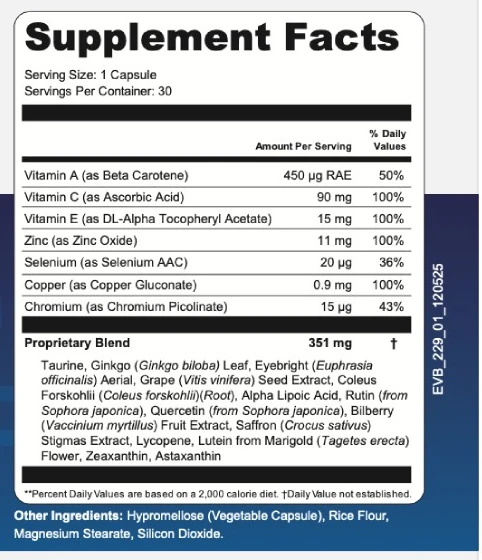
The label at a glance
One capsule makes a serving, and each bottle holds 30 of them. The amounts below are all per capsule.
| Nutrient | Amount | % Daily Value | Supplied as |
|---|---|---|---|
| Vitamin A | 450 mcg RAE | 50% | beta carotene |
| Vitamin C | 90 mg | 100% | ascorbic acid |
| Vitamin E | 15 mg | 100% | DL-alpha tocopheryl acetate |
| Zinc | 11 mg | 100% | zinc oxide |
| Selenium | 20 mcg | 36% | selenium AAC |
| Copper | 0.9 mg | 100% | copper gluconate |
| Chromium | 15 mcg | 43% | chromium picolinate |
| Proprietary blend | 351 mg | Not established | 14 ingredients |
Count it up: seven vitamins and minerals plus fourteen names in the blend gives 21 ingredients. The seller’s sales page says “22-in-1”, and our number is taken from the label.
Hold the label up to the offer
Open the order page to see the packages, e-books and refund terms side by side.
See VisiFlora on the Official Order PageCheckout run by ClickBank
The seven lines with real amounts
These are the entries whose numbers you can check yourself.
- Vitamin A, 450 mcg RAE (50%). Delivered as beta carotene. The seller links vitamin A with normal low-light vision and healthy cells.
- Vitamin C, 90 mg (100%). One of the antioxidant vitamins on the panel.
- Vitamin E, 15 mg (100%). The form used is DL-alpha tocopheryl acetate, and the seller pairs it with vitamin C as an antioxidant duo.
- Zinc, 11 mg (100%). Provided as zinc oxide. According to the seller, it supports normal enzyme activity in the eye.
- Selenium, 20 mcg (36%). Called an essential mineral by the seller.
- Copper, 0.9 mg (100%). Also an essential mineral in the seller’s wording, and it stands next to zinc on the panel.
- Chromium, 15 mcg (43%). Mentioned for healthy metabolic function.
Vitamin A, zinc, copper and selenium come with a percentage of the daily value. If you already take a multivitamin, tally those numbers across everything before assuming all is well.
The 351 mg blend, grouped by kind
The label lists the fourteen blend ingredients in its own order under one total of 351 mg per capsule. For readability we sort them by type, and the roles come from the seller. No per-ingredient amounts are printed, so we state none.
The carotenoids. Lycopene, lutein (from marigold), zeaxanthin and astaxanthin. These are the pigments most often associated with eye-focused products. In the seller’s phrase astaxanthin is a potent antioxidant of the carotenoid family, and lycopene is another antioxidant on the list.
The plant extracts. Ginkgo leaf, eyebright aerial parts, coleus forskohlii root, bilberry fruit extract and saffron stigma extract. The seller pairs ginkgo and coleus with healthy microcirculation, visual focus and nutrient delivery to the eye. Eyebright is, to the seller, a traditional botanical that people have long used for eye comfort; bilberry is rich in anthocyanins; and saffron is a carefully studied botanical.
The bioflavonoids. Grape seed extract, rutin and quercetin, with rutin and quercetin sourced from Sophora japonica per the label. To the seller, this trio is about cell integrity and the blood vessels around the eyes.
The odd pair out. Taurine, which the seller says supports cellular hydration, and alpha lipoic acid, another antioxidant.
If you wonder how the seller organizes the formula, it uses four marketing groups that appear on its sales page. That framing belongs to the seller, so for the story see the hub page.
Everything else in the capsule
Below the panel, the label names rice flour, magnesium stearate and silicon dioxide, with hypromellose forming the vegetable capsule. The seller describes the product as non-GMO, stimulant-free and vegetarian-friendly, and adds that ingredients pass through a certified facility run to strict quality standards. We report those as the seller’s statements.
Research behind the ingredients
We know of no published study on VisiFlora. What follows is research on single ingredients and on the topic, each described only as its title says. None of it tests this capsule.
- Lycopene. A 2024 article in the Journal of Nutrition and Metabolism reviews lycopene as an antioxidant with a range of health benefits.
- Beta-carotene. A 2005 paper in Investigative Ophthalmology and Visual Science studies how cultured human eye cells convert beta-carotene into vitamin A.
- Eyebright. A 2014 paper in the Balkan Medical Journal puts eyebright extract through laboratory tests on human corneal cells.
- Lutein, zeaxanthin and beta-carotene. A 2020 review in Antioxidants covers the three carotenoids in eye health.
What these show is that the carotenoids and plants on the label are real subjects of study. They cannot say what this exact capsule will do for you, which is why evidence sits at 4.0 in our scorecard.
Comfortable with what the label says?
Six bottles come to $49 each, with no US shipping charge and three e-books.
Claim the 6-Bottle VisiFlora PriceOne payment, no subscription
Why the blend is a single line
A proprietary blend is a common label format. The maker names every ingredient in it and prints one combined weight, here 351 mg per capsule, without splitting it up. Names on a supplement panel are generally ordered from the largest amount to the smallest, so the sequence of the fourteen hints at relative quantities while still hiding the numbers. For a shopper the practical result is that you can see what is in the blend and its total, but you cannot line it up ingredient by ingredient against a product that prints separate doses. That is one reason our transparency score stops at 4.5.
A note on the seller’s wording
Throughout this page the roles given to ingredients belong to the seller, and they are deliberately soft. The seller speaks of support, comfort and antioxidant behavior, and it does not claim that any single ingredient changes your eyesight. We follow that restraint. If a description here sounds modest, that is on purpose.
How to read this label sensibly
- Total the vitamins. With a multivitamin in the picture, add up vitamin A, zinc, copper and selenium across everything you take.
- Trust your own bottle. Names, forms and amounts printed on the bottle in your hand are what count. Compare it with this page.
- Remember what the blend hides. Two products can list the same names and still differ hugely in amounts.
- Pair with habits. Breaks, good lighting and eye exams do jobs a capsule cannot. The comparison page lines them up.
- Keep your doctor in the loop. The safety page names the ingredients that matter alongside certain medicines.
Our post on the VisiFlora ingredients list shows the same panel as a table, and the one on VisiFlora ingredients discusses the main names in depth.
Start your VisiFlora routine
One capsule a day, and two months from delivery to decide.
Get VisiFlora at the Best PriceBacked by the 60-day guarantee