The Genius Song reviews you will find online mostly trace back to one source: the seller’s 39-minute sales video and the pages around it. This is our full review. We go through what the $39 order contains, how the seller wants you to use it, which of its claims research can speak to, and the small print that most write-ups skip. Everything here comes from the seller’s own pages, its Terms, the ClickBank checkout and the video captions. We did not buy the track.
Short answer A digital audio track for $39, sold with large promises about luck, money and brain power that no study of the track supports, and covered by a 90-day refund window.
This article is independent: we are not the seller, and we may earn a commission if you buy through our links.
Health for Weight Loss mostly writes about food, metabolism and exercise. We review products like this one because readers ask about them, and because the video mentions weight loss among its stories, which falls squarely in our lane.
What the $39 order contains
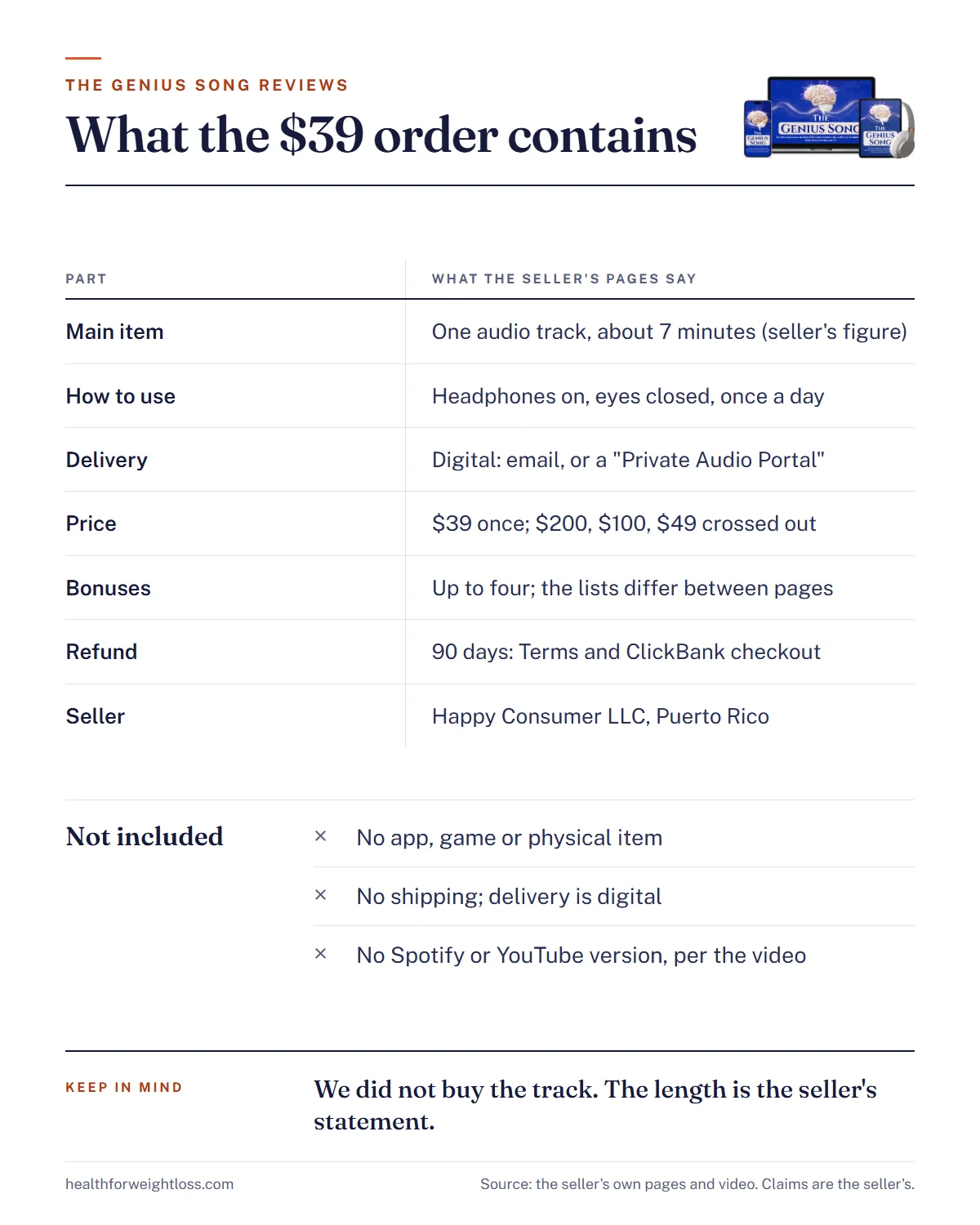
Under the long story, the product is small. In the video it is a “seven minute sound wave”, said to be made by turning “one hour of brain entrainment” into one short recording. You pay once, through ClickBank, and the track is delivered digitally. There is nothing to ship.
| Part of the order | What the seller’s pages say |
|---|---|
| Main item | One audio track, about seven minutes long (seller’s figure) |
| Delivery | Digital; email within minutes per the video, a “Private Audio Portal” per the text page |
| Price | $39 once; $200, $100 and $49 appear crossed out as the seller’s reference prices |
| Bonuses | Up to four digital extras, and the list changes between pages |
| Refund | 90 days under the Terms (digital products); 90 days at ClickBank’s checkout |
| Seller | Happy Consumer LLC, Puerto Rico; ClickBank vendor ID geniusbr |
| Licence | Personal use by one person; no sharing or resale |
The delivery row deserves a second look. The video promises the track by email. The text version of the sales page talks about login details for a private portal where you “stream from any device”, while the FAQ on that same page talks about saving the track on a phone or computer. Nor is it an app or a game, and the video describes the seller’s own site as the only place to get it, with no YouTube or Spotify version. We cannot tell which delivery method buyers actually receive, so the fair description is an audio track delivered digitally, which the seller describes as both a download and an online portal.
The daily routine the seller describes
The video keeps it simple: headphones on, eyes shut, seven minutes of playback a day. The presenter says a missed day is “okay”. He claims it works from the first session, that many buyers notice a change after two or three days, and that most daily listeners see results within a couple of weeks. Those timelines are his, and nobody has tested them.
One detail does not add up. The hook of the video promises a “seven second brain trick” and a “seven second morning ritual”, but what is for sale is a seven-minute track, and the video never explains what the seven seconds refer to.
Want to see the seller’s pitch for yourself?
One digital audio track for $39. Refund window: 90 days, written in the Terms and repeated by ClickBank.
Visit the Official WebsiteSponsored link through ClickBank to the seller’s site. A purchase may earn us a commission.
The Genius Song reviews and claims, set against the evidence
The video’s central idea is that adults have a “dormant” gamma brain wave, which it calls “the super brain wave”, and that its sound wave can switch gamma back on through “brain entrainment”. From there it promises eureka moments, easier problem solving, faster learning, sharper memory, luck, abundance, promotions, better relationships, better grades for children and easier bedtimes. It also tells stories of weight loss (a 16 lb colleague), quitting smoking, migraines fading and joint pain easing.
Here is how the main claims compare with what we could find.
| What the video claims | What we could find |
|---|---|
| “MIT found” lucky, wealthy people share one brain wave | No published study saying anything like that |
| A “brand new discovery in 2026” | A sales line; no paper is named that we could check |
| Gamma can be activated by this sound wave | No study tests this track at all |
| Faster learning, memory, focus | Mixed findings in beat studies; none used this track |
| Luck, money, promotions | None; on casino luck the presenter concedes there is no proof |
| Weight, smoking, migraines, pain | Anecdotes only; the site says it treats no disease |
That casino line is worth quoting in full. Asked whether the track helps at the casino, the presenter mentions customers’ lucky streaks, then admits there is “no evidence to support” that the track caused them. It is a rare moment of candor, and it applies just as well to the other stories in the video.
What gamma and audio research actually covers
Gamma waves are real. They are fast brain rhythms, roughly 30 to 100 Hz, that researchers link to attention and to the way the brain processes memories. Three lines of research sit closest to the seller’s story:
- Meditators. In a 2004 PNAS study from the University of Wisconsin, long-term meditators showed high-amplitude gamma activity while meditating. This is likely the source of the video’s “monk” story, told in a simpler form.
- 40 Hz stimulation at MIT. The Tsai lab has studied 40 Hz light and sound, mainly in mouse models of Alzheimer’s disease, with small early trials in people. That work is about brain disease, not IQ, luck or income.
- Binaural beats and entrainment. The picture is mixed. A 2019 meta-analysis in Psychological Research found a medium overall effect (g = 0.45) on some outcomes across cognition, anxiety and pain, while a 2023 systematic review in PLOS ONE found that most of the 14 entrainment studies it covered (8 of them) did not show the brainwave change.
None of these studies used The Genius Song. The seller’s own Terms add a strange pair of lines: one says that all claims about brainwave entrainment are “substantiated by established scientific research”, while another, in the same document, concedes entrainment is “not an exact science” and files the products under “for entertainment purposes only”. We would give more weight to the second.
The fine print: pen name, Terms, refunds and bonuses
The presenter uses a pen name
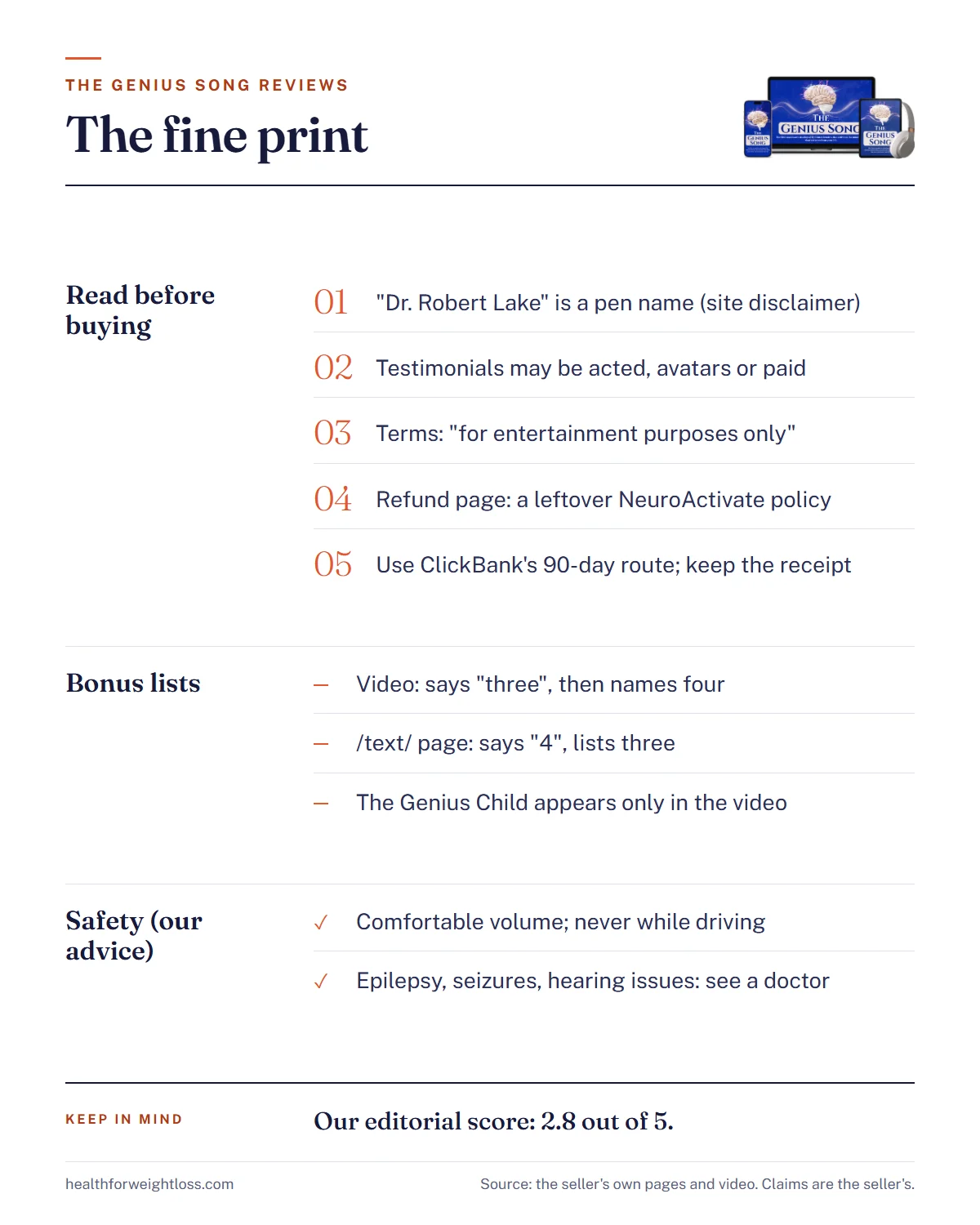
The man in the video introduces himself as Dr. Robert Lake and describes a New York City clinic and a 34-year neuroscience career. The text page calls him a “NASA-Trained Neuroscientist”. The footers of both sales pages, however, say that Robert Lake “is a pen name”, one the seller’s lead neuroscientist agreed to. So the name on screen is not a real person’s name, and the credentials attached to it are claims we cannot check.
What the Terms say about the testimonials
The Terms explain that names in the marketing have been changed, that pen names are used, and that some parts of the marketing “have been dramatized”. The faces and voices may be avatars or actors. Some people giving testimonials were compensated, and some are close to the founders as friends, family or early backers. The Terms also call the results shown “exceptional” and say they may not match a typical customer’s experience. The video speaks of 18,366 Americans helped, while the headline of the text page says 19,389. Neither figure can be checked, and they do not agree with each other.
Two refund pages that do not match
Under the Terms, a refund on a digital product can be requested for 90 days after purchase, and ClickBank’s checkout states the same limit. The site’s separate refund page is something else: a policy for unopened bottles of “NeuroActivate”, with 60 days and a return address in Tallmadge, Ohio, which cannot fit a digital track. If you want your money back, go through ClickBank within 90 days and keep the receipt it emails you.
The bonus list changes between pages
In the video, the presenter announces “three free bonuses” and then names four: “The Genius Child” (an audio for children’s focus), a classic book on attracting financial success said to have inspired The Secret, a guided visualization from a creator on the Calm app, and a printable infographic of five habits. On the text page, “4 free bonuses” worth “$197.00” are promised, but only three appear: the book, the “Create Your Ideal Future” infographic and the “Genius Visualization”, with no Genius Child. Expect up to four extras, and do not count on any single one.
Read the Terms before you decide
The seller’s site links its Terms of Sale, including the 90-day rule for digital products and the entertainment-only section.
Check the Current Price on the Official SiteSponsored link through ClickBank to the seller’s site. A purchase may earn us a commission.
Where our link takes you
Our links go through ClickBank’s tracking link, which opens the seller’s site, geniussongoriginal.com. Do not be surprised by what you see first: the home page currently promotes the seller’s related audio, The Genius Wave, and The Genius Song presentation lives one page deeper, at /video/ on that domain. The seller pitches them differently (twelve minutes of theta for one, seven minutes of gamma for the other), so check the product name at checkout. The item line should name The Genius Song and its 90-day money back guarantee, and the price appears in your local currency plus any tax.
Safety notes
The seller does not list any of these, so treat them as our advice:
- Keep the volume at a comfortable level; long, loud listening on headphones can harm hearing.
- You listen with your eyes shut, so the car, or any machinery, is no place for it.
- People who have had seizures, live with epilepsy or have hearing trouble should get a doctor’s view first.
Our verdict
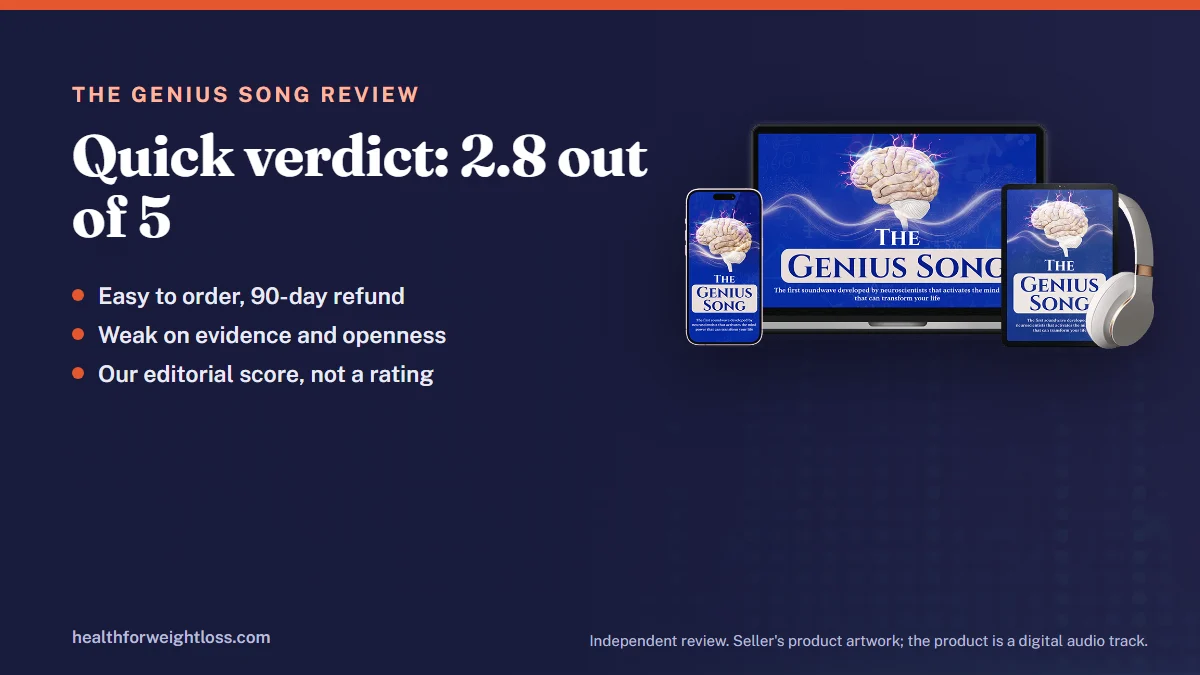
Our editorial score for The Genius Song is 2.8 out of 5. That is our own score, built from six areas: value, the guarantee, evidence, how easy it is to order, transparency and what the order contains. The guarantee scores best, because the 90-day window appears in both the Terms and the ClickBank checkout. Transparency and evidence score worst, because of the pen name, the dramatized testimonials, the borrowed research and the stray bottle refund page. For a shorter version with the score for each area, see our quick verdict and scorecard.
It may suit you if you want a short daily listening habit, can spare $39 and will actually use a refund window.
Skip it if you are hoping for money, luck, weight loss or relief from a health problem, or if the pen name and acted testimonials put you off, which would be a reasonable reaction.
Still curious after the fine print?
Check that the checkout names The Genius Song, save the ClickBank receipt, and note the date 90 days out.
Visit the Official WebsiteSponsored link through ClickBank to the seller’s site. A purchase may earn us a commission.
If a refund request goes unanswered, a guide from the FTC walks through disputing the charge with your card company. For product questions, the sales pages point to [email protected], and ClickBank’s order desk answers on 1-800-390-6035 and through clkbank.com.
Prefer to judge the video yourself?
The Genius Song video runs about 39 minutes on the /video/ page of the seller’s site. Treat every result in it as the seller’s claim.
Go to the Official WebsiteSponsored link through ClickBank to the seller’s site. A purchase may earn us a commission.