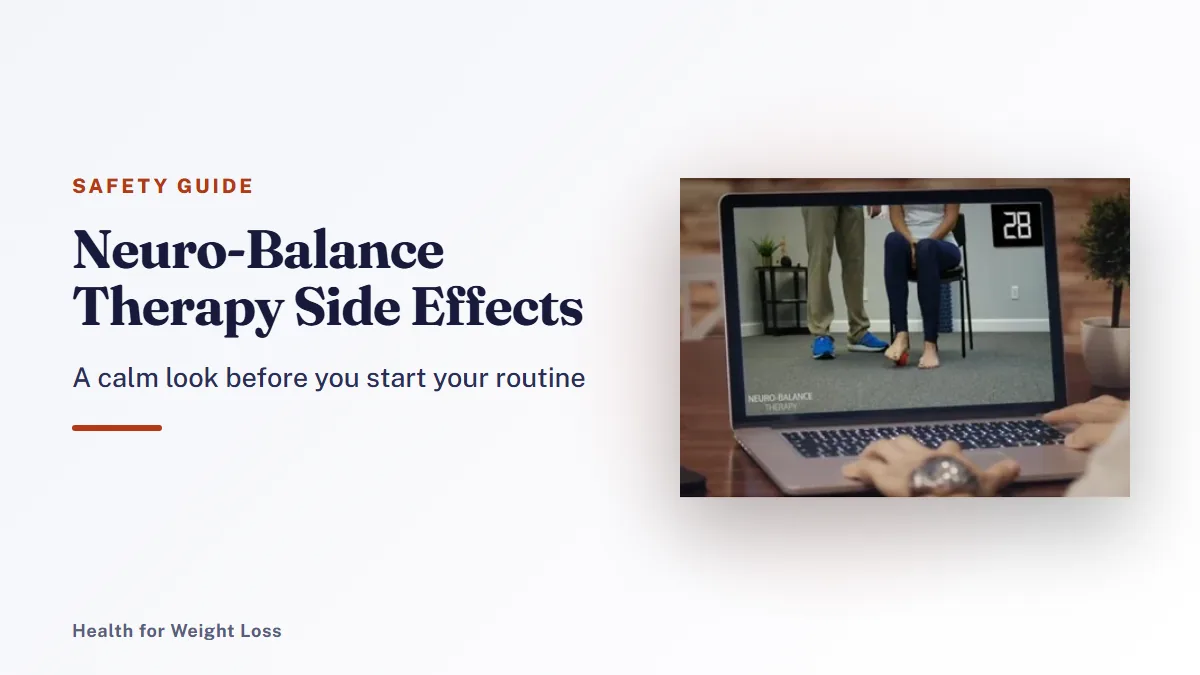
A balance routine should leave you feeling steadier and more at ease, so it pays to begin with a safety plan. This guide treats Neuro-Balance Therapy side effects the way a home exercise program deserves: how to ease in, what support to set up, how to handle the spike ball and when to talk to your doctor. Follow it, and the short follow-along lessons become something to look forward to.
Begin gently with Beginner lessons
Three levels, a manual and 60 days to make up your mind.
Start the $37 digital versionInstant download · ClickBank checkout · 60-day refund promise
Neuro-Balance Therapy side effects: the right question to ask
Neuro-Balance Therapy is a set of follow-along video lessons with a digital manual, and the DVD edition adds a disc and a spike ball. It is an exercise routine, not a pill, powder or device that you take or wear. According to the seller, it is designed to support footing that feels steadier, leg strength and confidence on stairs and while walking.
That makes the useful safety question a practical one: how do you do the routine well? A few habits answer it, namely checking with your doctor, holding something solid, starting gently and listening to your body. The steps below turn those habits into a plan.
Step 1: Ask your doctor first
This is our own advice, and it holds for any balance or exercise routine. Raise it with your doctor before day one, and say so if any of these apply to you:
- a recent fall or operation;
- spells of dizziness;
- neuropathy or numb feet;
- a joint replacement;
- osteoporosis;
- any other medical condition.
Your prescribed medicines carry on, and an exercise program is no reason to change any of them. One short conversation at the start lets your doctor tell you what to avoid and what to watch for.
Step 2: Set up support and space
Balance work goes smoothly when you have something dependable to hold. Before you press play:
- Stay next to a solid chair or the counter for any standing moves, and keep one hand free to grip it.
- Use a supportive seat for any floor-based moves.
- Clear a small area around you so you have room to move.
- Sit down straight away if you feel unsteady.
The seller says the routine can be done at home, even while sitting and watching TV, so you can start from a chair.
A routine you can start from a chair
Short sequences, at your own pace.
Get instant accessDigital version $37 · a 60-day window to decide
Step 3: Start at Beginner and go at your own pace
Lessons are grouped into Beginner, Intermediate and Advanced levels, and the choice is yours. We suggest starting at Beginner and staying there until the moves feel comfortable. Nobody is racing you. If a move feels like too much, repeat an easier one, or pause and return another day. Pain or feeling unwell means stopping, and a signal to rest and, if it continues, to call your doctor.
The digital manual helps here, because its pictures and descriptions let you check a move before you try it.
Step 4: Use the spike ball gently
Short sequences in the routine put a spiky massage ball under your feet. Because a spike ball can bruise sensitive skin, keep the pressure light at first and build up slowly. Leave the ball out on broken skin or numb feet unless your doctor agrees, since you may not feel how hard you are pressing.
Keep in mind that the digital edition comes without a ball, while the DVD edition includes one. The lessons are the same either way. If you use your own massage ball, pick one that feels comfortable, and check with your doctor if your feet give you any concern.
Step 5: Take unsteadiness seriously
Unexplained unsteadiness, or a fall, is a reason to see a doctor. It deserves a medical check, because the cause may be something only a doctor can look into, such as medicines, blood pressure, eyesight or the inner ear. A home routine can sit alongside medical care, but it never replaces it. The seller’s terms say the same in its own words: the program is no substitute for medical advice, and a health care professional should be consulted before you act on it.
What the program offers once you are ready
When your doctor is comfortable with the idea, Neuro-Balance Therapy gives you a structured, guided way to practise. The digital edition at $37 downloads instantly and includes the lessons, the manual and a home-safety checklist bonus, which we call the Top 20 Tips. The physical edition at $47, with shipping and handling extra, adds the disc series and one spike ball, includes the download and carries the same bonus. Our guide to what comes in each edition lists the contents, and our Neuro-Balance Therapy safety page gathers the safety points in one place.
Try a guided routine with 60 days to decide
Both editions include the free bonus checklist.
Choose my edition$37 digital · $47 plus the shipping charge line for the disc edition
Signs to pause and call your doctor
A calm guide should also say when to stop. Pause the lesson and sit down if you feel pain, dizziness or unwell. If the feeling lingers, or new unsteadiness appears, speak to your doctor before you continue. After a fall, tell your doctor even if you feel fine. These are our own safety suggestions, not claims about the program, and they suit any exercise routine.
Making the room safe
A tidy room helps any balance routine. Move loose rugs, cables and clutter away from your practice area, and keep your chair or counter within arm’s reach. Good lighting helps you see the screen and the floor. Keep your phone or tablet on a stable surface at eye level, so you are not leaning to watch. The seller’s bonus, a home-safety checklist that we call the Top 20 Tips, sits alongside the program for exactly this reason: it gives you a list of tips for your living space.
If it is not for you
A two-month refund promise covers both editions. For the $37 edition, you send a Refund Request through ClickBank order support. For the DVD edition, you return the disc at your own postage, and the refund leaves out shipping and handling. If you decide the routine does not suit you or your doctor advises against it, you have a clear way out. Our refund steps for both editions cover each route.
A short weekly rhythm to keep it safe
A calm schedule keeps a new routine pleasant. You could try three short sessions in your first week, each beside your chair or counter, with a rest day between them. Keep a glass of water nearby, wear comfortable clothes and choose a time of day when you feel alert. Write down any questions for your doctor, and bring them to your next visit. If you ever feel unwell during a lesson, stop, sit down and rest.
A word on expectations
The seller frames the routine as support for steadier footing, leg strength and confidence on foot and on stairs, and results vary from person to person. A gentle approach suits that framing. Treat each lesson as practice, enjoy the small wins and keep your doctor in the loop.
Our verdict
Neuro-Balance Therapy is a gentle, guided way to begin a home balance routine, and its safety comes down to common sense: ask your doctor, hold something sturdy, start at Beginner, handle the spike ball with care and get unexplained unsteadiness checked. We score the program 4.5 out of 5 on our own scale, and you can read the full reasoning in our complete review. For both editions in one view, visit the main Neuro-Balance Therapy overview.
Start safely, start today
A guided home routine with a free bonus and a 60-day guarantee.
Get Neuro-Balance Therapy for $37Sold through ClickBank · money-back promise of 60 days