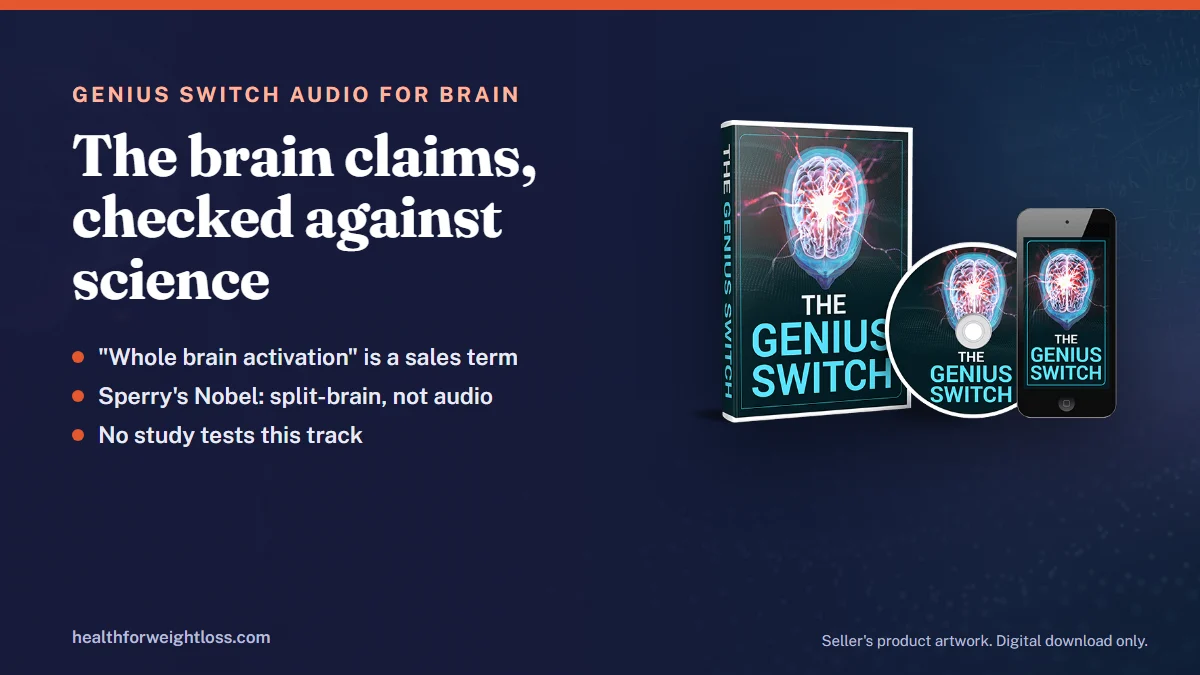
People who search for The Genius Switch audio for brain benefits are usually asking one thing: can an eight-minute recording really change how a brain works? The seller says yes, through what it calls “whole brain activation”. This article takes the brain claims one at a time. It looks at what hemisphere sync means, what Roger Sperry’s Nobel Prize was actually for, and what brain science can and cannot say about a track like this.
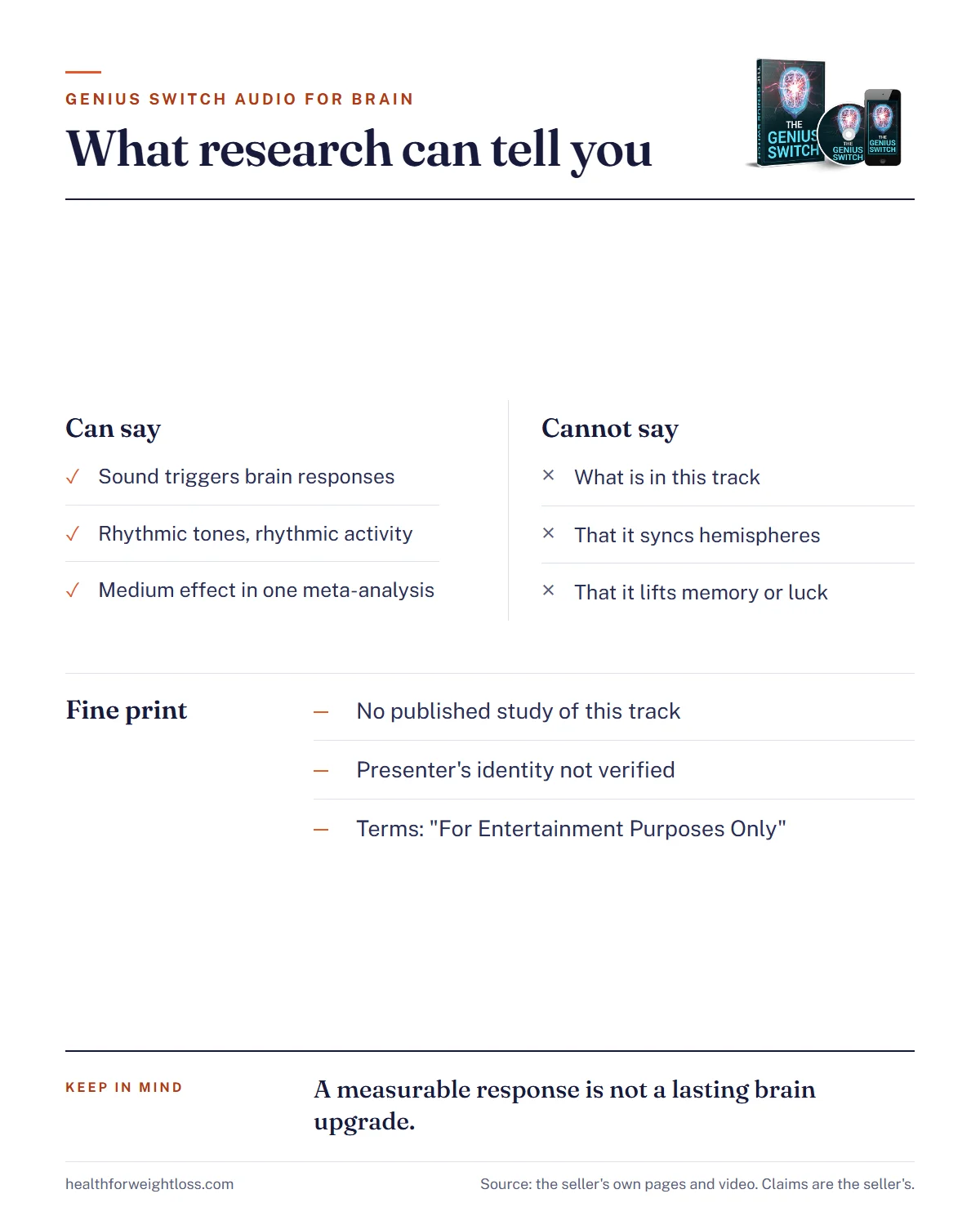
Short answer Sound does produce measurable brain responses, and binaural beat research is mixed: pooled studies show a medium effect on some outcomes, while most studies testing the brainwave mechanism did not confirm it. Nothing published shows that this $39 track activates, syncs or upgrades the brain of anyone who listens.
None of our editors has heard the recording. What follows compares the seller’s own words, from the sales page, the 36-minute video and the Terms, with what published research supports.
The Genius Switch audio for brain: the claim in the seller’s words
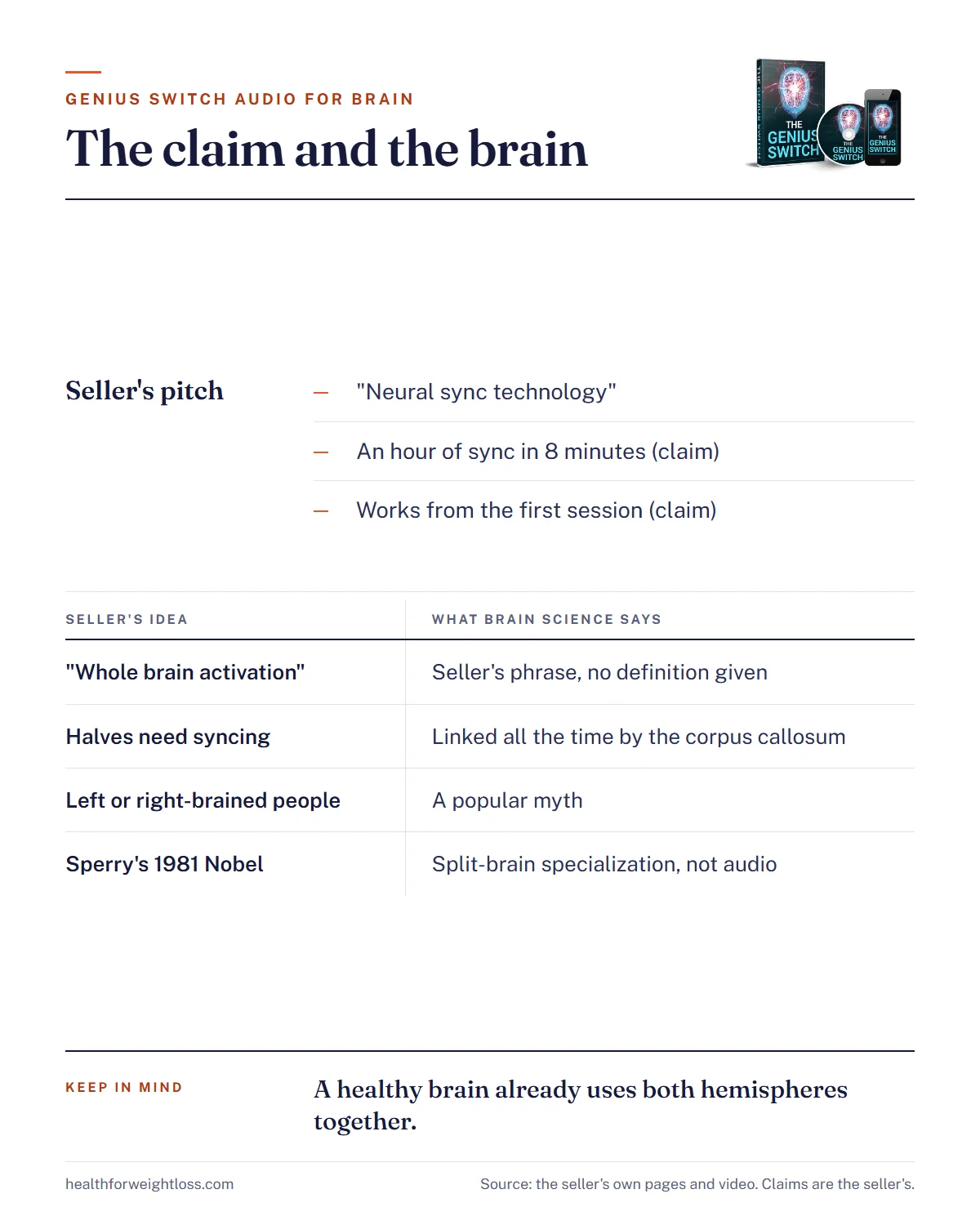
The pitch rests on a single idea. According to the sales video, your brain’s left and right hemispheres are not working together as well as they could, and the track fixes that. The seller calls the result “whole brain activation” and credits it to “neural sync technology”. The video adds that one hour of this neural sync has been squeezed into eight minutes of audio, played through headphones, eyes shut, every day.
From there, the video moves quickly from the brain to daily life. It links the track to eureka moments, faster learning and a sharper memory, then to luck, promotions, money, relationships and even children’s grades. It says results begin from the very first session.
The rest of this article stays with the brain part of that story, because that is where the claims are most specific and easiest to check against research.
Hear the seller’s full explanation
The sales video sets out the brain theory in the presenter’s own words. The track costs $39 via ClickBank, and refunds can be requested for 90 days under the Terms.
Watch the Brain PitchOpens the seller’s order page.
“Whole brain activation” is a sales term
Search a medical textbook for “whole brain activation” as a condition or a treatment goal and you will not find it. It is the seller’s own label. That matters, because a label without a definition cannot be tested. The video does not say what a “fully activated” brain looks like on a scan, how much activation counts as success, or how a listener could tell whether it happened.
There is also a quieter assumption under the phrase: that an ordinary brain is somehow partly switched off. That idea has no support. Brain imaging shows activity across both hemispheres during almost everything people do, including resting with their eyes closed. A healthy brain is not waiting for an audio file to switch on the other half.
Hemisphere sync: how the two halves already work together
The brain does have two hemispheres, and they are not identical. Language, for example, leans on the left side in most people, while some aspects of spatial attention lean right. But the two sides are joined by the corpus callosum, a thick bridge of nerve fibers, and they trade information constantly.
| Popular idea | What brain science says |
|---|---|
| Most people use one side more than the other | Both hemispheres are active in nearly every task |
| “Left-brained” and “right-brained” personalities | A popular myth; personality is not split by hemisphere |
| The halves need help to communicate | The corpus callosum links them all the time |
| More synchrony is always better | Researchers measure synchrony, but do not treat it as a simple score to maximize |
| Sound can sync the halves for good | No study shows lasting change from this track |
Researchers can measure how closely activity in different brain areas rises and falls together, and this is an active field. But “more sync” is not a health score. The right amount depends on the task, and nobody has shown that eight minutes of audio shifts it in a lasting, useful way.
Roger Sperry’s Nobel Prize: what it was for
The sales video leans on a real Nobel laureate. Roger Sperry received a share of the 1981 Nobel award for physiology or medicine, and the prize summary credits him with discoveries on how the brain’s two halves divide up their work.
His best-known work involved split-brain patients. These were people whose corpus callosum had been cut by surgeons to control severe epilepsy. With the bridge between the halves gone, careful tests could show what each hemisphere did on its own. That research taught us that the two sides specialize. It did not test sound, music or any audio product, and it did not describe “whole brain activation”.
So the link the video draws runs backwards in an important way. Sperry’s findings came from brains where the two halves had been surgically separated. They tell us about specialization. They do not show that healthy, connected hemispheres need to be synced by a recording.
Prefer to judge the track by ear?
One digital recording of about eight minutes for $39, emailed after checkout. Keep the ClickBank receipt in case you ask for a refund within 90 days.
Check the Current OfferAffiliate link to ClickBank’s order page for this product. If you buy, we may be paid a commission; the price is unchanged.
What neuroscience can measure about sound
Brain research is not silent on audio. A few things are well established:
- The brain responds to sound in measurable ways. Recordings such as EEG pick up responses in the hearing system within a fraction of a second of a tone.
- Rhythmic sound can produce rhythmic responses. When a tone pulses at a steady rate, brain recordings often show activity at that rate while the sound plays.
- Binaural beats have been studied for decades. Garcia-Argibay and colleagues combined earlier experiments on cognition, anxiety and pain in a 2019 meta-analysis and found a medium overall effect, with its size depending on the beat frequency and the timing of listening. A 2023 review was less clear on the brainwave side: of 14 studies, 8 contradicted entrainment.
- Specific lab tasks can shift. The 40 Hz study by Ross and Lopez, which the Genius Switch sales page lists among its references, looked at an attention task in young adults over three days and found faster training gains with 40 Hz beats.
That is real science, and it is also narrow. These studies use stated frequencies, small groups, short time frames and specific lab tests. The step from “a measurable response on a test” to “better memory, luck and money” is not one any of them takes.
What neuroscience cannot say about this track
Here the gaps become the story.
| Brain claim | What would be needed to test it | What exists |
|---|---|---|
| Syncs the two hemispheres | Brain recordings before and after listening | No published study of this track |
| “Whole brain activation” | A definition and a way to measure it | Neither is provided |
| An hour of neural sync in 8 minutes | A description of the method and a comparison | Seller’s statement only |
| Works from the first listen | A controlled trial with a dummy track | None |
| Better memory and faster learning | Standard memory tests, ideally blinded | None for this track |
There is a further problem. Science cannot test what it cannot see, and the seller does not describe the sound itself: no frequencies, no note on whether it contains tones, music or a voice. On top of that, the messaging contradicts itself. Early on, the presenter separates his method from brain waves altogether. Meanwhile the reference list on the sales page is built around 40 Hz beats and gamma rhythms, which are entirely about brain rhythms. Without knowing what is in the recording, nobody outside the seller can say which of those messages fits.
Who is making the brain claims?
The brain theory comes from a man on screen who introduces himself as Dr. Daniel Barone, billed in the sales page headline as a “Top NYC Brain Doctor”. We found no way to check his identity or his link to the business, and a sales video is not a medical opinion in any case.
The seller’s Terms add context worth knowing. One section is titled “For Entertainment Purposes Only”, and it calls brain entrainment “not an exact science”. Elsewhere the Terms say the people in testimonials could be actors or computer avatars, and that a few of them may have a personal tie to the founders as supporters, friends or relatives. Even the presenter, after one casino story, concedes there is “of course no evidence” the track caused it.
Questions to ask about any brain audio product
These questions work for The Genius Switch and for any other recording sold on brain claims:
- What exactly is in the audio? Frequencies, tones, music or speech should be stated plainly.
- What is the claimed effect, in measurable terms? “Activation” or “sync” needs a definition.
- Has the product itself been tested? Studies of similar audio are not studies of this one.
- Who is the expert, and can you verify them? A title on a video is not a credential you can check.
- What do the Terms say? Fine print sometimes frames a product very differently from the sales pitch.
- What happens if it does nothing for you? Here the Terms and ClickBank allow refund requests within 90 days.
Going ahead as an experiment?
$39 for the recording and four digital bonuses, sold through ClickBank. Treat the brain claims as unproven and let your own record decide.
See Price and Refund TermsAffiliate link to ClickBank’s order page for this product. If you buy, we may be paid a commission; the price is unchanged.
Listening without risk to your brain or ears
These precautions are ours, offered for any audio of this kind:
- Keep the volume low. The NIDCD notes that repeated loud sound through headphones can cause lasting hearing loss.
- Never listen while driving or using machinery. Closed eyes and a relaxed state do not mix with either.
- Epilepsy, past seizures or hearing loss? Get a doctor’s opinion before your first session.
- Do not swap it for care. If you are worried about memory, focus or brain fog, a doctor can look for causes such as poor sleep, medication effects or other treatable problems.
Bottom line
Genius Switch audio for brain claims sound scientific but do not hold up as science. “Whole brain activation” is a sales phrase without a definition. Healthy hemispheres already work together through the corpus callosum. Sperry’s Nobel was for showing how separated hemispheres specialize, not for syncing them with sound. Brain research does show that audio can produce measurable short-term responses. This recording, though, has never been put through a study, and the seller does not even say what it contains. If you want to try it, treat it as an eight-minute listening habit, keep the volume low, and give it a fair trial before the 90 days for refunds run out.
Curious enough to try the track?
Digital only, $39, delivered by email. The Terms and the ClickBank checkout each give 90 days to request a refund.
Get The Genius SwitchAffiliate link to ClickBank’s order page for this product. If you buy, we may be paid a commission; the price is unchanged.