People searching for The Genius Switch binaural beats usually want one answer: is this just a binaural beats recording with a big sales video in front of it? The honest answer is that the seller sends mixed signals. The video says the method has nothing to do with brain waves, yet the sales page points to binaural beat studies. This guide sets out what the seller says, what binaural beat research actually shows, and how to listen safely if you decide to try it.
What it is, in one line The Genius Switch is a single 8-minute digital audio track sold for $39 through ClickBank. Every benefit described on the sales page and in the video is the seller’s claim, not a proven result.
If you want the wider picture first, read our Genius Switch reviews guide. If you are mostly wondering how you play the file, see is there a Genius Switch app.
The Genius Switch binaural beats question in short
Here is the position as plainly as we can put it:
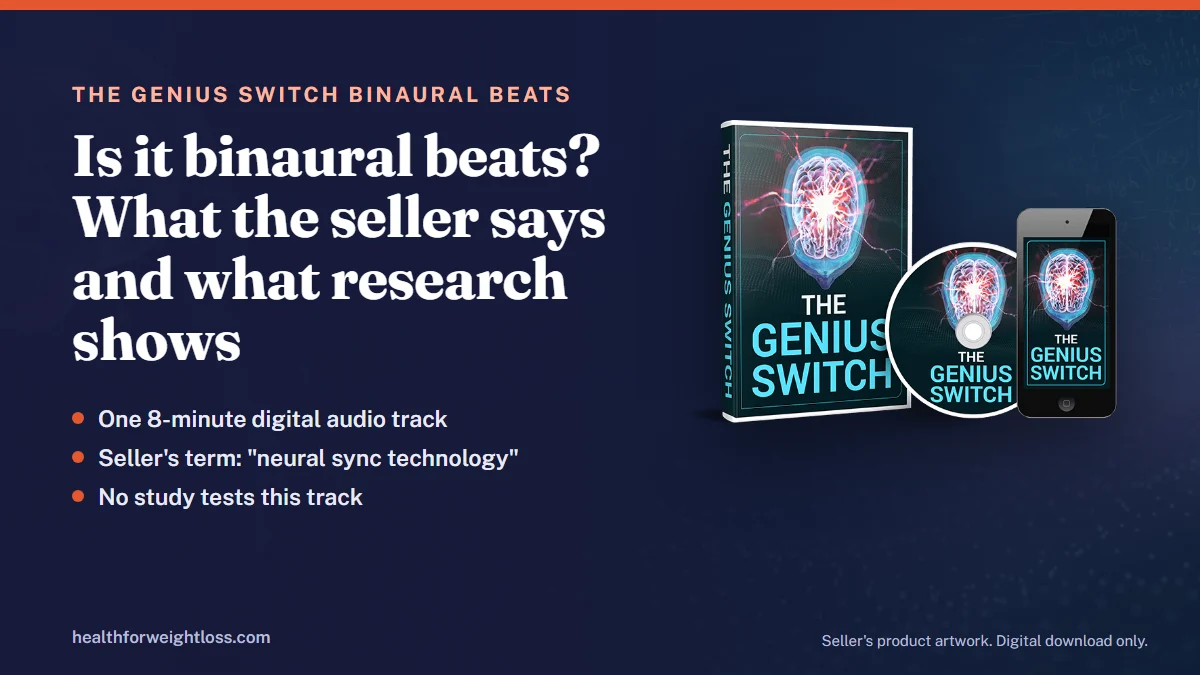
- The product is one audio file, about 8 minutes long, that the seller calls a “targeted auditory sequence”.
- The seller’s explanation is “whole brain activation” through “neural sync technology”, which it says syncs the two halves of the brain.
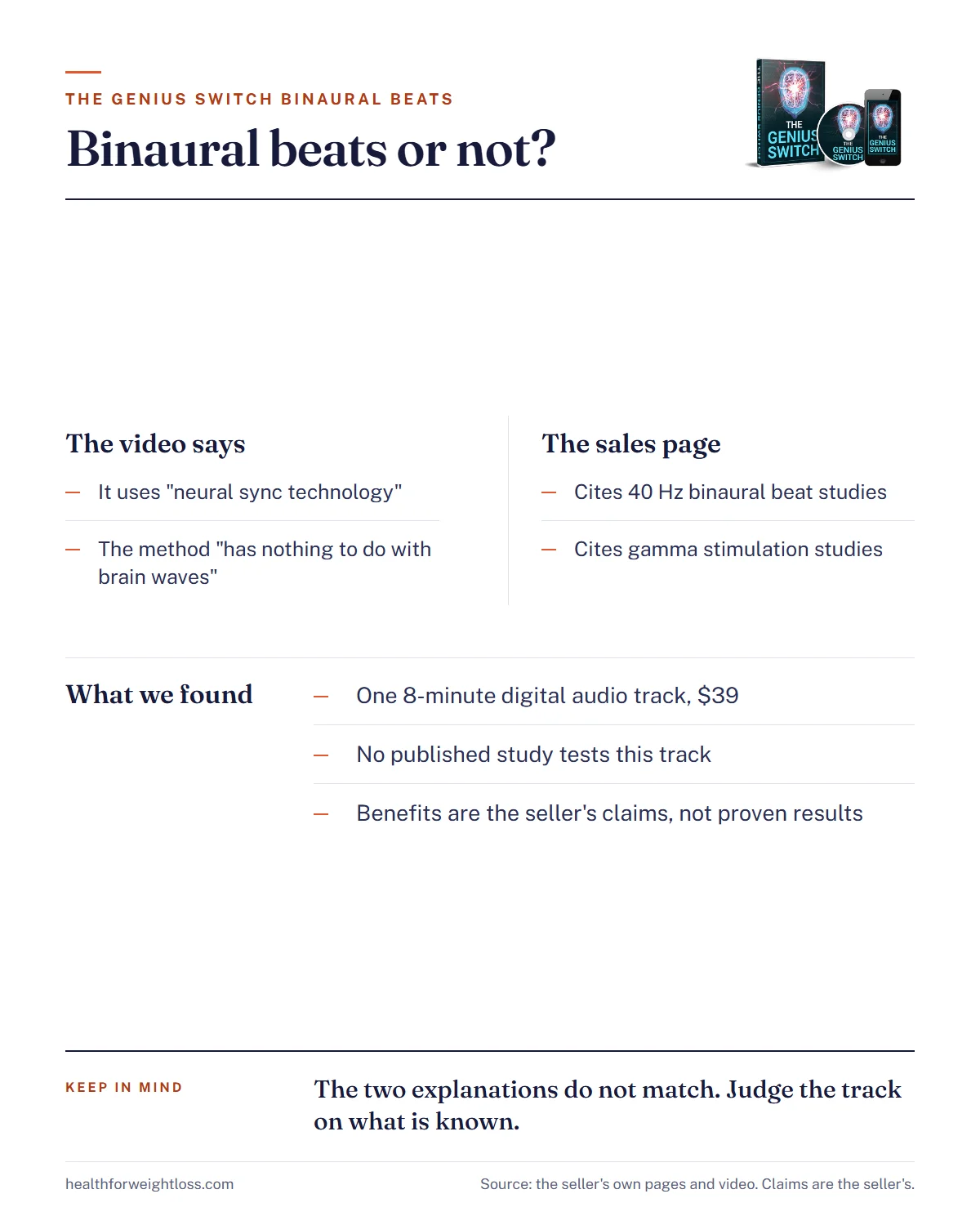
- The video says the method “has nothing to do with brain waves” and describes sound waves as “incomplete”.
- The sales page still lists studies on 40 Hz binaural beats and gamma stimulation as its references.
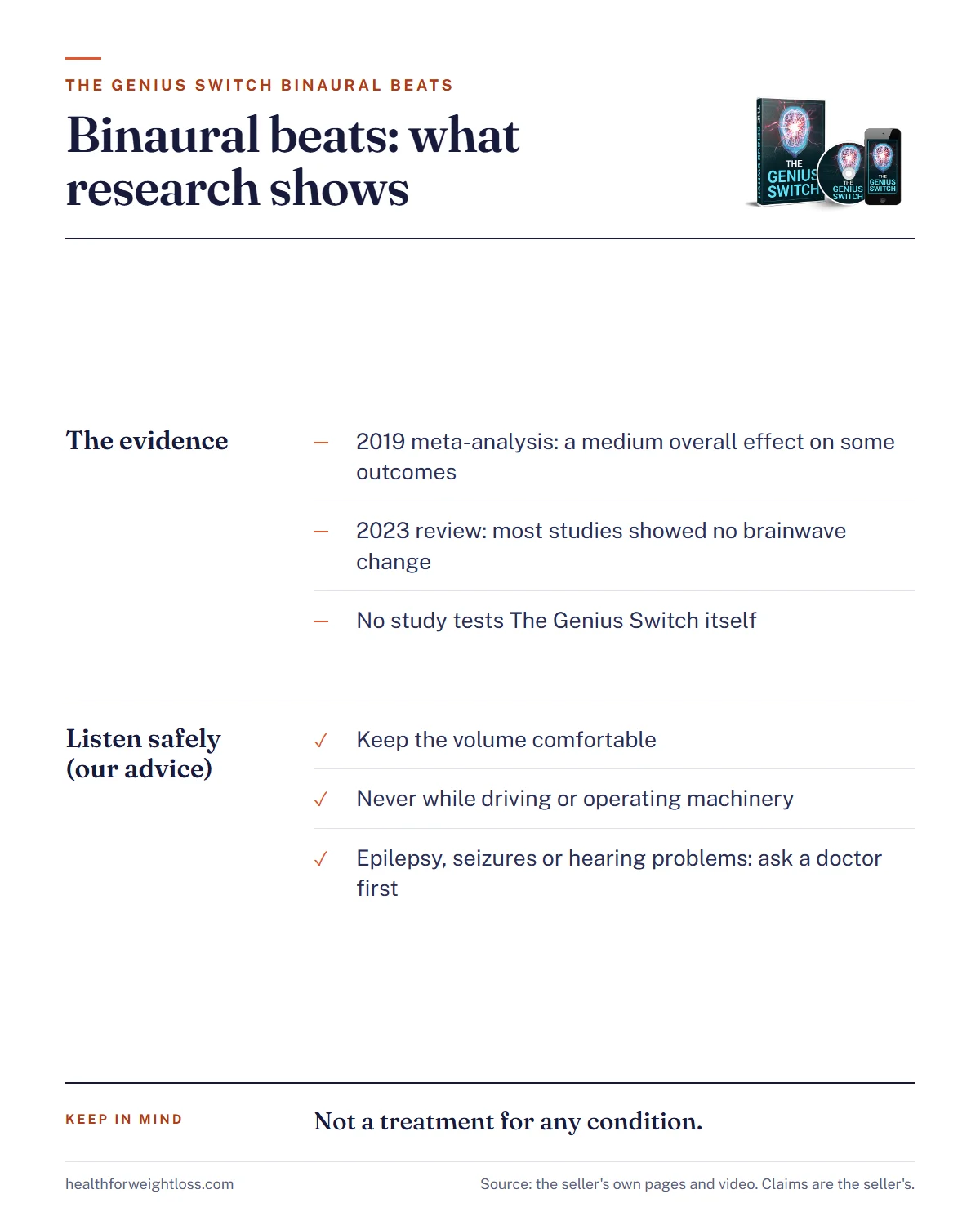
- No published study tests The Genius Switch track itself.
So we cannot tell you that it is a binaural beats track, and we cannot tell you that it is not. What we can do is explain what binaural beats are, what the cited kind of research found, and where the seller’s claims go well beyond it.
Want to hear the track for yourself?
One 8-minute digital audio track, $39 through ClickBank, delivered by email. The Terms give a 90-day refund window for digital products.
See The Genius Switch OfferOpens the seller’s order page via ClickBank.
What binaural beats are
A binaural beat is something your brain creates, not something in the recording. You play one tone in the left ear and a slightly different tone in the right ear. Your auditory system combines them, and you hear a soft pulsing at the difference between the two. If the left ear gets 400 Hz and the right ear gets 440 Hz, the perceived beat is 40 Hz.
Three practical points follow from that:
- Headphones matter. Each ear has to receive its own tone. Through a single speaker the two tones mix in the air and the effect is lost.
- The beat is subtle. Many recordings hide the tones under music, rain or noise, so you may not consciously notice them.
- “Entrainment” is the theory. The idea is that brain activity may partly follow the beat frequency. Researchers measure this in labs with equipment such as EEG or MEG. It is a measurable response in some studies, which is not the same thing as a lasting change in how you think.
| Term | What it means |
|---|---|
| Binaural beat | A pulse you perceive when each ear hears a slightly different tone |
| Beat frequency | The difference between the two tones, for example 40 Hz |
| Gamma range | Fast brain rhythms, roughly around 40 Hz, often studied for attention |
| Entrainment | Brain activity partly following an outside rhythm while it plays |
| Whole brain activation | The seller’s own phrase, not a clinical or scientific term |
What the seller says the track does
The sales video is hosted by the presenter, who introduces himself as Dr. Daniel Barone, a New York City neurologist. We could not verify his identity or his involvement with the product, and nothing here should be read as an endorsement by any doctor. The presenter says the track uses “neural sync technology”, that one hour of neural sync was compressed into 8 minutes, and that listening daily syncs your brain’s two hemispheres.
He links this to Roger Sperry’s Nobel Prize. Sperry did win the 1981 Nobel Prize in Physiology or Medicine, for his split-brain research on how the two hemispheres specialize. He did not win it for “whole brain activation”, and that phrase is the seller’s, not a medical one.
The claimed results are broad. According to the video, listeners get eureka moments, learn faster and remember more, and also see luck, promotions, money, better relationships, weight loss, easier headaches and joint pain, and better grades for their children. The video says it “starts working the very first time you listen” and that most people see results within a couple of weeks. On one casino story, the presenter himself says “there is of course no evidence to support that the genius switch caused that”. We would apply the same caution to every claim on the list.
The “nothing to do with brain waves” contradiction
This is the part that matters most for anyone searching for binaural beats.
Early in the video, the presenter says this at-home method “has nothing to do with brain waves”. Later he describes sound waves as growing in popularity online but “incomplete”, because they “only address brain waves”. He also says the track is “not a brain pill or a brain wave”.
Yet the sales page lists research on 40 Hz binaural beats and gamma stimulation as references. Binaural beat research is, almost by definition, research about brain rhythms and how they respond to sound.
We are not saying either statement is false. We are saying they pull in different directions, and the seller does not explain how they fit together. A fair reading is this: the marketing distances itself from ordinary “brain wave” audio, while borrowing the credibility of binaural beat studies. Keep that in mind when you weigh the evidence section below.
Prefer to judge it by ear?
It is a $39 digital download, not a subscription. Keep your ClickBank receipt so you can use the 90-day refund window in the Terms.
Check the Current PriceOpens the seller’s order page via ClickBank. Affiliate link: we may earn a commission at no extra cost to you.
What research on binaural beats actually shows
Binaural beats have been studied for decades, and the results are interesting but limited.
The 2019 meta-analysis. Garcia-Argibay and colleagues pooled 22 studies on memory, attention, anxiety and pain perception, published in Psychological Research. They reported an overall medium effect and concluded that the size of the effect depended on the beat frequency, how long people listened, and when they listened relative to the task. That is encouraging for the general idea, though the pooled lab experiments used different tones, lengths and tasks.
The 2023 review. Ingendoh and colleagues (PLOS ONE) asked a narrower question: do binaural beats actually pull brainwaves toward the beat frequency? Of the 14 studies they reviewed, 5 supported that idea, 8 contradicted it and 1 was mixed. So the field as a whole is mixed: a medium effect on some outcomes, and weak support for the brainwave mechanism.
The 40 Hz study the sales page cites. Ross and Lopez (Scientific Reports, 2020) followed 27 healthy young adults over three days on an attentional blink task, a computer test where people try to spot a second target shortly after a first one. Participants heard 40 Hz beats on one day and 16 Hz beats on another. Brain recordings showed a stronger response to the 40 Hz beats. Performance improved between sessions rather than within a session, and the authors concluded that 40 Hz beats during training sped up the training effect.
What these studies do not show:
| What the studies looked at | What The Genius Switch marketing claims |
|---|---|
| Short-term lab tasks like attention tests | Lasting “whole brain activation” |
| Specific frequencies, described in the paper | A track whose contents are not described |
| Small groups of volunteers | “18,456 everyday Americans” helped (seller’s figure) |
| Attention, mood, anxiety, pain perception | Luck, money, promotions, weight loss, kids’ grades |
| Published methods anyone can check | No published test of this track |
Put simply, the research supports a narrow, short-term idea: some beat frequencies may nudge attention or mood in a lab. It does not support the wider life outcomes in the video, and it says nothing about this particular file.
How to listen safely
This is our general advice for any audio product built around beats or entrainment, including The Genius Switch.
- Keep the volume comfortable. You should be able to hear someone speaking near you. The NIDCD warns that listening through headphones at high volume can damage hearing over time.
- Never listen while driving or operating machinery. The seller asks you to close your eyes and relax, which is the opposite of what those tasks need.
- Ask a doctor first if you have a history of epilepsy or seizures, or any hearing problem.
- Stop if you feel unwell, for example dizzy, anxious or headachy, and do not push through it.
- Do not replace care. The site itself says it is “not intended to diagnose, treat, cure, or prevent any disease”. If you are dealing with pain, low mood, memory problems or headaches, talk to a professional.
The seller’s routine is simple: headphones on, eyes closed, 8 minutes a day. The video says missing a day is okay. If you want to try it, a quiet chair after work or before bed is a sensible setting.
Who might still want to try it
Some people enjoy a short, eyes-closed audio break, and that habit has value on its own. Eight quiet minutes can be a cue to wind down before bed or reset before focused work, and good sleep and steady focus help almost any health goal, including sticking to a meal plan. That benefit comes from the routine, though, and the track is not a weight-loss tool. The seller’s 17 lb story is an unverified anecdote.
You might reasonably try it if you:
- like guided or ambient audio and are curious about this one;
- can treat $39 as the cost of an experiment, with the 90-day refund window as a backstop;
- will judge it by how you feel after a few weeks, not by the promises in the video.
You might skip it if you want a product with published evidence behind it, or if free binaural beat recordings already work for you. The presenter says tracks on YouTube or Spotify are not the same, but that is his claim and we cannot compare the files.
Curious enough to test it?
$39 one-time through ClickBank, emailed after checkout. Terms: refund requests for digital products within 90 days of purchase.
Go to the Order PageOpens the seller’s order page via ClickBank. Affiliate link: we may earn a commission at no extra cost to you.
Price and refund, briefly
The sales page shows $39 for the track plus four bonuses, paid through ClickBank. Checkout shows your local currency plus tax, so the amount can differ by country. Your card statement will read CLKBANK*GeniusSwitch.
On refunds, the site’s Terms say digital products can be refunded if you ask within 90 days of your initial purchase, and ClickBank’s checkout also states 90 days from purchase. One oddity: the separate refund page on the site is a copy of a policy for “NeuroActivate” bottles (60 days, unopened bottles, an address in Tallmadge, OH). It does not fit a digital track, so rely on the Terms and ClickBank instead, and keep your ClickBank receipt. ClickBank order support can be reached at 1-800-390-6035.
Bottom line
Is The Genius Switch a binaural beats track? The seller never says so plainly. The video says its method has nothing to do with brain waves, while the sales page leans on binaural beat and gamma studies. Those studies report short-term effects on things like attention in lab settings, and the wider binaural field is mixed. They do not test this track, and they do not support claims about luck, money, healing or weight loss.
If you try it, treat it as an 8-minute relaxation habit, keep the volume comfortable, never use it while driving, and judge it on your own experience within the 90-day refund window.
Decided to give it a fair try?
$39 digital audio track via ClickBank. Save the receipt and note the 90-day refund window in the Terms.
Get The Genius SwitchOpens the seller’s order page via ClickBank. Affiliate link: we may earn a commission at no extra cost to you.