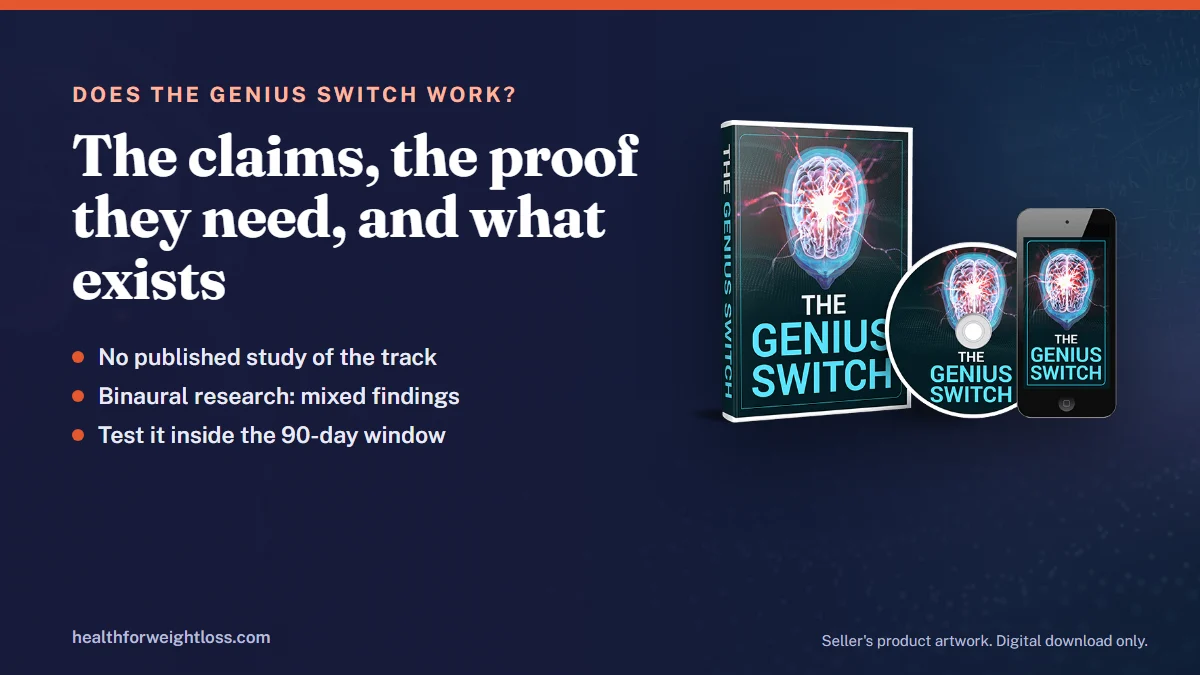
Does The Genius Switch work? That depends on what “work” is supposed to mean, and the sales video sets the bar very high: sharper memory, faster learning, luck, money, even weight loss. This page takes each promise in turn, asks what kind of evidence would prove it, and checks whether that evidence exists. Then it shows how to give the track a fair personal trial if you decide to buy it anyway.
Before you read on The Genius Switch is one downloadable audio track of about 8 minutes, priced at $39. Every benefit tied to it comes from the seller, and no independent test of the track has been published.
We worked from the seller’s sales page and 36-minute video, the Terms and the ClickBank checkout, plus published research on related audio. We have not run our own trial.
Want to see exactly what is being promised?
The order page plays the full sales video. The track costs $39, arrives by email, and the Terms allow refund requests for 90 days.
Watch the Video on the Order PageOpens the seller’s order page.
Does The Genius Switch work? The short answer
Nobody has shown that it does what the video says. No published study tests this track, so there is no measured result to point to, good or bad. Research on binaural beats, the nearest field, is mixed: a 2019 meta-analysis reported a medium overall effect on some outcomes, yet a 2023 review found weak support for the idea that the beats change brainwaves at all.
The seller’s own legal text is cautious too. In a section headed “For Entertainment Purposes Only”, the Terms describe entrainment as inexact, “not an exact science”, and offer the products as entertainment. That is a long way from the “genius” language in the video.
What can be said is narrower. Eight quiet minutes with your eyes shut is a pleasant break for many people, and a daily pause like that can help some of us wind down. That is a benefit of resting, and you would get it from many kinds of audio, or from silence.
What “working” means in the sales video
To judge a product fairly, you first need its own definition of success. The video gives three layers.
The mechanism. In the video, the presenter (he introduces himself as Dr. Daniel Barone, a neurologist) credits “neural sync technology” with bringing the two halves of the brain into step, which he calls “whole brain activation”. He says an hour of neural sync has been squeezed into 8 minutes. We could not verify who the presenter is.
The outcomes. Eureka moments, learning faster, better memory, lucky coincidences, promotions and money, better relationships, quitting smoking, easier headaches and joint pain, a 17 lb weight-loss story and better school grades for children.
The timing. According to the video, effects begin from your very first session, plenty of buyers pick up on a change by day two or three, and most see results inside roughly two weeks.
So for the seller, “working” means broad, fast, life-wide change. That is the claim to test.
Claim by claim: what would count as proof
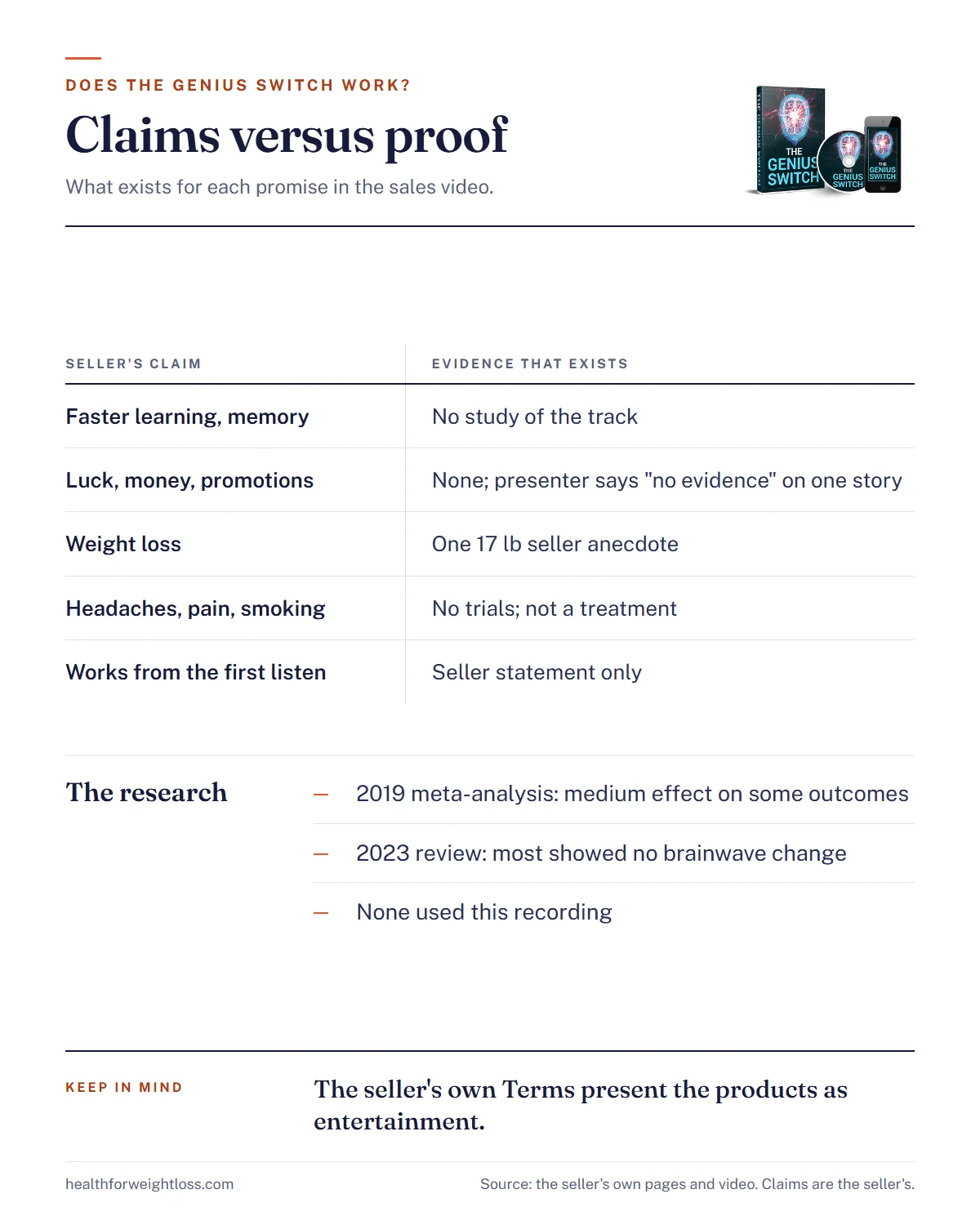
For any of these outcomes, solid evidence would mean a controlled trial: some people hear the track, others hear a neutral recording, neither group knows which it got, and the results are measured the same way for both. Here is how each claim stands.
| Claim in the video | What would prove it | What exists |
|---|---|---|
| Faster learning, better memory | A blinded trial of this track against a dummy recording | No study of the track |
| Eureka moments, insights | A defined measure of insight, tested against a control | Nothing published |
| Luck, money, promotions | No audio study could measure these fairly | Presenter admits “no evidence” on one casino story |
| Weight loss (17 lb story) | A trial with measured weight in both groups | One seller anecdote |
| Headaches, joint pain, smoking | Clinical trials with medical oversight | None; the disclaimer rules out treating disease |
| Children’s grades | School results compared with a control group | Nothing published |
| Works from the first listen | Before and after tests on the first day | Seller statement only |
The table makes a simple point. Several of the claims could be tested, and none has been. Others, like luck, are not the kind of thing an audio file could plausibly be shown to change.
Why the testimonials cannot settle it
One of the people telling a story in the video is introduced as “Ellie from Manhattan”. Read her story, and the rest, with the seller’s own caveat attached: the Terms say testimonials may be played by actors or digital avatars, that some of the people shown may be relatives, friends or early backers of the company’s founders. On top of that, the Terms say the results described are exceptional, not typical.
Even if every story were genuine, a handful of hand-picked successes cannot answer whether a product works. A seller shows its best cases. You never see the people who listened for a month and noticed nothing. The same goes for the “18,456 everyday Americans” and the “stacks of five star reviews” the video mentions: these are the seller’s figures, and we found no way to check them.
The science the seller leans on
Roger Sperry. The video draws on Sperry’s 1981 Nobel Prize in Physiology or Medicine. Sperry was honored for his split-brain work on how the two hemispheres specialize. That work says nothing about this track, and “whole brain activation” is a sales phrase, not a medical term.
Binaural beats. Among the references on the sales page are papers on gamma stimulation and on 40 Hz beats, one of them an attentional-blink study by Ross and Lopez published in 2020. Earlier work on cognition, anxiety and pain was combined in a 2019 meta-analysis led by Garcia-Argibay. It found a medium, fairly consistent overall effect across those outcomes. A 2023 systematic review by Ingendoh and colleagues asked a different question, whether the beats actually shift brainwaves, and the 14 studies it covered split: 5 supported that, 8 contradicted it and 1 was mixed.
The contradiction. In the opening minutes, the presenter rules out any link to brain waves, and later he labels sound-wave methods “incomplete”. The references on the sales page point to exactly that kind of research. Either the track is related to binaural beat work, in which case it rests on a mixed body of research, or it is not, in which case those studies do not apply to it at all.
Prefer to judge it on your own experience?
ClickBank sells the track plus four digital bonuses for $39. Plan your trial so you finish well inside the 90-day refund window.
Look at the Offer in FullThis is an affiliate link to the ClickBank order page. If you buy, we may earn a commission at no cost to you.
How to test it fairly yourself
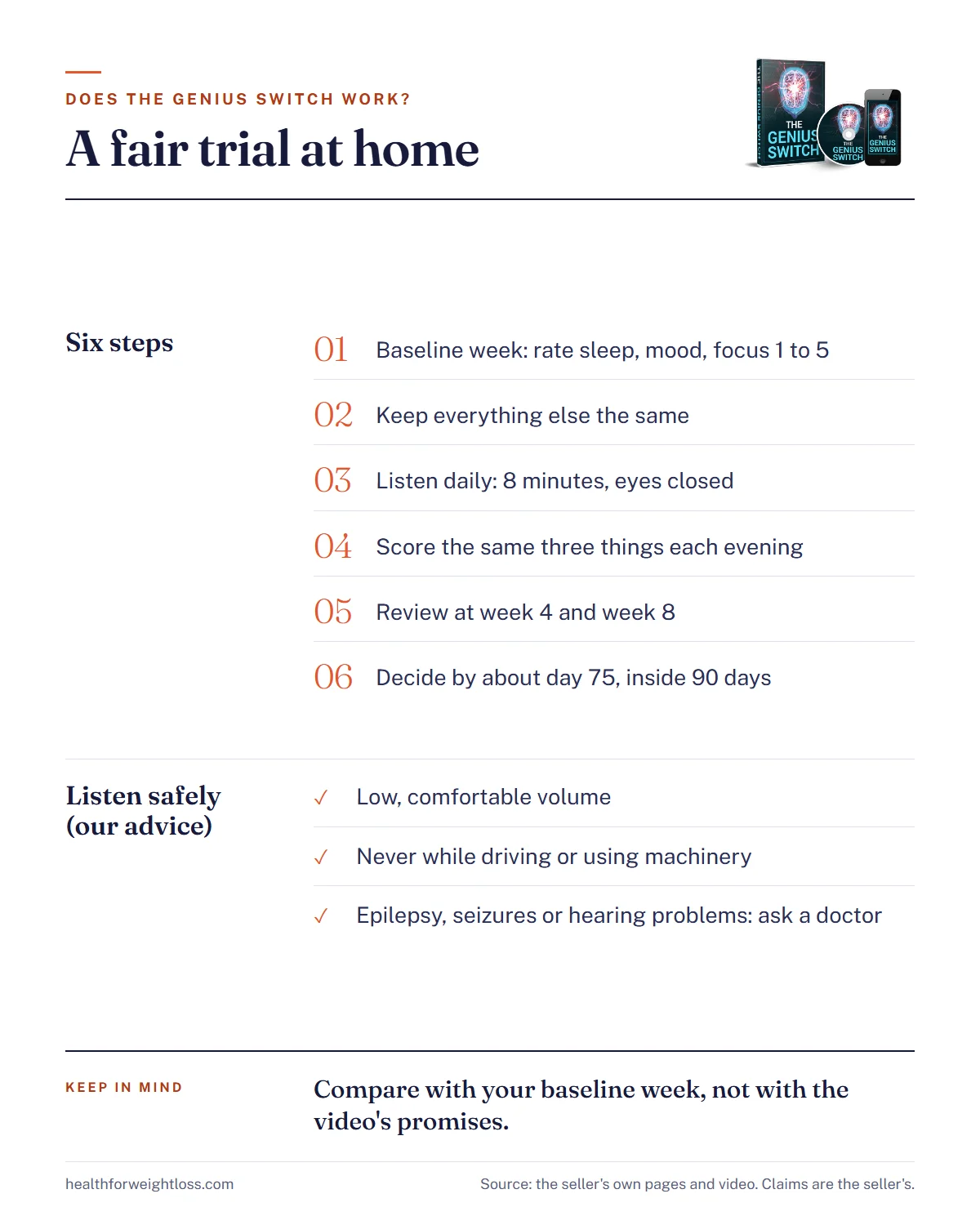
If you buy it, a little structure turns “I think I feel sharper” into something you can actually judge. This plan is our suggestion, not something the seller provides.
- Write a baseline first. For one week before you start, rate your sleep, mood and focus each evening from 1 to 5.
- Keep everything else steady. Change one thing at a time. If you also start a new diet or sleep routine, you will not know which one helped.
- Listen at the same time daily. The seller’s routine is a daily 8-minute session with headphones and closed eyes, and the video says a missed day is okay.
- Score the same three things each evening. Add one line of notes.
- Review at week four and week eight. Compare with your baseline week, not with the video’s promises.
- Decide by about day 75. That leaves room to request a refund inside the 90 days.
| Day | Listened? | Sleep (1 to 5) | Mood (1 to 5) | Focus (1 to 5) | Note |
|---|---|---|---|---|---|
| Baseline week (example) | No | 3 | 3 | 3 | Before starting |
| Day 1 | Yes | ||||
| Day 2 | Yes |
Be honest about expectation. Most of us rate a new routine kindly when we hope it works, which is why trials compare against a dummy. You cannot blind yourself at home, so treat small changes with caution and look for clear, steady differences.
When an audio track is the wrong tool
If you are struggling with memory, concentration, low mood, headaches or pain, see a doctor. These can have causes that need proper care, and the site’s own disclaimer rules out diagnosing, treating or curing anything. The same goes for weight: the 17 lb story is a single claim from the seller, and steady habits around food, sleep and movement have far better support than any recording.
Our own listening advice for audio of this kind: start at a low volume and stay there, never play it while you drive or run machinery, and if seizures, epilepsy or hearing trouble are part of your history, get a doctor’s view before you begin.
Going ahead with a trial?
Order through ClickBank, file the receipt email somewhere safe, and start your log before the first listen.
Order The Genius SwitchThis is an affiliate link to the ClickBank order page. If you buy, we may earn a commission at no cost to you.
Bottom line
Does The Genius Switch work? On the evidence available, nobody can say it does. The video promises a wide range of results, from memory to money to weight, but no study has tested the track, the testimonials come with the seller’s own warning that they may be acted and are not typical, and the research it cites is about related audio, where the findings are mixed. The Terms even describe the products as entertainment.
If you are curious, the honest way to find out is a structured personal trial, finished in time to use the 90-day refund window if the answer is no. Go in expecting a calm eight-minute break, and treat anything more as a surprise rather than a promise.
Try it with clear expectations
One $39 digital audio track, emailed after checkout. Keep notes, keep your receipt, and decide before the refund window closes.
Get The Genius SwitchThis is an affiliate link to the ClickBank order page. If you buy, we may earn a commission at no cost to you.