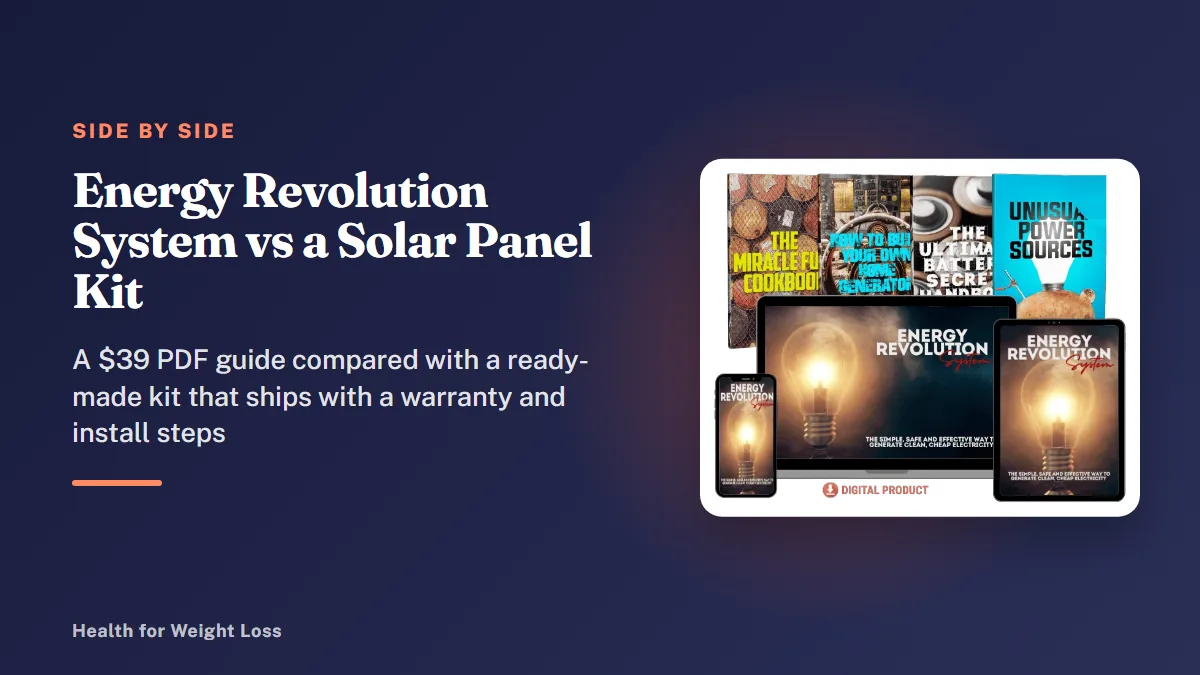
Energy Revolution System vs solar panel kit is a comparison of two different products. One is a $39 PDF guide about a small home power device, and the other is a physical kit with its own packaging, warranty and instructions. This article looks at the two in general terms, asking what each one gives you, without naming any brand and without making performance or price claims about solar equipment.
Compare the guide’s single payment
$39 once for a PDF guide, delivered as a download link by email.
See the $39 guideClickBank is the retailer for the guide’s order
Energy Revolution System vs solar panel kit: the core choice
The core choice is between written plans and finished hardware. A guide gives you instructions, a sequence of steps and a materials list, all in one file. A kit gives you parts that arrive together, plus whatever paperwork the manufacturer supplies. Which one fits depends on whether you want to learn the design and assemble it yourself, or whether you would rather start from equipment someone else has already matched.
Neither route is better in every case. The table below is not a ranking. It simply lists the items that differ, so you can see where each product stands before you choose.
| Consideration | DIY guide | Ready-made kit |
|---|---|---|
| What arrives | A PDF with a quick-start guide and a materials list | Physical hardware |
| Instructions | A walkthrough you follow and adapt | Instructions written for that equipment |
| Warranty | None from the guide itself | Usually a manufacturer warranty |
| Parts sourcing | Your responsibility | Included with the kit |
| Permits | Your responsibility | Your responsibility |
What a DIY guide gives you
A guide explains a concept, then shows how the pieces could fit together. For a reader who wants to understand each stage before touching anything, that is a real benefit. It can also help when you need to adapt a plan to your own roof, room or fuse box, because the logic behind the setup is written down rather than tucked inside a box.
The seller describes Energy Revolution System as a PDF that contains a Beginner Quick-Start Guide and a materials list. Those items are the guide’s main value. What the guide does not supply is the hardware, the warranty on that hardware or a support route for a physical product. You would source every part yourself, and the seller’s pages do not list them.
What a ready-made kit usually includes
A ready-made solar panel kit arrives as hardware. Its manufacturer typically provides a product warranty, installation instructions written for that specific equipment and a support route if a part arrives damaged. Many kits are also designed so the components match one another, which removes a layer of guesswork for the buyer.
Those points are general considerations, not a promise about any particular product. Warranty terms, instruction quality and support differ from one maker to another, so read the terms of any kit you consider before you spend money on it.
Warranty, instructions and permits as general considerations
Three areas separate a guide from a kit in most cases. The first is the warranty. A manufacturer warranty covers a finished product for a stated period, while a guide carries no equivalent promise about the parts you select. The second is installation. A kit normally comes with instructions for its own parts, while a guide asks you to assemble a plan from several sources. The third is permits.
The permit point deserves emphasis. A finished kit does not remove the need for local approval, and a guide does not either. The rules depend on your address, the size of the work and whether the system connects to the house wiring. Check with your local authority before you commit to either route.
Where the $39 guide makes sense
At $39 as one payment, the guide has a low entry cost compared with buying hardware before you understand the design. For a reader who wants to learn how a small home power device is laid out, the file can serve as a study document. It also suits someone who plans to work with a licensed electrician and wants a written plan to discuss with that professional.
That is a fair position for the guide. It does not pretend to be hardware, and it does not promise a finished unit. If your aim is to learn and plan, the single payment is straightforward to understand, and the refund route is written down for you.
Choose the guide for the planning stage
A single $39 payment for the PDF, plus a 60-day money-back guarantee.
Order the Energy Revolution System guideKeep your confirmation email for any refund request
Where a finished kit fits better
A finished kit suits a reader who wants a warranty, a set of matched parts and instructions written for that equipment. It also suits someone who does not want to source components, compare specifications or design a layout alone. The trade-off is that you commit to hardware first, and the planning and permit questions still have to be answered before any installation begins.
Neither route removes the safety questions. Fire and shock risks, local rules and licensed work apply to both, so the choice comes down to what kind of help you need and how much of the design you want to own yourself.
Free DIY power articles as a third option
Free online articles about DIY power are a third route. They can explain basic concepts well, and many are a useful first read. Their drawback is that they rarely give a complete plan, and they seldom bring the materials list and the quick-start steps together in one document. A guide bundles those pieces, while free articles leave you to stitch them together.
Using free articles alongside the guide is a reasonable approach, provided you check every figure and every instruction against your local rules. Read free material as background, and keep the seller’s file as the document you work from.
Set the guide beside the free reading
$39 once for the PDF, with the materials list and quick-start guide included.
Read the guide’s order pageSingle payment · ClickBank is the retailer
Who each route suits, in plain terms
A reader who enjoys planning and wants to understand the layout first is the natural fit for the guide. Such a reader will spend time on the materials list, read the quick-start steps closely and bring a finished plan to a conversation with a licensed electrician. That reader accepts that sourcing parts and checking them against local rules is part of the job.
A reader who wants a finished product, a warranty and a clear support route is better served by a kit. That reader accepts a higher starting cost and a narrower set of choices in return. Both readers still need the same local permits and the same respect for fire and shock risk, so neither route removes the planning work. For more on the offer, the hub gathers the seller’s facts, and the safety page restates the local-rules point in its own words.
Our short verdict on the comparison
A guide and a kit are not the same product, so the right comparison is about the job you need done. The guide is a low-cost written plan that you must source and check yourself. The kit is hardware that comes with its own warranty and instructions, at a higher starting point. Both still require permits, licensed work where needed and careful attention to fire and shock risk.
For a reader who wants to learn and plan, the single $39 payment is a sensible starting point, and the seller’s refund route is written out for you. Our review of the guide sets out the score and the open points, and the hub lists the seller’s facts in one place. If you are still weighing the file itself, our what-is article and the PDF delivery article cover the format in more depth. Read the file, check it against local rules, and only then choose what to build.
Start with the written plan
$39 for the Energy Revolution System PDF, delivered by email.
Go to the $39 order pageSingle payment through ClickBank · keep your confirmation email