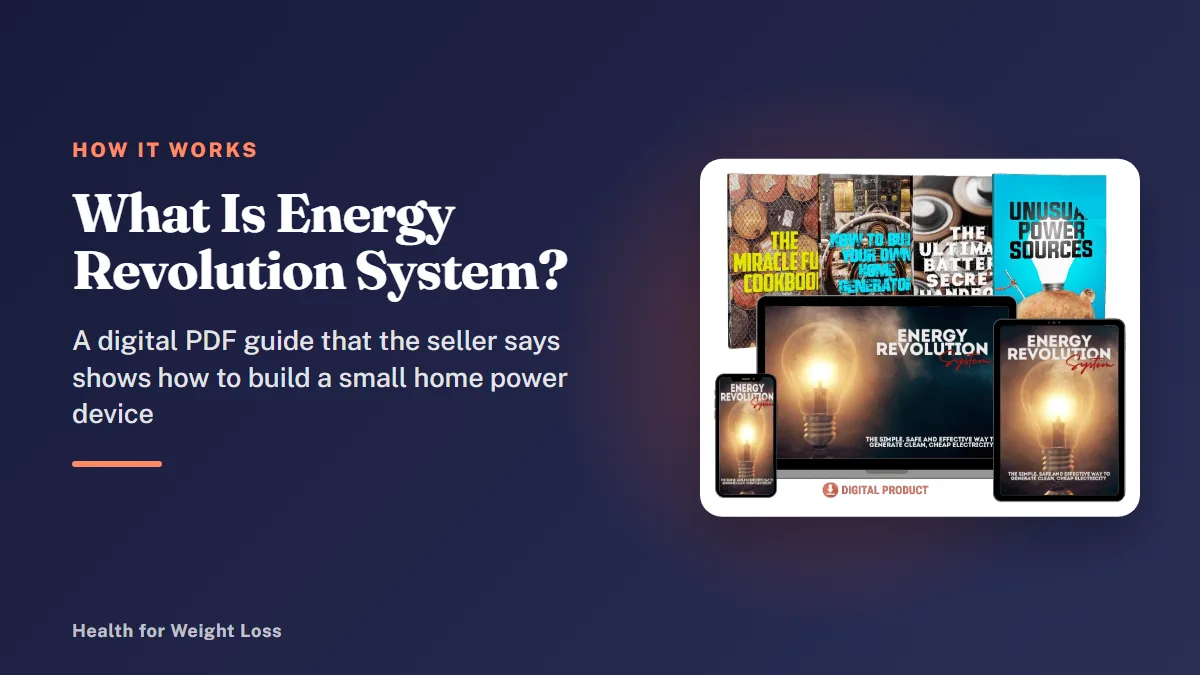
What is Energy Revolution System, in plain terms? The sales copy calls it a PDF manual covering a compact home power unit. You pay $39 once, receive a link in your inbox, and open the file on a computer or a phone. Nothing physical arrives in the post. This piece lays out the offer as its maker frames it, marks the points we cannot confirm, and puts safety ahead of every other consideration for anyone weighing a home power project.
See the guide’s order page
A digital file for $39, reached through the button below.
Visit the $39 checkoutCheckout is ClickBank’s, and ClickBank is the retailer.
What is Energy Revolution System? The sales copy’s version
The sales copy presents Energy Revolution System as a PDF manual covering a compact home power unit. That description is the whole product as far as the written pages go. The thing you receive is a document, and no hardware follows it. Postage plays no role, because the file reaches you electronically.
Most of the persuasion lives in a promotional video. A personal anecdote opens the pitch, followed by broad promises about what the unit could do for a household. We do not repeat those promises here. The plain text pages are thin: they name the file, the price and the refund route, and they say little about what the chapters cover. Our hub gathers the facts in one view.
Read in that light, the description is a pitch for a finished walkthrough. Whether that walkthrough is complete, accurate or fit for your house is a separate matter, and the plain pages cannot settle it. That gap runs through the rest of this article.
The quick-start document and the materials list
Inside the file, the sales copy points to two starter items: a document labelled Beginner Quick-Start Guide and a list of materials. The first is pitched as an opening read before the main build. The second is pitched as the next thing to look at, so you can gauge what a project would call for.
Those two items are the only components the plain pages name. A starter document shows where to begin, which is helpful, but it is not the full route. The materials list would be the more useful of the two, yet no copy of it appears on the pages we can read, so you cannot set it against the tools and parts already in your garage. Once you have the file, check whether the list covers tools, protective gear, any wiring and the permits a project needs, and whether it flags the steps that call for a licensed electrician.
What we cannot confirm from the sales pages
Several points stay out of reach until the PDF is open. We cannot see the chapter order, so the sequence of a build is unknown. Parts and tools go unnamed on the plain pages. No materials cost is given, and nothing explains which local permits a build would trigger. The video asserts outcomes for the device, yet the written pages offer nothing to check those assertions against.
There is a further gap. We have not assembled the device, so this review describes the offer rather than the workmanship inside it. Anyone opening the file should measure every step against local rules before acting on it, and should regard the presentation as a sales document rather than a substitute for a qualified assessment of the property.
The seller’s own limits, restated
The footer of the seller’s page carries a disclaimer. In substance, it says the narrative and presentation exist for promotion, that the device is an experiment which was never technically assessed or produced in quantity, and that certain changes to a home could be unlawful depending on your location, with the local authority as the place to ask. It adds that the byline is a pen name and that actors portray the people quoted in the stories.
We keep those limits in view rather than letting the confident video set the tone. The pitch is the seller’s claim, and the footer is the seller’s own boundary on that claim. Our review explains how the score reflects both.
Safety comes before the parts list
Many newcomers start by scanning the parts list. For a home power project, flip that order. Before any diagram, confirm which local rules cover electrical work and power generation at your address, and whether an inspection must happen before anything is energised. Settle who is allowed to make each connection, then build the schedule around that answer. A written guide can explain a principle, but it cannot examine your consumer unit, your fuel store or the airflow in your garage.
The same caution applies to anything else you find alongside the file. The bonus titles touch fuel, alternators and batteries, and each carries its own hazards. No page should be read as permission to begin work. Each one is a prompt to check local requirements first.
Open the file with the rules in mind
$39 paid once, and the file arrives in your inbox.
Start at the $39 order pageSingle payment, with checkout run by ClickBank
What the $39 covers
The price is $39, charged once. An upgrade offered during checkout is listed as its own line, so read every line before you confirm. The $39 pays for the PDF and the items named inside it. It does not pay for materials, tools, inspections or an electrician, and no estimate of those costs is supplied.
A 60-day money-back guarantee attaches to the order. Keep your confirmation email, since it contains the order details a refund request needs. The steps for asking are set out in our money-back article.
Questions to settle before you read the file
Before you open the PDF, write down the questions the plain pages leave open. Those questions form a practical checklist, and they make the contents easier to weigh once the file is in front of you.
- Does the chapter order in the file match the order of the sales video?
- Which tools and materials appear, and are quantities given for each one?
- Which permits does the guide mention, and does it say when a licensed professional is required?
- Does the file say anything about fuel storage, ventilation or heat?
- Does it separate the quick-start steps from the full build, so a beginner knows where to stop?
Unanswered points stay open until the file answers them. Our complaints article works through the questions readers raise, and the what’s-included page restates the seller’s own list.
Know what you are opening
A PDF guide for $39, with a 60-day money-back guarantee and a written refund route.
Go to the order pageKeep your confirmation email · Our editorial score is 2.7 out of 5
Where to go from here
This article answers a narrow question: what the offer says the file is. It does not tell you whether the file suits your skills, your property or your local rules, and it does not price the project. For the score and the open points, read our review. For the offer terms as a whole, return to the hub.
A clear description is a useful start, not a verdict. Read the seller’s words, measure them against your local rules, and make your choice with the confirmation email and the refund steps at hand.
Ready to read the seller’s terms?
$39 once, a PDF delivered by email and a 60-day money-back guarantee.
Order the PDF guidePayment through ClickBank · keep your confirmation email