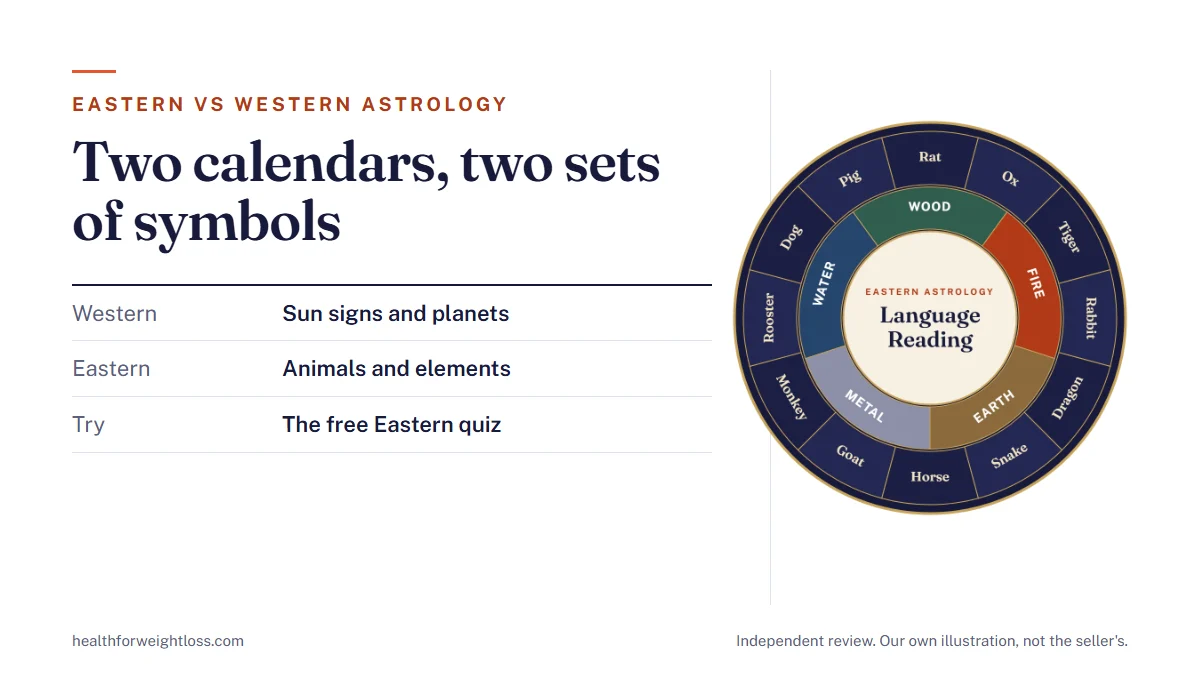
You probably know your sun sign, and you may know your zodiac animal too. Eastern vs Western astrology is really a story of two calendars, two sets of symbols and two ways of drawing a chart. This guide explains how each system works, side by side, and shows where the free quiz for the Eastern Astrology Language Reading fits in if you want to explore the lesser-known half.
Curious about your Eastern side?
The free quiz is the front door to your Eastern reading.
Take the free quizAffiliate link. Opens the quiz page.
The short version
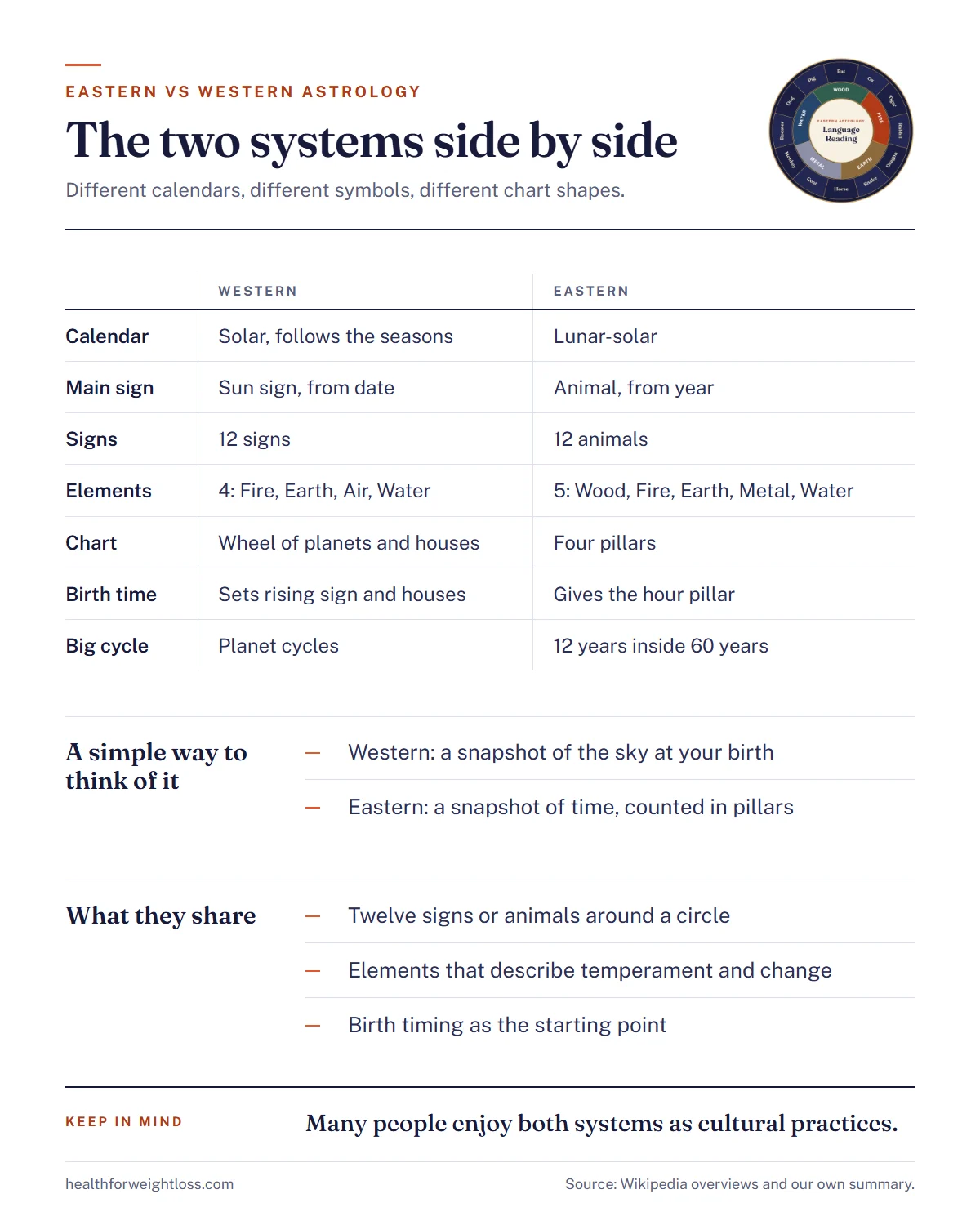
| Western astrology | Eastern (Chinese) astrology | |
|---|---|---|
| Calendar | Solar, following the seasons | Lunar-solar, with the new year in late January or February |
| Main sign | Sun sign, set by birth date | Zodiac animal, set by birth year |
| Number of signs | 12 signs | 12 animals |
| Elements | 4: Fire, Earth, Air, Water | 5: Wood, Fire, Earth, Metal, Water |
| Chart | A wheel of planets, signs and houses | Four pillars: year, month, day, hour |
| Birth time | Sets your rising sign and houses | Gives the hour pillar |
| Big cycle | Planet cycles, such as Saturn’s | A 12-year animal cycle inside a 60-year cycle |
Think of Western astrology as a snapshot of the sky, and Eastern astrology as a snapshot of time itself, counted in years, months, days and hours.
How Western astrology works
Western astrology uses the tropical zodiac, which is counted from the spring equinox. The ecliptic, the sun’s path across the sky, is split into twelve signs of 30 degrees each, and each sign has a rough run of dates. Aries starts around March 20 or 21, and the year rolls through Taurus, Gemini and the rest until it reaches Pisces in late winter.
A full Western chart is more than a sun sign:
- The Big Three. The sun sign, the moon sign and the rising sign (the sign on the eastern horizon at birth) are often read together. The rising sign changes roughly every two hours, so it needs a birth time.
- Planets. Mercury, Venus, Mars and the outer planets are placed in signs too.
- Houses. The chart is divided into twelve houses, each linked to an area of life, from self and home to relationships and career.
- Elements and modes. Signs belong to Fire, Earth, Air or Water, and to a cardinal, fixed or mutable mode.
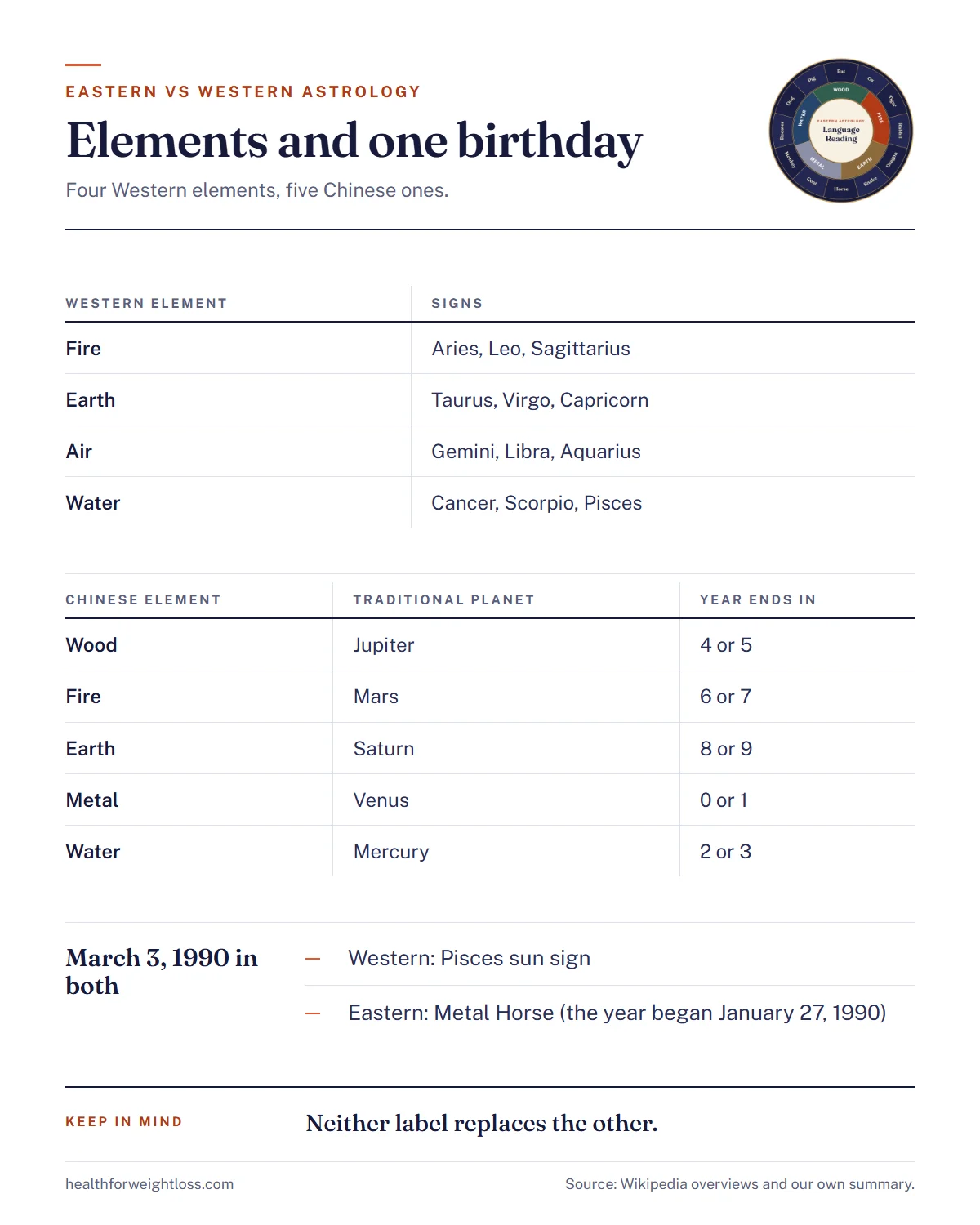
| Element | Signs |
|---|---|
| Fire | Aries, Leo, Sagittarius |
| Earth | Taurus, Virgo, Capricorn |
| Air | Gemini, Libra, Aquarius |
| Water | Cancer, Scorpio, Pisces |
How Eastern astrology works
Chinese astrology counts time with the Heavenly Stems and Earthly Branches, ten stems and twelve branches that combine into a 60-year cycle. The twelve branches are the twelve animals. The ten stems carry the five elements, each in a yang and a yin form.
- Your year gives your animal. It changes at Lunar New Year, not January 1.
- The last digit of the year gives your element. A year ending in 0 or 1 is Metal, 2 or 3 is Water, 4 or 5 is Wood, 6 or 7 is Fire, and 8 or 9 is Earth.
- A deeper chart uses four pillars. Your birth year, month, day and hour each become a pair of characters, called BaZi, or “eight characters”.
Our beginner’s guide to Eastern astrology covers the animals and elements in more detail, and the guide to your Eastern astrology birth chart explains the four pillars.
Elements and cycles, side by side
The two systems share a love of elements and cycles, and the differences are interesting.
- Four elements or five? The Western four are tied to the signs. The Chinese five describe how things change: Wood feeds Fire, Fire makes Earth, Earth bears Metal, Metal carries Water, and Water nourishes Wood.
- The sky connection. The Chinese five elements have traditional links to five visible planets: Jupiter with Wood, Mars with Fire, Saturn with Earth, Venus with Metal and Mercury with Water.
- Twelve years. One popular explanation for the twelve-animal cycle is Jupiter, which takes close to twelve years to go around the sky. Western astrologers, meanwhile, watch cycles like Saturn’s, which takes about 29 years.
A quick glossary
| Term | Meaning |
|---|---|
| Sun sign | The Western sign the sun occupied on your birthday |
| Rising sign | The Western sign on the eastern horizon at birth |
| House | One of twelve Western chart sections, each tied to a life area |
| Heavenly Stem | One of ten Chinese characters carrying an element and polarity |
| Earthly Branch | One of twelve Chinese characters, matching the animals |
| BaZi | The Chinese four-pillar birth chart |
What each system is best at answering
The two traditions tend to answer different questions, which is part of why people enjoy having both.
- Western astrology is often used for the “right now” questions. What is the mood this month? What is the moon doing? Daily and weekly horoscopes follow the planets as they move, so you can check in as often as you like.
- Eastern astrology is often used for the “big picture” questions. What is the character of this year? Which element do I carry? BaZi readers also look at ten-year stretches called luck cycles, which give a longer view of life stages.
Neither is meant to be the only voice. One easy way to use both is Western astrology as a weekly habit and Eastern astrology as an annual one, saved for Lunar New Year or a birthday.
One person, two readings
Here is how the systems label the same birthday. Take March 3, 1990:
| System | Placement | In plain words |
|---|---|---|
| Western | Pisces sun sign | A water sign, born in late winter |
| Eastern | Metal Horse | A Horse year (1990 began January 27) with a Metal element |
Neither label replaces the other. The Western view tells you about the season you were born in, and the Eastern view places you in a particular year of a long cycle.
Where does “Eastern” begin and end?
In this guide, Eastern means Chinese astrology, which is also followed across East Asia. Other Eastern traditions exist too. Vedic astrology from India uses a sidereal zodiac, which sits roughly 24 degrees away from the Western tropical one, and Vietnam’s zodiac swaps the Rabbit for the Cat. Our focus here is the Chinese system, because it is the one with the animal signs most people ask about.
Your animal is only the beginning
A full Eastern chart adds your element, named stars and more. The free quiz is the doorway.
Start the Eastern Astrology Language Reading quizAffiliate link. The quiz is free.
Trying the Eastern side
If you already know your Western chart, a personal Eastern reading is a natural way to add a second perspective. The Eastern Astrology Language Reading is one: per the seller, a chart (which it calls the Eastern Destiny Chart) over fifty pages long, sent to your inbox, centered on animal and element, plus three stars it names Wealth, Peach Blossom and Nobleman.
| Package | Price | What changes |
|---|---|---|
| Essential | $19 | Standard delivery, two to three days |
| VIP | $47 (seller’s regular price: $97) | Faster delivery, priority support and three bonuses |
You start with the seller’s free quiz: nine questions, then your name, email and birth date, and your reading and the offer appear.
Add an Eastern chapter to your story
A free quiz, a first reading and an offer. Essential starts at $19.
Start your free readingAffiliate link. Quiz page run by the seller.
Eastern vs Western astrology: which is deeper?
Neither wins. Western astrology has a huge amount of detail in its planets and houses. Eastern astrology has an elegant calendar system and a cultural history that is deeply tied to festivals, family and the Lunar New Year. Many people simply enjoy both, and that is a perfectly good way to use them.
A 60-day safety net
ClickBank gives your Eastern reading a 60-day money-back guarantee. Study your chart, compare it with your Western one, and if you decide it is not your cup of tea, you can ask for a refund inside the 60 days.
Who will enjoy comparing the two
- Sun sign fans who want a fresh angle on themselves.
- People with Chinese heritage who grew up with the animal signs.
- Curious learners who like seeing how two cultures describe time.
- Gift hunters shopping for an astrology lover.
- Both systems are cultural practices that many people enjoy for reflection and fun.
- The seller describes its readings as entertainment, lists software and pre-written text among the ingredients, and says results vary.
See your Eastern chart for yourself
Try the free quiz, with a 60-day refund window protecting any order.
See your Eastern chartWe may earn a commission on this link.