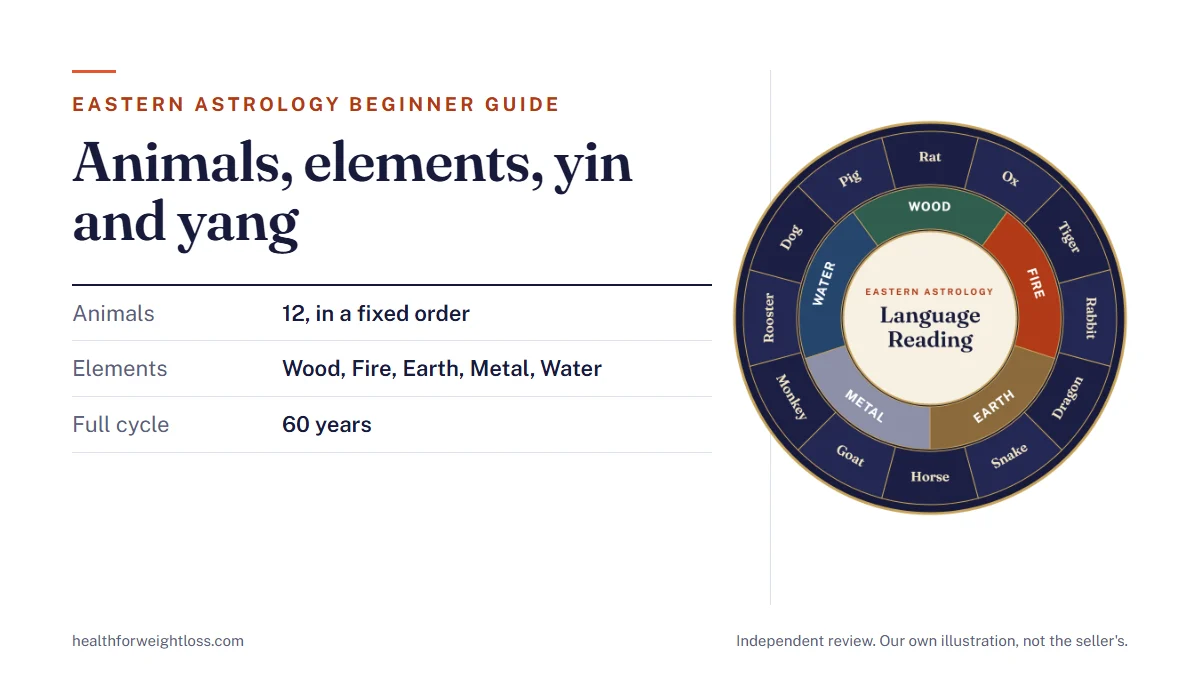
Eastern astrology is the old art of reading a person through the year they were born. Instead of twelve sun signs by month, it uses twelve animals by lunar year, mixes in five elements, and adds the balance of yin and yang. If you have ever been told you are a Dragon or a Tiger and wondered what that means, this beginner’s guide gives you the whole picture in one friendly read, and shows a simple way to get your own personal chart with the Eastern Astrology Language Reading.
Full disclosure: we publish independent guides, we do not sell any reading, and orders placed through our links can earn us a commission.
Curious about your own animal and element?
A free nine-question quiz shows you a first reading and offers a fuller personal chart.
Take the free quizThis opens the brand’s quiz page. A first name, an email and a birth date are needed to see your result.
What Eastern astrology is
The tradition grew out of China and spread across East and Southeast Asia, where versions of it are still woven into festivals, naming customs and family life. People often call it Chinese astrology or the Chinese zodiac. At its center is a simple idea: time moves in repeating cycles, and the character of a year colors the people born in it.
For most readers it works as a rich cultural practice and a pleasant way to think about personality, relationships and timing. It is a tradition and a pastime, not a scientific forecast, and it is best enjoyed in that spirit.
It starts with the lunar year
Western astrology follows the sun through the months. Eastern astrology follows the lunar calendar, and the year begins at Lunar New Year, which falls between late January and mid-February. In 2026, for example, the Year of the Horse began on February 17, and it runs until February 5, 2027.
That one fact explains the most common beginner surprise. A person born on January 20 does not belong to the animal of that calendar year: they belong to the animal of the year before, because the new lunar year had not started yet.
The twelve animals
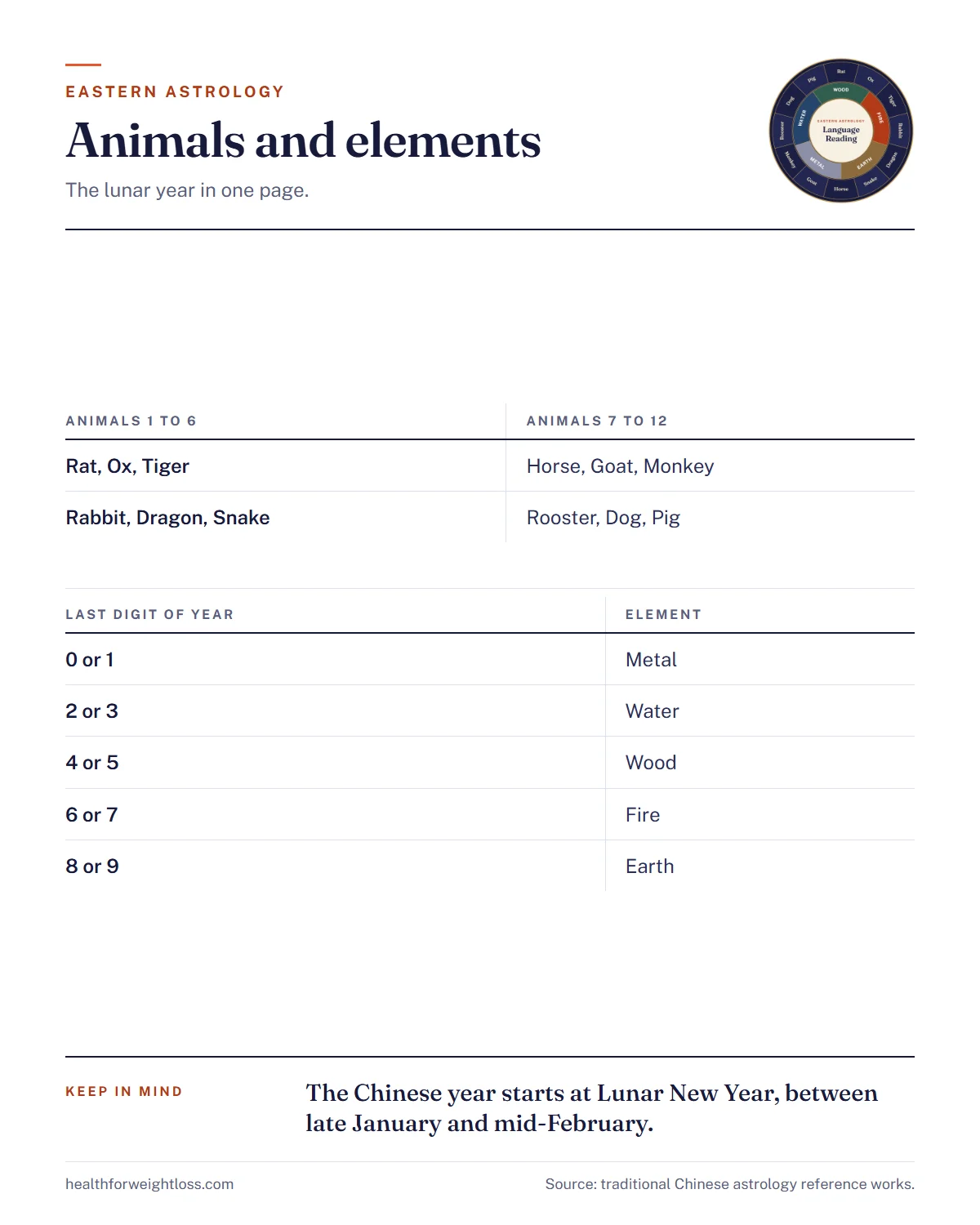
The animals always arrive in the same order, and the cycle repeats every twelve years:
| Order | Animal | Order | Animal |
|---|---|---|---|
| 1 | Rat | 7 | Horse |
| 2 | Ox | 8 | Goat (also called Sheep) |
| 3 | Tiger | 9 | Monkey |
| 4 | Rabbit | 10 | Rooster |
| 5 | Dragon | 11 | Dog |
| 6 | Snake | 12 | Pig |
A beloved legend explains the order. In one popular telling, the Jade Emperor held a race across a river and promised that the first twelve animals to arrive would each have a year named after them. The Rat hitched a ride on the Ox and leapt ahead at the end to finish first, and the Ox came second. Other tellings differ, which is part of the charm: the story is passed from generation to generation, and every family seems to have a favorite version.
The five elements
On top of the animal, each year carries an element. The five are Wood, Fire, Earth, Metal and Water, and they describe different kinds of energy: growth, warmth, stability, precision and flow.
A simple rule gives the element of a year from the last digit of the year:
| Last digit | Element |
|---|---|
| 0 or 1 | Metal |
| 2 or 3 | Water |
| 4 or 5 | Wood |
| 6 or 7 | Fire |
| 8 or 9 | Earth |
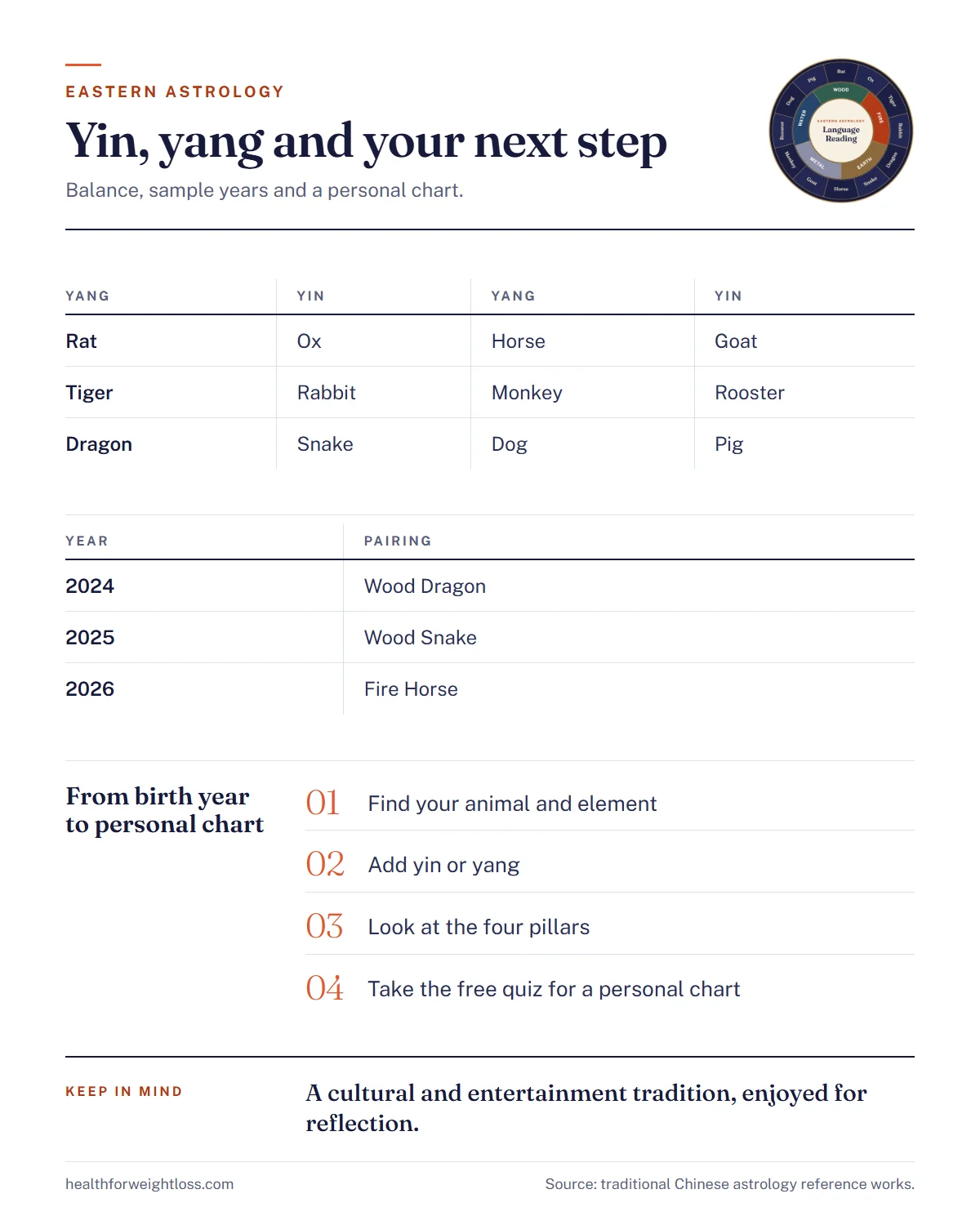
So 2024 (a Dragon year) is Wood, 2025 (Snake) is Wood, and 2026 (Horse) is Fire, which makes it a Fire Horse year. Combine twelve animals with five elements and you get a cycle of sixty years, which is why a Fire Horse year only returns about once in a lifetime.
Yin and yang
The last ingredient is balance. Yin is the receptive, quiet, inward side of things, and yang is the active, outward side. In this system, a year ending in an even digit is yang and a year ending in an odd digit is yin, and the animals alternate between the two as well. The Rat, Tiger, Dragon, Horse, Monkey and Dog are yang animals; the Ox, Rabbit, Snake, Goat, Rooster and Pig are yin.
See how your year, element and animal fit together
The quiz works out the pieces from your date of birth, so there is nothing to calculate.
Start the Eastern Astrology Language Reading quizThe quiz sits on the seller’s site. Our link is a ClickBank partner link, and it adds nothing to your cost.
Putting the layers together
It helps to think of the three layers as three questions about one person. The animal answers “what is the overall style?” The element answers “what flavor does that style take?” And yin or yang answers “is it shown outwardly or kept inward?” A yang Fire Horse, in the old vocabulary, is a very different character sketch from a yin Water Rabbit, even though both are lively reads in their own way.
Because the cycle is sixty years long, people also talk about a person’s “return year,” when the same animal and element come around again. Turning sixty is a big milestone in many Chinese communities for exactly this reason: it marks a full circle of the calendar, and it is usually celebrated with family and good food.
Seeing the system as layers also makes it easier to enjoy. You can stay at the first layer and simply learn your animal, or you can go deeper and add the element, then the yin and yang balance, and later the pillars. There is no wrong depth to stop at. Many people stay at the animal for years and only add the other layers when a birthday, a wedding or a new year makes them curious again.
From a year sign to a personal chart
Your animal and element are only the first layer. A fuller personal chart looks at more than your birth year. The best-known method, BaZi or the “four pillars,” reads four moments of your birth together, the year, the month, the day and the hour, so two people with the same animal can still have very different charts. That is why many people go beyond the animal and look for a personal reading.
A good first step is a guided quiz. The quiz for the Eastern Astrology Language Reading is billed as a one-minute experience: nine questions, then a first name, an email and a birth date, and a first result follows. For the full chart, the seller emails a 50+ page reading, Essential at $19 or VIP at $47 (its regular price is listed as $97) with three bonuses. ClickBank’s 60-day guarantee protects the order.
For the details of that offer, start with our overview of the Eastern Astrology Language Reading, then the section-by-section look and the editorial review.
Easy ways to enjoy it as a beginner
- Start with your own animal and element, then look up your family and friends.
- Read the traditional descriptions as prompts, not predictions. Ask which lines feel true to you.
- Celebrate Lunar New Year, when the whole system comes to life with food, red envelopes and family visits.
- Keep a short note of anything you discover, and revisit it at the next new year.
- Share the fun. Comparing animals is a friendly conversation starter.
Start your free reading
Nine questions, your first reading on the page, and a fuller chart if you choose it.
Start your free readingNew tab, seller’s quiz, no pressure. We are paid a small partner fee if you later order.
A respectful note on tradition
Eastern astrology belongs to living cultures. For many families the animals are part of how birthdays, weddings and festivals are planned, and they carry real meaning beyond a quiz. If you are exploring from the outside, approach it warmly and with curiosity, and let the tradition speak in its own terms.
- Eastern astrology is a cultural and entertainment tradition, not a scientific forecast, and the seller frames its reading as reflection.
- Its seller states that readings can draw on software and prepared text, and outcomes differ between people.
- For health, money or relationship decisions, speak to a qualified professional.
Go from your sign to your story
Take the free quiz and see where your animal and element lead.
Take the free quiz nowGoes to the quiz page. A sale through this link brings us a modest fee.