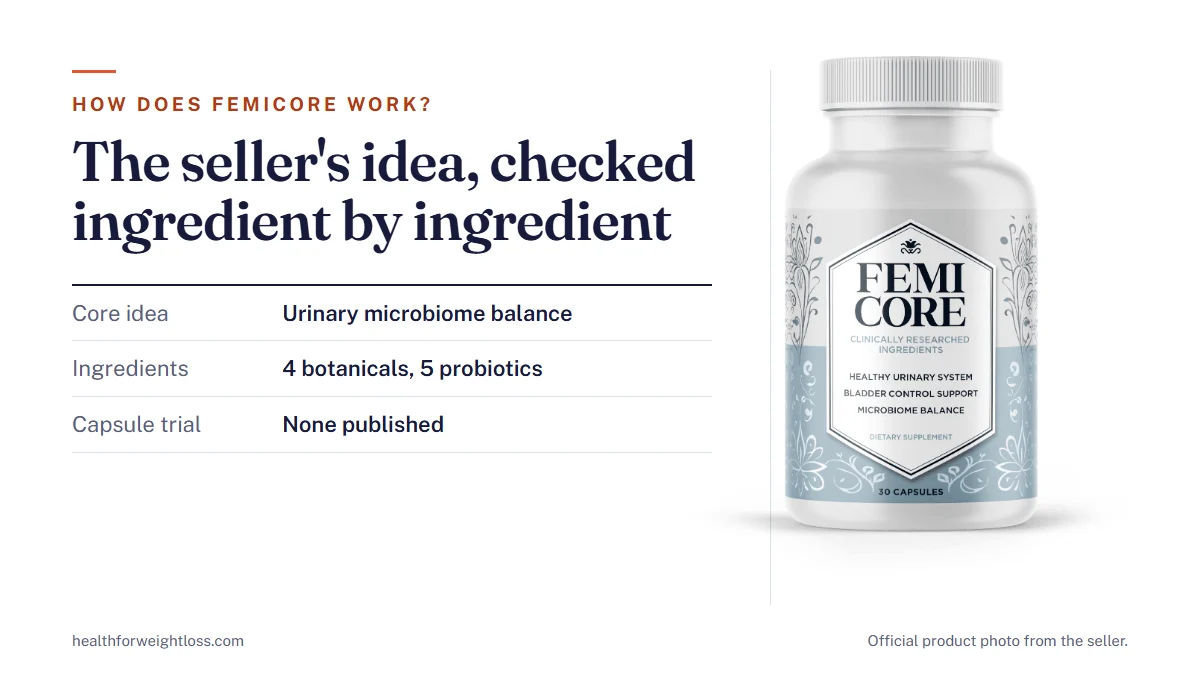
How does FemiCore work? The short version is that it is built on one idea: the bladder has its own population of bacteria, and a healthier mix might mean a calmer, better-protected urinary tract. Five Lactobacillus species are there to support that mix, and four plant ingredients are there to back it up. This page traces the seller’s mechanism step by step, gives each ingredient’s role and the strength of its evidence, and marks clearly where the science stops.
For a deeper look at each ingredient and its safety, see our FemiCore ingredients list. If your question is whether the result is worth the money, does FemiCore really work weighs that up. Practical directions are in FemiCore how to use, and the FemiCore buyer guide has everything on one page.
Read the seller’s own explanation
The official page shows the ingredients, the label claims and the 60-day refund terms.
Visit the Official FemiCore SiteOpens the official FemiCore website.
How does FemiCore work, according to the seller?
On the bottle, FemiCore is a single daily capsule aimed at women, with three claims printed on the label: “Bladder control support”, “Healthy urinary system” and “Microbiome balance”. Another line on the bottle, “Clinically researched ingredients”, points to studies of single ingredients. No trial of the finished capsule has been published.
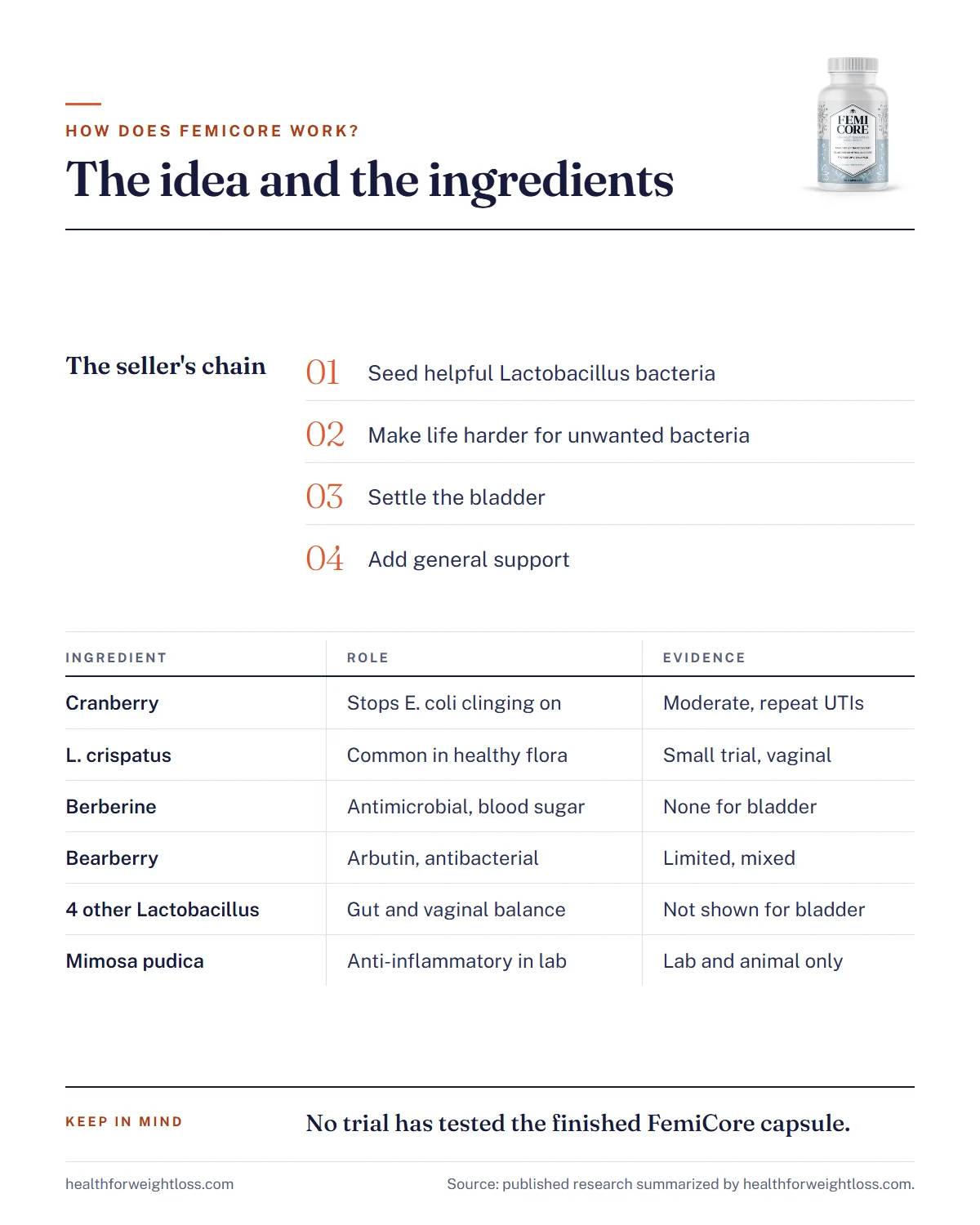
Read together, the claims describe a chain of events the seller hopes for:
- Seed helpful bacteria. The Lactobacillus species are meant to encourage a urinary microbiome where these bacteria dominate.
- Make life harder for unwanted bacteria. Cranberry and bearberry are there because of their effects on bacteria that cause urinary infections.
- Settle the bladder. With less irritation, the hope is fewer urgent trips and better control.
- Add general support. Berberine and mimosa pudica bring antimicrobial and other activity seen mostly in the lab.
Each link in that chain is plausible on its own. The weak point is that nobody has shown the whole chain working in women taking this capsule.
The science the idea borrows
Until about 2012, standard teaching held that healthy urine is sterile. Then DNA sequencing, with Loyola University Chicago among the groups involved, turned up resident bacteria in bladders of women with no symptoms. Later work compared women who had urgency incontinence with women who did not, and Lactobacillus was less common in the first group.
That is an association. It suggests a target, but it does not show that changing the bacteria changes the symptoms, and it does not show that bacteria swallowed in a capsule end up in the bladder. FemiCore takes the first step of that argument and leaves the rest untested.
Two groups, nine ingredients
All nine ingredients sit in one proprietary blend, so the label gives no individual amounts. They split into two groups with different jobs.
| Ingredient | Group | Role in the seller’s idea | Evidence strength |
|---|---|---|---|
| Cranberry extract | Botanical | Its A-type PACs keep E. coli from clinging to the tract wall | Moderate, for repeat UTIs |
| L. crispatus | Probiotic | A species common in healthy urogenital flora | Small trial, given vaginally |
| Berberine | Botanical | Antimicrobial; also lowers blood sugar | Good for blood sugar, none for bladder |
| Bearberry (uva ursi) | Botanical | Arbutin becomes an antibacterial compound in urine | Limited and mixed |
| L. acidophilus, L. plantarum, L. gasseri, L. casei | Probiotic | General gut and vaginal balance | Strain-specific, not shown for bladder |
| Mimosa pudica | Botanical | Anti-inflammatory and antispasmodic in lab work | Lab and animal only |
Want to test the idea yourself?
A capsule each day, bottles from $49, and a refund you can request within 60 days of delivery.
See FemiCore PackagesOpens the official FemiCore website. Affiliate link: we may earn a commission at no extra cost to you.
What each ingredient is meant to do
Cranberry extract
The A-type proanthocyanidins (PACs) in cranberry interfere with how E. coli grips the inside of the urinary tract. A 2023 Cochrane review concluded that cranberry products can reduce repeat urinary tract infections in women prone to them, after earlier reviews had mixed results. The benefit depends on the PAC dose, and FemiCore does not state it. The research is also about infections, not leaks or urgency.
The five Lactobacillus species
L. crispatus has the most relevant result: in a small placebo-controlled trial, a vaginal L. crispatus product reduced repeat UTIs. The other four species have research mainly on gut and vaginal health. Probiotic effects belong to specific strains, and FemiCore lists species without strain codes or a CFU count, so its probiotics cannot be matched to any study.
Bearberry
Bearberry leaf contains arbutin, which the body turns into hydroquinone that reaches the urine and has antibacterial activity in the lab. Studies in people are few, and their results disagree. In Europe, regulators list it as a traditional herbal option for mild lower urinary complaints, limited to roughly a week at a time. A product meant for daily use over months does not fit that pattern well.
Berberine
Trials in people support berberine for blood sugar and cholesterol, typically using 1,000 to 1,500 mg daily. Bladder research on it is lacking. Of the nine ingredients, it raises the most questions about medicine interactions.
Mimosa pudica
This plant has lab and animal reports of anti-inflammatory, antimicrobial and antispasmodic activity. No human bladder trial turned up in our search, so it has the thinnest support of any ingredient here.
The route a capsule would have to take
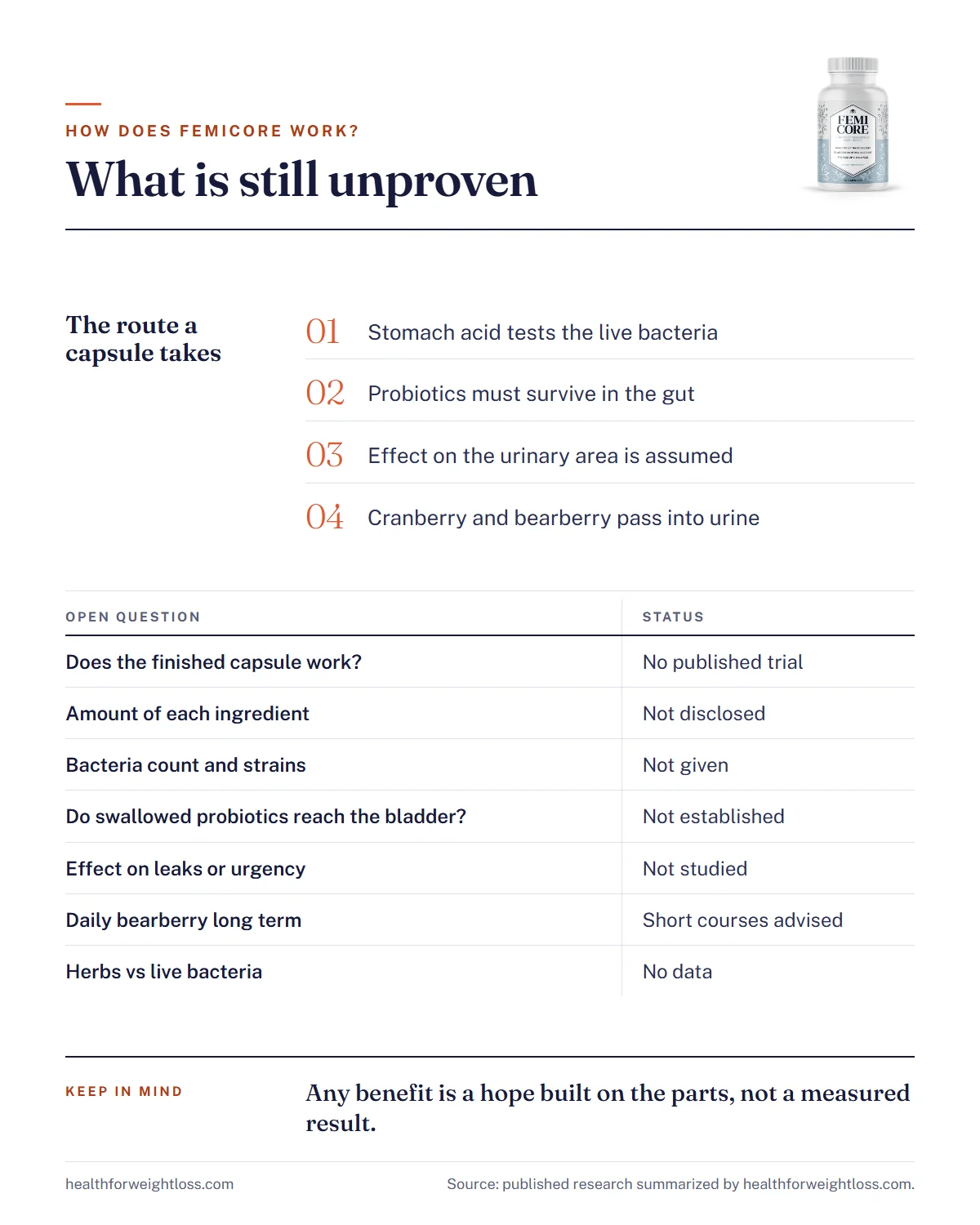
It helps to picture what has to go right for the seller’s idea to work in your body. First, the capsule passes through the stomach, where acid challenges live bacteria. Then the probiotics have to survive and act in the gut. From there, the idea assumes they influence the vaginal and urinary areas nearby, a route that is suggested but not proven for an oral product. Meanwhile, cranberry and bearberry compounds are absorbed and pass into the urine, which is the better understood part of the journey.
Every step depends on dose, and dose is the one thing the label does not show.
What is still unproven
| Question | What we know |
|---|---|
| Does the finished capsule work? | No published trial |
| How much of each ingredient is inside? | Not disclosed |
| How many live bacteria, and which strains? | No CFU count, no strain codes |
| Do swallowed probiotics reach the bladder? | Not established; the best result was vaginal |
| Does it reduce leaks or urgency? | Not studied; most research is on infections |
| Is daily bearberry wise long term? | Regulators advise short courses only |
| Do the antibacterial herbs affect the live bacteria? | No data either way |
None of these gaps means the product cannot help anyone. They mean that any benefit is a hope based on its parts, not a measured result.
Prefer to judge it on your own results?
Keep a simple bladder log from day one, decide before day 60 after delivery, and return all bottles if it does not help.
Check the Official FemiCore PriceOpens the official FemiCore website. Affiliate link: we may earn a commission at no extra cost to you.
What this means for your expectations
If FemiCore helps you, expect it to be gradual. The seller suggests at least three months of daily use, while the refund window lasts 60 days from delivery, so plan a check before that window closes. Women with a history of repeat infections are the group closest to the research, mainly through the cranberry evidence. Women with stress leaks when coughing or lifting are furthest from it, and pelvic floor training has much better support for that problem.
Our editorial score for FemiCore is 3.9 out of 5. The mechanism is reasonable; the proof for this exact capsule is missing.
Before you start
Nothing here replaces advice from your own clinician. FemiCore is sold as a dietary supplement, so the FDA’s supplement rules apply to it, not the approval process used for medicines. The seller’s site suggests seeing a physician first for anyone who is pregnant, nursing, taking medication or managing a health condition. Of the ingredients, berberine affects blood sugar and drug clearance, bearberry should be avoided in pregnancy and kidney disease, and cranberry has warfarin case reports. Urinary symptoms with blood, fever, flank pain or an abrupt loss of control call for a medical visit before any supplement.
Bottom line
FemiCore works, in the seller’s telling, by tilting the urinary microbiome toward Lactobacillus while cranberry and bearberry discourage infection-causing bacteria and berberine and mimosa pudica add supporting activity. Cranberry has the strongest human evidence, for repeat infections. The probiotic route from capsule to bladder is unproven, the doses are hidden, and no published study has looked at the complete capsule. That makes FemiCore a reasonable experiment with a refund attached, not an established treatment.
Decided to try the formula?
Choose 2, 3 or 6 bottles and pay once through BuyGoods. US delivery is free on the two larger packages.
Order From the Official FemiCore StoreOpens the official FemiCore website. Affiliate link: we may earn a commission at no extra cost to you.