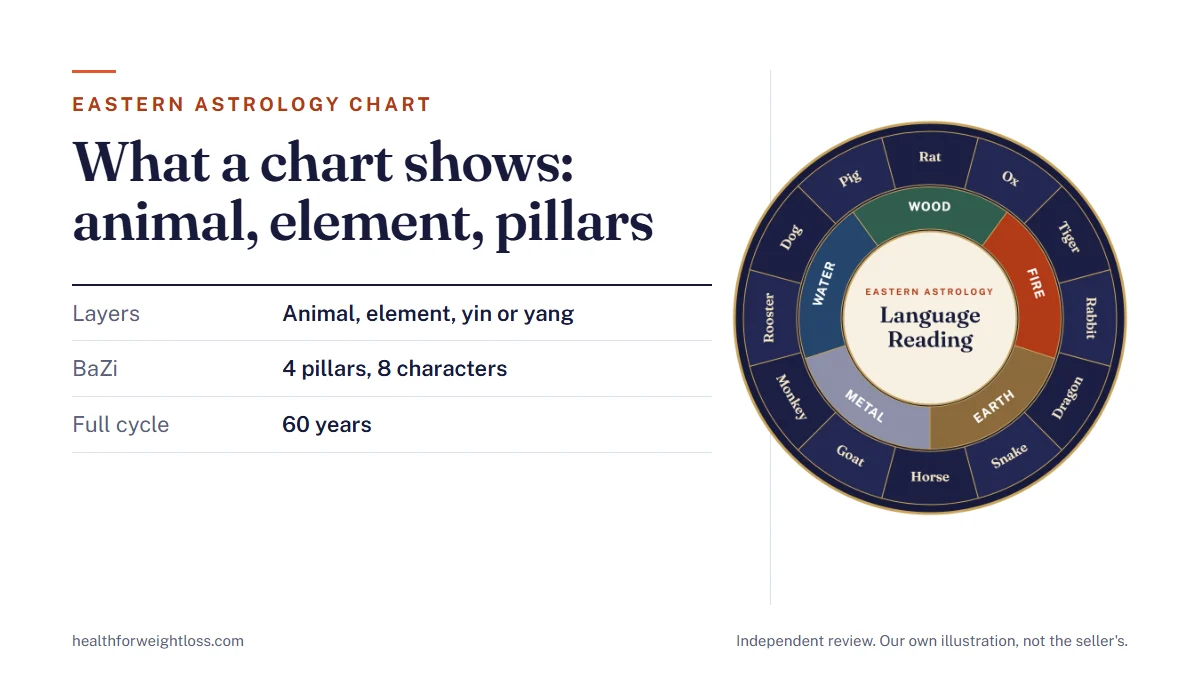
A horoscope in a newspaper gives you one line. An Eastern astrology chart gives you a whole picture: your animal, your element, your balance of yin and yang, and the four pillars that tradition builds from the moment of your birth. If you have ever wondered what a chart actually contains and how people read one, this guide takes you through it piece by piece, and ends with an easy way to see your own through the Eastern Astrology Language Reading.
A word on how this site works: no reading is sold by us, our writing is independent, and a commission can follow orders that start from our links.
See a chart built around your birth date
Start with a free quiz and get a first reading, then choose the full chart if you like it.
Start the Eastern Astrology Language Reading quizQuiz page on the seller’s site, reached by ClickBank. It asks for a first name, an email and your birth date before showing results.
What an Eastern astrology chart shows
Think of the chart as a portrait made of several layers, from the broad to the detailed.
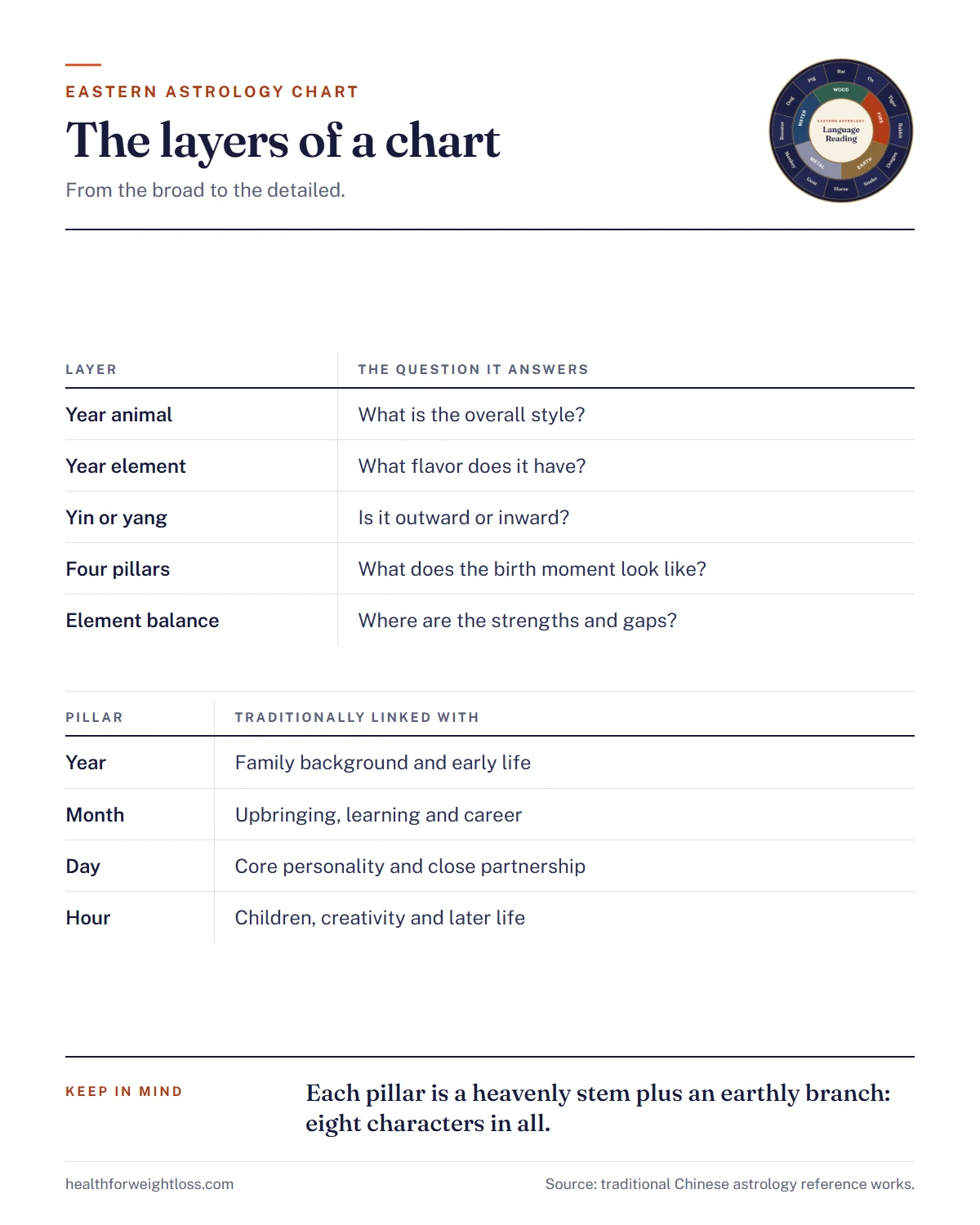
| Layer | What it is | The question it answers |
|---|---|---|
| Year animal | One of twelve, by lunar year | What is the overall style? |
| Year element | Wood, Fire, Earth, Metal or Water | What flavor does it have? |
| Yin or yang | Receptive or active | Is it outward or inward? |
| Four pillars | Year, month, day and hour of birth | What does the whole birth moment look like? |
| Element balance | Which elements are strong or quiet | Where are the strengths and gaps? |
The first three layers come from your birth year, which is why most people begin there. The pillars and the balance take the chart further, and that is where the richer reading lives.
The first layer: your animal and element
If you only know one thing about your chart, it is probably your animal. Each lunar year belongs to one of twelve animals, and the Chinese year opens on Lunar New Year, a date that moves between late January and mid-February. The element follows the last digit of the year: 0 and 1 are Metal, 2 and 3 Water, 4 and 5 Wood, 6 and 7 Fire, and 8 and 9 Earth. A person born in 2025 after Lunar New Year, for example, is a Wood Snake.
If you want to look up your own animal, our guide to the twelve signs and their birth years lists them with the Lunar New Year dates.
The four pillars of BaZi
The deeper layer is BaZi, which means “eight characters.” A chart is made of four pillars, one for the year, one for the month, one for the day and one for the hour of birth. Each pillar has two characters: a heavenly stem and an earthly branch. The twelve earthly branches are the familiar zodiac animals, from the Rat to the Pig, and the ten heavenly stems are the yin and yang forms of the five elements. Four pillars with two characters each make eight.
Traditional practitioners connect each pillar with a different area of life:
| Pillar | Traditionally linked with |
|---|---|
| Year | Family background and early life |
| Month | Upbringing, learning and career |
| Day | Core personality and close partnership |
| Hour | Children, creativity and later life |
The day pillar is often treated as the center of the chart, and its stem is used as the reference point for reading the rest.
A small example: the year 2026
A single year shows how a pillar is put together. The year 2026 is written in the traditional calendar as Bing-Wu. Bing is the heavenly stem, the yang form of Fire. Wu is the earthly branch, the Horse. Put them together and you have the Fire Horse, the first since 1966. A full chart repeats that stem-and-branch pairing for the month, the day and the hour, which is how four short pairs grow into a detailed portrait.
Because there are ten stems and twelve branches, they come back into the same pairing only every sixty years. That is the same sixty-year cycle you meet when you combine twelve animals with five elements.
Start your free reading
Nine questions, a minute of your time and a first look at your own animal and element.
Start your free readingPartner link to a free quiz. We are rewarded on sales, and your price is unaffected.
Balance of the five elements
Once all the characters are laid out, readers look at the elements across the whole chart. Maybe Water shows up in several places, while Fire hardly appears. Practitioners use that pattern as a conversation starter about temperament, habits and what a person might want more of. Some also look at the ten-year stretches of a life, often called luck cycles, as a way of thinking about timing.
To make it concrete, imagine a chart in which Wood is strong and Metal is quiet. A reader might describe the person as growth-minded and flexible, then ask what supports precision and focus. That is illustrative only: the real skill in this tradition is the way a practitioner weaves the pieces into a story.
The stars and symbols in a reading
Many chart readings also mention symbolic “stars.” The reading, for example, mentions three stars, Wealth, Peach Blossom and Nobleman, and tradition links them with resources, romance and charm, and helpful people. They add color and imagery, and they give you language for thinking about relationships, work and support.
How people read a chart in practice
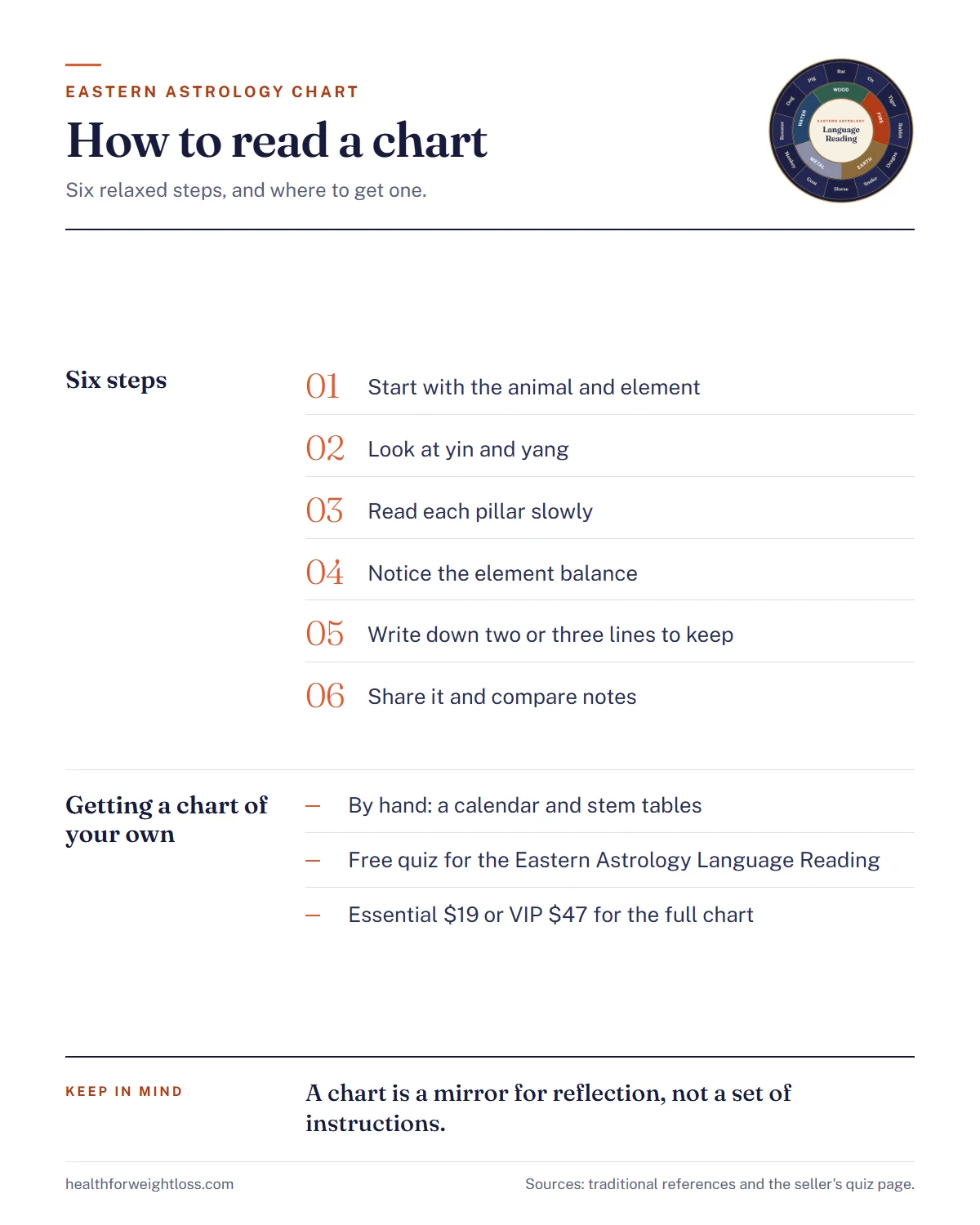
You do not need to be an expert to enjoy one. A relaxed approach looks like this:
- Start with the animal and element. They set the tone.
- Look at yin and yang. Is the chart more outward or inward?
- Read each pillar slowly, asking which lines feel familiar.
- Notice the element balance. What is strong, and what is quiet?
- Write down two or three lines that you would like to remember.
- Share it with someone who knows you, and compare notes.
Treat the chart as a mirror for reflection and not as a set of instructions. The most valuable part is usually the questions it prompts. Plenty of people return to the same chart every new year, reading it again with fresh eyes and noticing which lines hit differently now. That habit turns a one-time curiosity into a small yearly ritual, and it costs nothing once the chart is in your hands.
Getting a chart of your own
Of course, building a full chart by hand takes a calendar, a table of stems and branches, and plenty of patience. Many readers choose a guided reading instead.
The quiz for the Eastern Astrology Language Reading is one easy route (the seller trades as Your Astrology Language). The seller bills it as quick, around sixty seconds: nine questions, followed by the details it needs to build your result. Next comes a first reading, and then a 50+ page chart that arrives by email, built on your zodiac animal, element and the BaZi idea. Essential costs $19. VIP costs $47 (the seller lists a $97 regular price) and adds bonuses, faster delivery and priority email help. A 60-day refund window through ClickBank applies to both.
Our deeper dives: the brand guide, the reading breakdown and the editorial review.
Turn your birth date into a full chart
A free quiz, then a long chart in your inbox from $19, with 60 days of refund protection.
Take the free quizThe quiz opens on the seller’s site. If you order afterward, a commission reaches us at no cost to you.
Who enjoys a chart most
- People who like detail and prefer layers to one-line answers.
- Curious beginners who have already met their animal and want the next step.
- Reflective readers who enjoy journaling.
- Gift givers looking for a personal present for an astrology fan.
- Treat a chart as a cultural curiosity and a conversation piece, in line with how the seller labels its own readings: entertainment and reflection.
- According to the seller, programs and prewritten passages may help generate a reading, and no result is promised.
- A chart is not a substitute for professional advice on health, money or relationships.
Ready to see your own chart?
Take the quiz, enjoy your first reading and decide what comes next.
Start your free readingTakes you to the free quiz. Sales made after this click can earn us a fee.