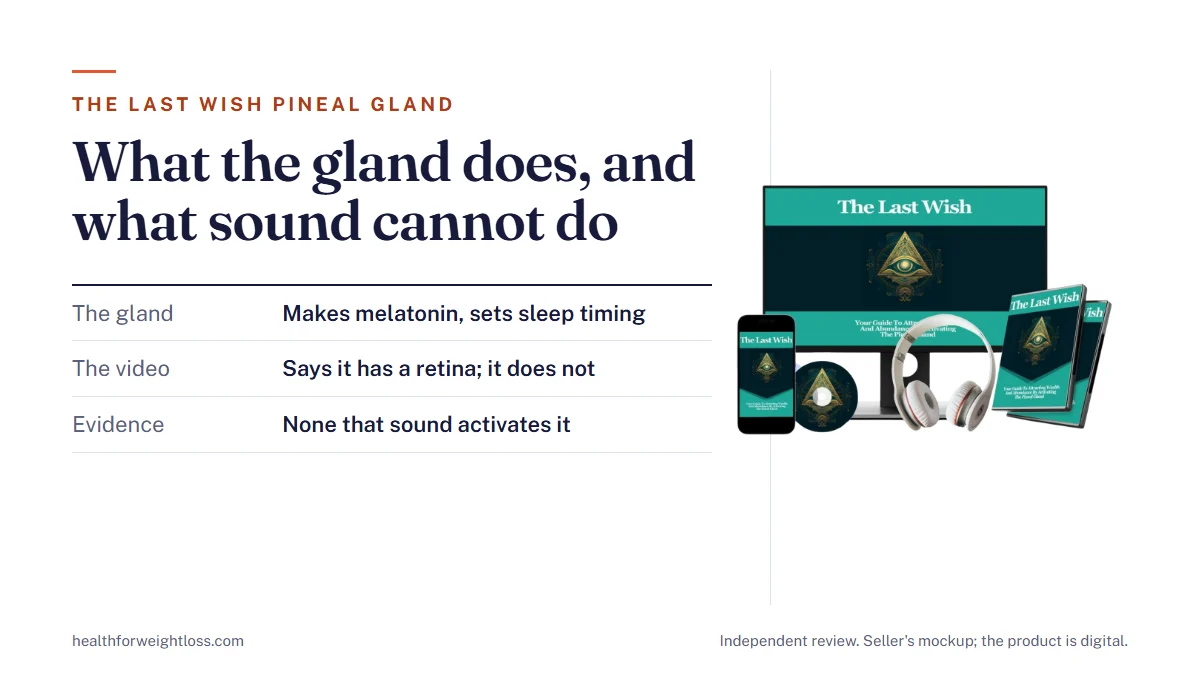
The Last Wish pineal gland story is the heart of the seller’s pitch: a small gland in the brain, said to be “dormant”, that a nightly audio recording can “activate” and so attract money. Before spending $37.44 it is worth knowing what the gland really does, what the video gets wrong, and what is simply untested. This guide sets the seller’s claims next to basic biology, with no mockery of anyone’s beliefs.
The label on the product The seller’s own Terms are headed “For Entertainment Purposes Only”. Nothing in the research on manifestation shows that wishing, or switching on a gland, makes money arrive. What studies do back is planning the steps toward a goal and rehearsing them in your mind.
This article is independent: we are not the seller, and we may earn a commission if you buy through our links. Our usual subjects are food, metabolism and sleep habits, so the biology here is familiar ground. For the wider picture, start with our full review.
Read the seller’s pitch yourself
Keep the seller’s page open beside this article and compare its wording with the facts below.
Read the Seller’s PitchOpens the seller’s order page via ClickBank. Affiliate link: we may earn a commission at no extra cost to you.
The Last Wish pineal gland claim, in plain words
The order page headline reads “The First Pineal Gland-Activating Audio Recording” and credits “Harvard and University of Michigan” research. It cites no study, author or link, and we found none tied to this product. The sales video, whose narrator calls himself Danny Kelly, adds the chain of ideas behind it:
- The pineal gland is “where you meet God” and holds “the key to wealth and abundance”.
- Fluoride, heavy metals, pesticides and time indoors make it “calcify and shut down”.
- Tiny calcite crystals in the gland are “extremely sensitive to sound”, so certain frequencies make them vibrate and “activate” the gland.
- The gland is said to hold a retina and to switch off when light reaches it, which is why listening must happen in the dark.
- Once activated, you “simply receive” money, opportunity or love.
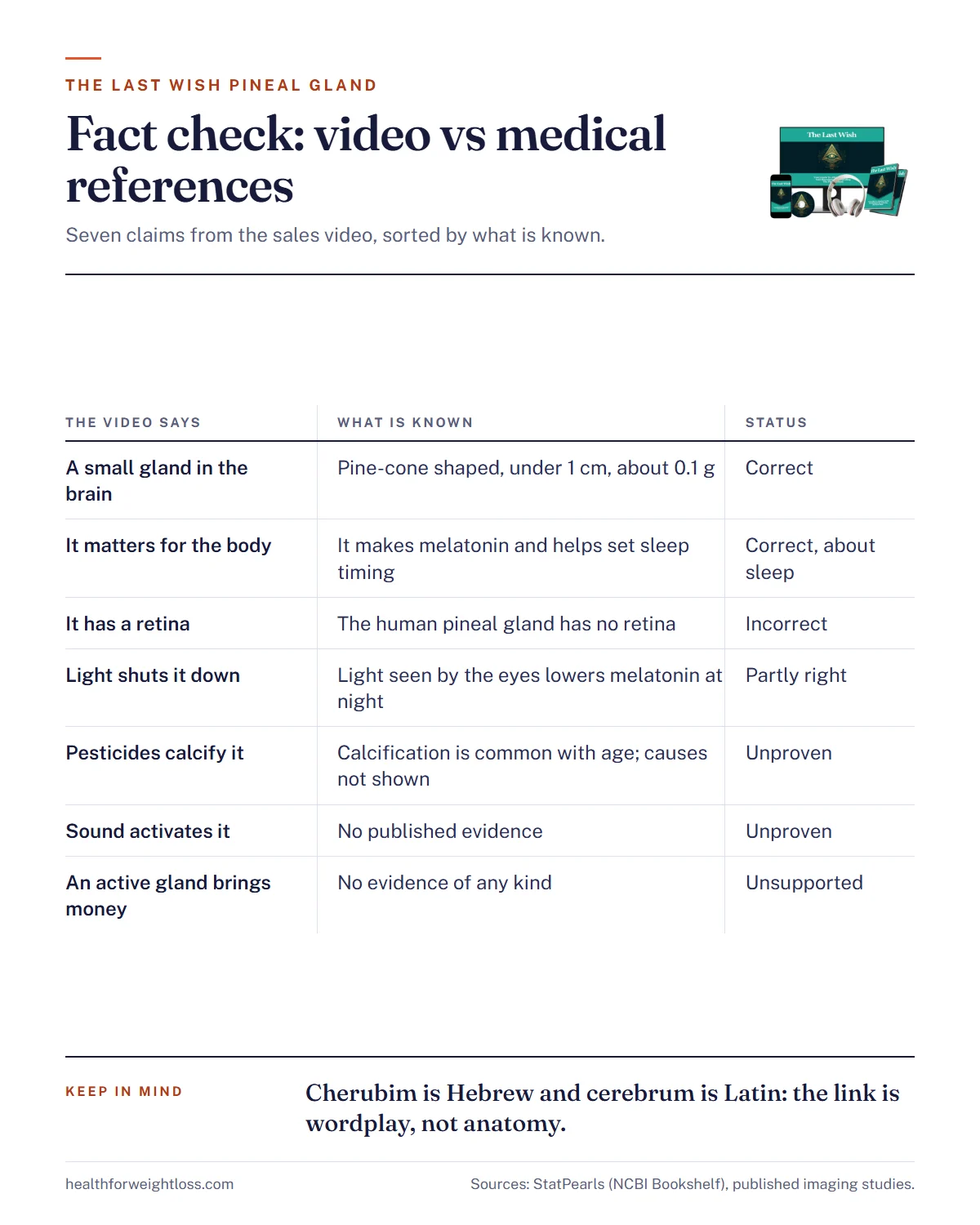
Each link in that chain has a different status. Some parts are real biology told in an unusual way, some are errors, and some are untested. The table below sorts them.
| What the video says | What is known | Status |
|---|---|---|
| The pineal gland is a small gland in the brain | It is pine-cone shaped, under a centimeter long, and weighs about a tenth of a gram in adults | Correct |
| It controls something important | It makes melatonin, which helps set the sleep-wake cycle | Correct, but about sleep |
| It has a retina | The human pineal gland has no retina | Incorrect |
| Light shuts it down | Light seen by the eyes lowers melatonin at night, indirectly | Partly right |
| Fluoride and pesticides calcify it | Calcification is common with age; the video’s causes are not shown | Unproven |
| Sound makes calcite crystals vibrate and activate it | No published evidence | Unproven |
| An active gland brings money | No evidence of any kind | Unsupported |
What the pineal gland actually does
Medical references describe the pineal gland as a small endocrine gland, roughly 0.8 cm long, that makes melatonin (StatPearls). Melatonin stays low during the day, rises at night, and the length of the nightly rise follows the length of the darkness. That rhythm is one of the signals the body uses to keep its roughly 24-hour sleep-wake cycle, and clinicians treat the melatonin rhythm as a marker of where someone’s body clock sits (Endotext).
That is the whole job description in mainstream medicine: timing, mostly of sleep. Nothing in it concerns luck, income or a link to God, and nothing in it makes the gland something you need to “switch on”. It works without any action from you.
Light, darkness and why a dark room is sensible
Here the video touches something true. Light at night lowers melatonin, and a dark bedroom is a normal part of good sleep habits. If a nightly routine gets you off bright screens and into a dark, quiet room, that may feel calming, and better sleep is a fair benefit to expect from a wind-down habit.
The mechanism is not the one the video describes. The video says the gland itself “has a retina” and shuts off when light reaches it. In humans it does not. Light is picked up in the eye, partly by special light-sensing cells that are not rods or cones, and the message travels to the body’s master clock in the brain, which then adjusts the signal to the pineal gland (Kozaki et al., 2018). So the dark-room advice has a sound reason, but the retina story is wrong.
Calcification: common, and not shown to cost you anything
The video says modern life makes the gland calcify and “shut down”. Deposits of calcium in the pineal gland are real, and they are common. One dental imaging study of 500 scans, mostly middle-aged and older adults, found calcification in about 59 percent. A study of 220 scans found about 34 percent, and linked it strongly to older age. Numbers vary with who is scanned and how, which is why we avoid one single figure.
Calcification is seen on scans as an ordinary finding in many people. What is not shown anywhere we could find is that it “shuts the gland down”, that diet or a plan reverses it, or that it has anything to do with money. The seller’s gift #2, “The Pineal Gland Decalcification Plan”, promises steps to “speed up the decalcification process”. We cannot see the guide before purchase, and we found no good evidence for the idea behind it. The same goes for the idea that the gland releases meaningful amounts of a “spirit molecule” in humans: that is speculation.
Want to see the gift list for yourself?
The order page names three gifts, including the decalcification plan. Contents are not shown before you buy.
View the Three GiftsOpens the seller’s order page via ClickBank. Affiliate link: we may earn a commission at no extra cost to you.
Does sound “activate” the pineal gland?
The video says chanting works in churches because its vibration makes tiny crystals in the gland vibrate, and that the recordings use “very specific frequencies” to do the same. We could find no published study showing that sound makes pineal calcifications vibrate, or that this “activates” the gland, or that any of it changes how the gland behaves.
Audio research does exist, but it is about something else. Studies of binaural beats, which send a slightly different tone to each ear, look at relaxation, attention and brainwaves, and they do not agree. One 2019 meta-analysis reported a medium overall effect on outcomes including memory, attention, anxiety and pain. A 2023 systematic review of 14 studies, by contrast, counted five in line with brainwave entrainment, eight against it and one mixed. None of this work tests The Last Wish, and the seller never claims that binaural beats are inside its files.
Three errors in the video, named neutrally
We would rather correct the record than score points, so here are three statements the video makes that do not hold up.
1. “The pineal gland has a retina.” It does not in humans. The eyes sense the light.
2. “Cherubim shares a root with cerebrum.” The video reads Exodus 25 (“two cherubim of gold”) as a hint at the two halves of the brain. “Cherubim” is a Hebrew plural and “cerebrum” is Latin. The similarity is in the English sound only. Readers can still value the verse for what it means to them; it just is not a clue about anatomy.
3. Scientists “know” the gland secretes spirit molecules. The video says science shows the gland releases molecules that “trigger divine experiences”. That is speculation, not an established fact about humans.
Other parts of the story are not errors but cannot be checked. The priest, the parchment “dating back to 309 AD” and the Vatican archive scene are all told by the narrator. Its Terms permit altered names and staged scenes, and his money anecdotes (a $3,617 commission day, a $10,137 tax refund, a $2,000 scratch ticket) are stories nobody has verified, so no reader should expect similar outcomes. For the person behind the story, see who is behind the story.
What a nightly dark-room routine can fairly offer
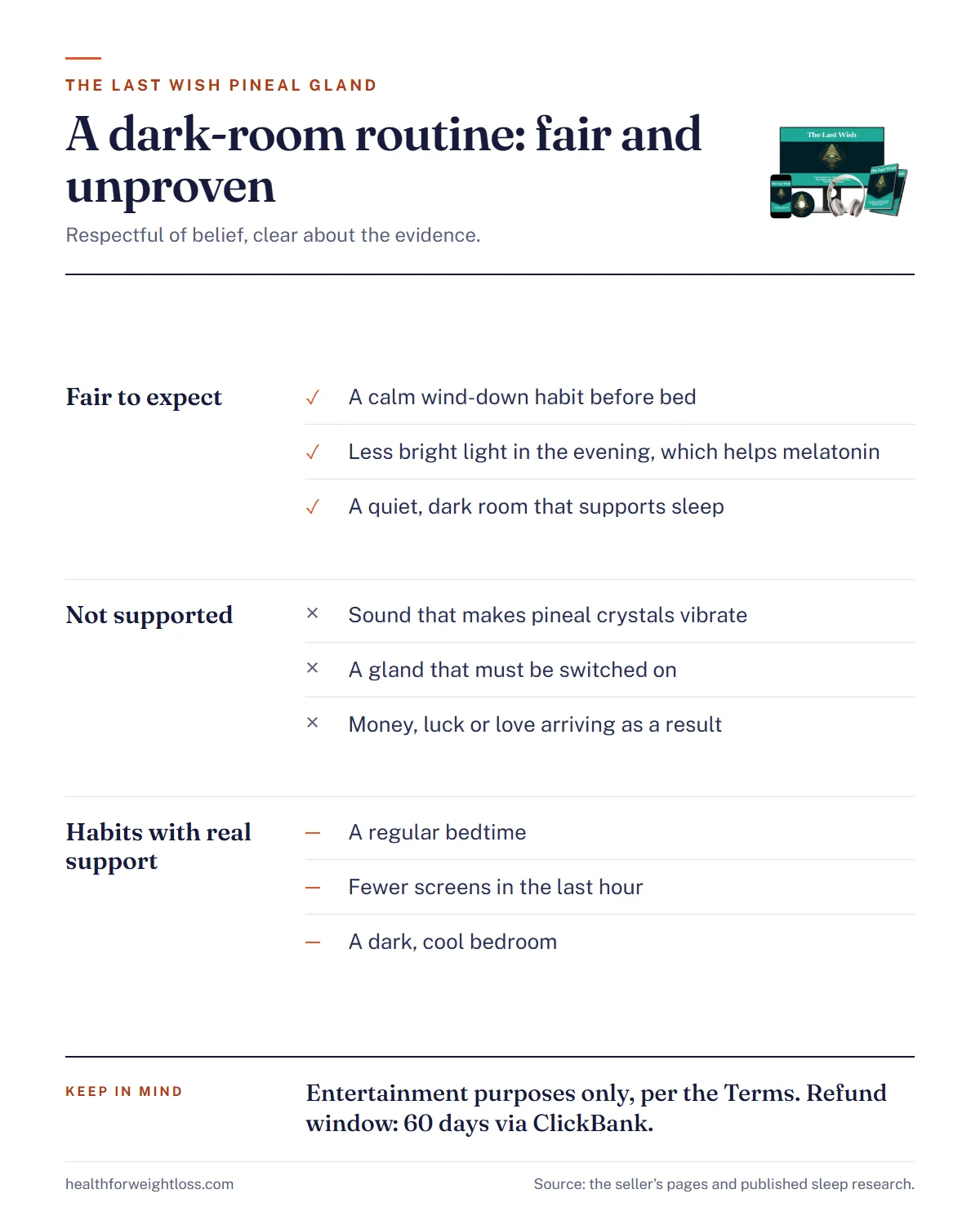
Respecting belief does not require agreeing with the science, and respecting the science does not require mocking belief. Some people find quiet listening in the dark restful and meaningful, and a short evening ritual can be a pleasant habit whatever one thinks about glands. That is the fair, modest claim. The jump from “relaxing” to “wealth appears” is where evidence stops.
If you do try a nightly routine for sleep or calm, these habits are the ones with real support: a regular bedtime, less bright light and screen use in the hour before bed, and a dark, cool room. They cost nothing.
Before you spend $37.44
- Price. Terms and order page: $37.44. Video page: 37.11. The crossed-out $309.77 is the seller’s own anchor figure. At ClickBank you will see your own currency, with tax added.
- Guarantee. Count on 60 days, the figure at checkout and in the Terms. A 365-day badge elsewhere has no text behind it, and the video page’s footer points to abundant-life.co, a different company’s pages, which set 90 days with conditions. Ask ClickBank and keep your receipt.
- Urgency. The ticking clock, the “Today Only” label and the warning that the video may vanish at any time are there to hurry you, not to inform you.
- Email. Expect marketing messages after you buy; the Terms allow third-party promotions in them.
- Money. Cash you need for rent or bills should not go toward promised abundance. Anyone struggling with a budget or with debts can find nonprofit counselors through the National Foundation for Credit Counseling.
Decided to try it as a wind-down habit?
Save your receipt, write down the purchase date and judge it as a bedtime routine inside the 60 days.
See The Last Wish at $37.44Opens the seller’s order page via ClickBank. Affiliate link: we may earn a commission at no extra cost to you.
Verdict on the pineal gland story
The pineal gland is real, interesting and well studied for one thing: melatonin and the sleep-wake cycle. The Last Wish builds a larger story on top of it. The retina claim is wrong for humans, the cherubim and cerebrum link is wordplay across two languages, and the idea that sound activates the gland to bring money has no evidence behind it. The one piece worth keeping is the dark room, which supports sleep for ordinary reasons.
If you are curious about the product as a bedtime ritual and accept that it is sold as entertainment, you can look at it with the guarantee in hand. If you were hoping the gland would fix money worries, we would spend the $37.44 on a budget review instead.
Take a last look at the offer
$37.44 one-time, 60-day guarantee through ClickBank. Entertainment purposes only, per the Terms.
Check the Current PriceOpens the seller’s order page via ClickBank. Affiliate link: we may earn a commission at no extra cost to you.